

Last updated on October 20th, 2026 at 02:20 am

By AcceptedTogether Editorial Team · Last updated October 20, 2026
You’ve booked your Casper date, and it isn’t a test you can cram for. Here’s the 2026 Casper test format, the rules on test day, how quartile scoring works and how to prepare without memorizing scripts. Writing Casper for OMSAS? See our full OMSAS guide.
TL;DR
- Casper is an online situational-judgment test from Acuity Insights that measures soft skills like empathy, ethics, collaboration and communication, not academic knowledge.
- The current format is 11 scenarios (4 video-response, 7 typed-response) with 2 questions each, about 65 to 85 minutes including optional breaks.
- You get a quartile, not a raw score. The 4th quartile is the top 25% of test-takers.
- You can prepare: the free official Acuity Insights practice test, timed practice on PrepMatch, and a bank of personal stories built before test day.
- Blank scratch paper is allowed. Programs get your results about 2 to 3 weeks after you test, and you see your quartile about 4 to 5 weeks after.
Table of contents
- What is the Casper test?
- What is the Casper test format in 2026?
- What are the Casper test rules?
- How is Casper scored?
- How do you get a 4th quartile on Casper?
- How should you prepare for Casper?
- How do you show emotional intelligence on Casper?
- Where can you get help from someone who’s taken Casper?
- What else do applicants ask about Casper?
What is the Casper test?
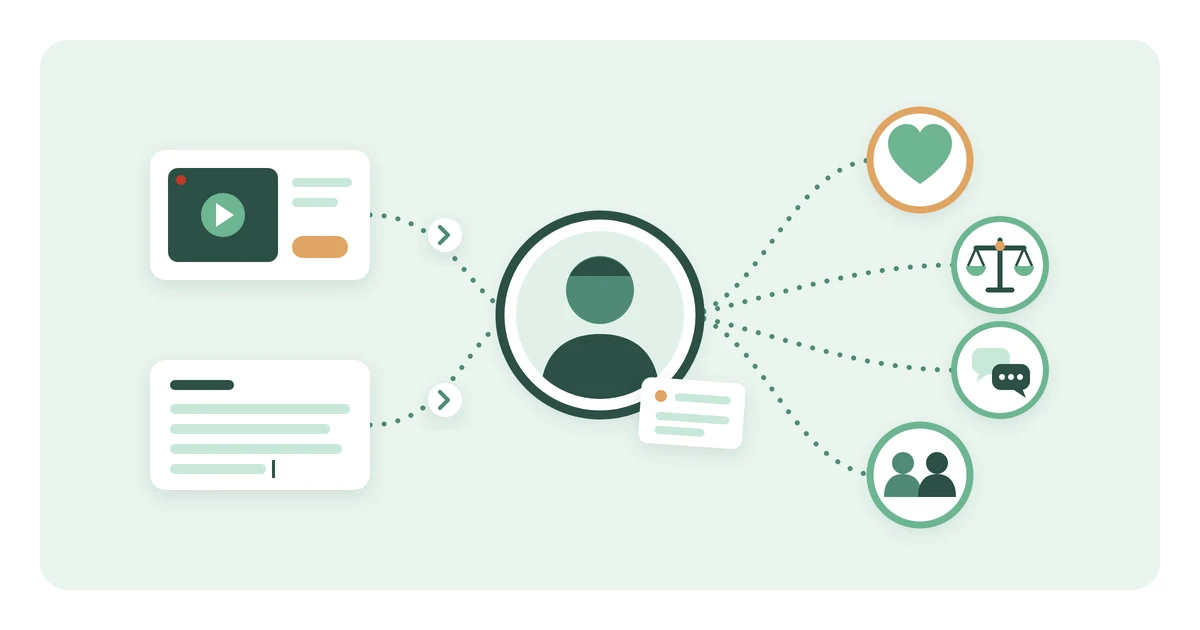
Casper is a situational-judgment test (SJT) that presents short scenarios and asks you to respond, in writing or on video, to gauge how you reason through interpersonal and ethical situations. It was developed by Acuity Insights (formerly Altus Assessments) and adopted first by Canadian medical schools, including McMaster, Queen’s, and the University of Ottawa through OMSAS, before spreading to dentistry, veterinary medicine, nursing, and admissions programs across the US and internationally.
Unlike an entrance exam, Casper is an open-response test with no right-or-wrong content to memorize. It scores nine core people skills: collaboration, communication, empathy, ethics, fairness, motivation, problem-solving, resilience, and self-awareness. Rather than testing what you know, it evaluates how you think through the kind of tricky, ambiguous situations you’ll face while caring for real patients.
Want feedback from someone who hit the 4th quartile? Browse hundreds of AcceptedTogether consultants here. Many have taken Casper themselves and can review your practice answers.
What is the Casper test format in 2026?
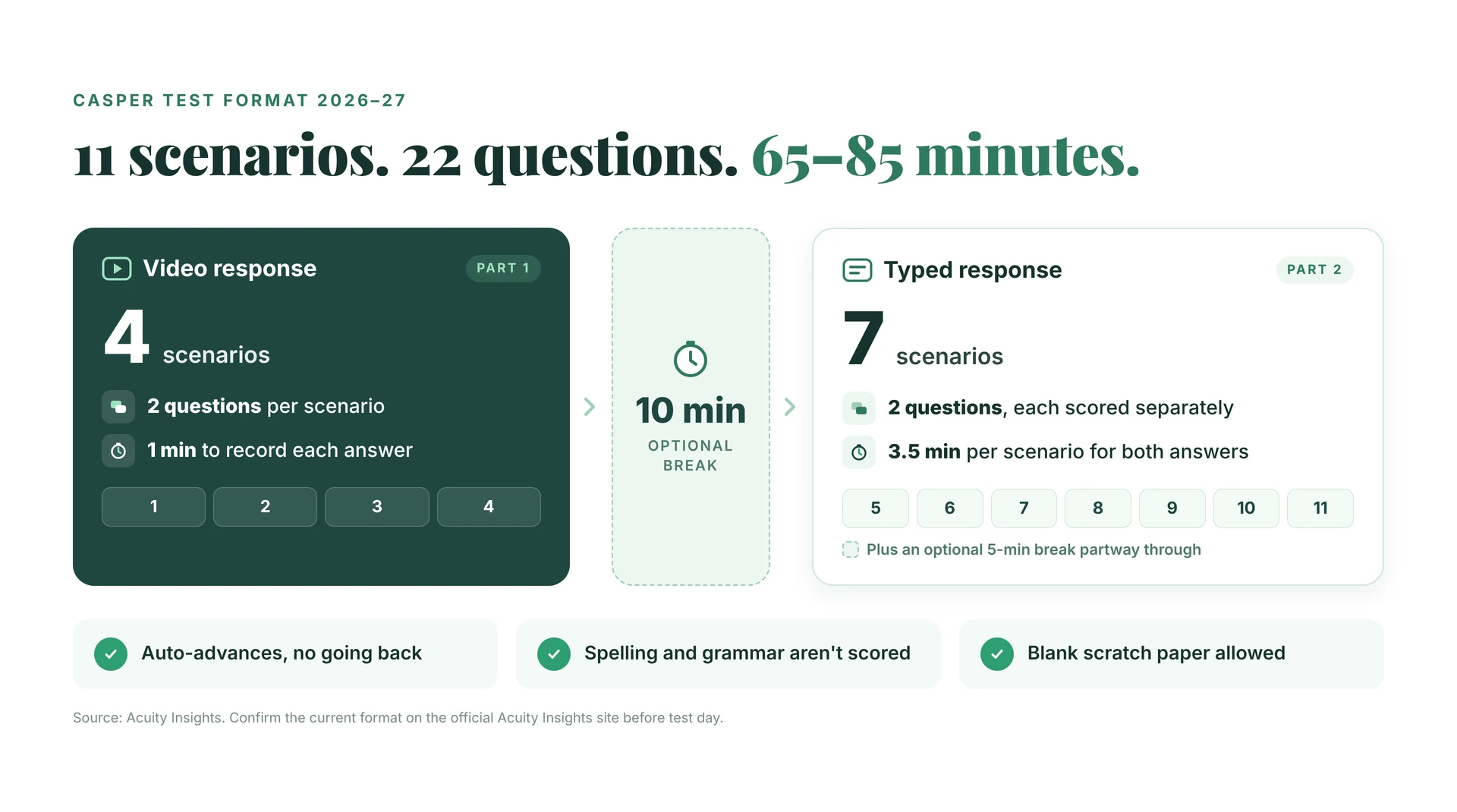
The Casper test format in 2026 is 11 scenarios (4 video-response and 7 typed-response) with 2 questions each, and the test takes about 65–85 minutes including optional breaks. Casper was streamlined a couple of admissions cycles ago, and this is the format you’ll sit for now.
| Section | Scenarios | Questions | Timing |
|---|---|---|---|
| Video response | 4 | 2 per scenario | 1 minute to record each answer |
| Typed response | 7 | 2 per scenario | 3.5 minutes total per scenario (both questions) |
| Total | 11 | 22 total | About 65–85 minutes, including optional breaks |
A few details worth knowing:
- The video section comes first: you watch a short clip of a situation, then record two spoken answers, one minute each.
- The typed section follows: you read a prompt and type answers to two questions shown together, with 3.5 minutes for the pair.
- Each typed question is scored individually, so treat the two questions in a scenario as separate mini-prompts, and don’t let your answer to one bleed into the other.
- There’s an optional 10-minute break after the video section, and an optional 5-minute break partway through the typed section.
- The test advances from one scenario to the next automatically, there’s no clicking between pages.
Why this matters for your Casper test preparation: with fewer scenarios and per-question scoring, every answer carries more weight, and the tighter timing rewards getting straight to the point. Open each typed answer with a direct sentence that names the core issue and who’s affected, rather than restating the prompt. Confirm the exact current format on the official Acuity Insights format page before test day, since details can shift between cycles.
What are the Casper test rules?
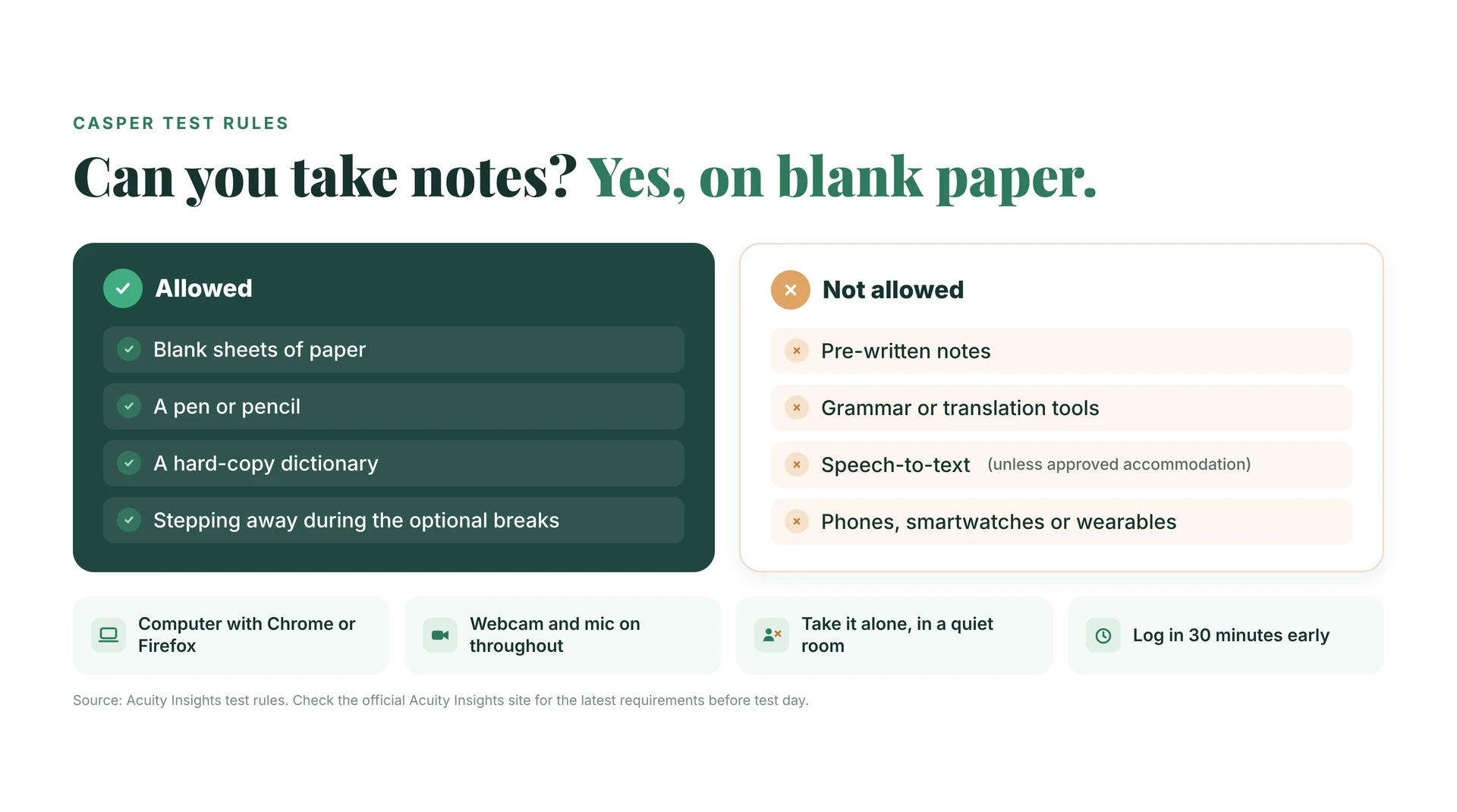
The Casper test rules allow blank paper, a pen or pencil and a hard-copy dictionary, so yes, you can take notes. Pre-written notes, grammar or translation tools, and speech-to-text (unless you have approved accommodations) aren’t allowed.
You take Casper alone on a computer, in Chrome or Firefox, with your webcam and microphone on throughout. Phones, tablets and Safari aren’t supported, so run the system check before test day. If you need accommodations, Acuity asks for documentation about four weeks in advance.
How is Casper scored?
Casper is scored on a quartile system: you never see a raw score, only which quartile you landed in compared with everyone else who took that version of the test. The 4th quartile is the top tier and the one you’re aiming for.
| Quartile | Percentile | What it means |
|---|---|---|
| 4th quartile | 75th–100th | Top tier: your answers beat roughly 75% of peers |
| 3rd quartile | 50th–74th | Above average |
| 2nd quartile | 25th–49th | Below average |
| 1st quartile | 0th–24th | Bottom tier |
Each scenario is scored independently by a different trained human rater, and your score reflects how your answer compared with other test-takers’ answers to that same scenario. One detail worth knowing: raters are instructed not to penalize spelling or grammar on the typed section, given the tight timing, so spend your effort on clear reasoning rather than polished prose.
What is a good Casper score?
A good Casper score is the 3rd or 4th quartile, meaning above the median of your comparison group. Casper is norm-referenced: you’re compared with applicants to similar programs, in the same country and language, so there’s no fixed raw score to hit. How much a given quartile matters depends on the program: some schools use Casper as a screen, while others weigh it alongside GPA, the MCAT, and interviews. For which schools require Casper and how they use it, see our Casper guide for medical school applicants.
When do you get your Casper results?
Programs on your distribution list receive your Casper results about 2–3 weeks after you test, and your own quartile score appears in your Acuity Insights account about 4–5 weeks after you finish. You’ll get an email confirmation within 24 hours of completing the test. If you decide to apply to more programs later, you can add them to your distribution list after the test. Check the Acuity Insights Dates and Fees page for current fees and each program’s deadline.
How do you get a 4th quartile on Casper?
You get a 4th quartile on Casper by giving fuller, better-reasoned answers than other test-takers on the same scenarios, because every response is rated against its peers. There’s no answer key, so no strategy guarantees a top quartile, but a few habits consistently help.
- Answer every question in each scenario. Each scenario has 2 questions, and a strong answer to one won’t make up for skipping the other.
- Gather information before you act. Many scenarios leave out key details. Say what you’d want to find out and how it would change your response.
- Weigh more than one perspective. Acknowledge how each person involved might see the situation before you settle on a course of action.
- Explain your reasoning, not just your decision. Raters only see your thinking if you write or say it.
- Use real examples for “describe a time” questions. A specific story from your own life is more convincing than a hypothetical one.
Pro tip: Raters are told not to penalize spelling or grammar on typed responses, so in practice, time yourself and make sure you finish both answers instead of polishing one.
How should you prepare for Casper?

You can prepare for Casper, just not by memorizing answers. Because Casper measures personal and professional reasoning, people often assume it’s impossible to study for. In practice, effective Casper test preparation means understanding what the test is assessing, getting comfortable with the format, and practicing under real time pressure.
Here’s a simple Casper test preparation plan you can follow over a few weeks:
- Learn the format. Know the 11-scenario structure, the timing, and the rules before you practise anything.
- Take the official practice test early. Use the free Acuity Insights practice test to find which section (video or typed) needs the most work.
- Build a story bank. Prepare at least two real experiences for each CanMEDS role so you’re never searching for an example under the clock.
- Practise timed scenarios. Work through Casper practice questions on PrepMatch and our free scenario list, recording your video answers and typing against a 3.5-minute timer.
- Get feedback, then retest. Have strong performers review your answers, then retake the official practice test in your final week.
Understand what Casper is assessing
Casper is a psychological assessment of your interpersonal skills, ethical judgment, critical thinking, and communication: the personal characteristics, like emotional and social intelligence, that matter in medicine and other health professions. This makes it the opposite of an MCAT-style exam: the MCAT measures knowledge, while Casper measures non-academic qualities. So Casper test preparation looks different: there’s no content to cram, just judgment and communication to sharpen.
Casper vs MCAT: how the two tests differ
| Feature | Casper | MCAT |
|---|---|---|
| What it measures | Non-academic skills: situational judgment, ethics, empathy, communication | Academic knowledge: sciences, reasoning, critical analysis |
| Format | 11 open-response scenarios (4 video, 7 typed) | Multiple choice, 4 sections |
| Length | About 65–85 minutes | About 7.5 hours including breaks |
| Scoring | Quartile (1st–4th) relative to other test-takers | Scaled score from 472 to 528 |
| How to prepare | Timed scenario practice, a personal story bank, feedback on answers | Content review and full-length practice exams |
For example, Casper presents ethical dilemmas to see whether you can approach hard situations with integrity while weighing everyone’s interests. It looks at how clearly you express your thinking, since clinicians need to communicate well with patients and colleagues. And it weighs emotional intelligence heavily: your ability to read, understand, and respond to your own emotions and other people’s, which is the foundation of empathetic care. According to Acuity Insights, these are the non-academic qualities Casper is designed to evaluate.
Note again that raters are asked not to evaluate grammar or spelling on the typed section, given the time constraints, so don’t burn prep time polishing sentence structure; spend it on the substance of your reasoning.
Get familiar with the format
Knowing the mechanics cold removes a major source of test-day stress. The video scenarios show actors playing out a real-life situation, after which you answer two open-ended questions out loud; the typed scenarios give you a written prompt describing a situation or dilemma, and you type answers to two questions shown together.
Since the test auto-advances and the timing is tight, the more familiar the platform feels going in, the more of your attention you can spend on actually reasoning through each scenario. That familiarity alone can meaningfully lift your performance.
Practice, practice, practice
The most useful part of Casper test preparation is practicing full scenarios under real time pressure:
Take the official practice test. Your Acuity Insights account includes a free, full 11-scenario practice test that mirrors the real thing exactly: same format, same timing, the same experience of being on camera. Acuity notes that applicants who take it tend to do better than those who don’t, and you can repeat it as many times as you like, so use it to get comfortable in front of the webcam.
Use PrepMatch (free). PrepMatch is a free, peer-to-peer platform with a large library of sample Casper questions. What makes it powerful is the rater community: other users give feedback on your answers, and you rate their answers in turn, which trains you to think like a reviewer. It covers both the typed and video sections. We’ve also put together a list of free Casper scenarios you can practice with directly.
Simulate real test conditions. Set a timer and practice under the actual limits. For the video section, record yourself and watch it back. It’s uncomfortable, but it’s the fastest way to spot habits (rambling, filler words, running out of time) worth fixing before test day.
Brainstorm your stories ahead of time. Casper often asks things like “describe a time you worked with someone you didn’t get along with,” and there’s rarely time to dig up an example on the spot. Build a bank of experiences in advance: a good rule of thumb is at least two stories for each of the CanMEDS roles (Communicator, Collaborator, Leader, Health Advocate, Scholar, Professional) that Canadian medical schools use. Include both positive experiences (a time you worked well with someone) and tougher ones (a conflict, a mistake, a hard call), so you’re not searching for an example under the clock.
Work on your typing. With only 3.5 minutes per typed scenario, typing speed and accuracy directly affect how much you can say. If typing slows you down, a few weeks of practice frees up mental space for the actual reasoning.
Want feedback from someone who hit the 4th quartile? Browse hundreds of AcceptedTogether consultants here. Many have taken Casper and can review your practice answers.
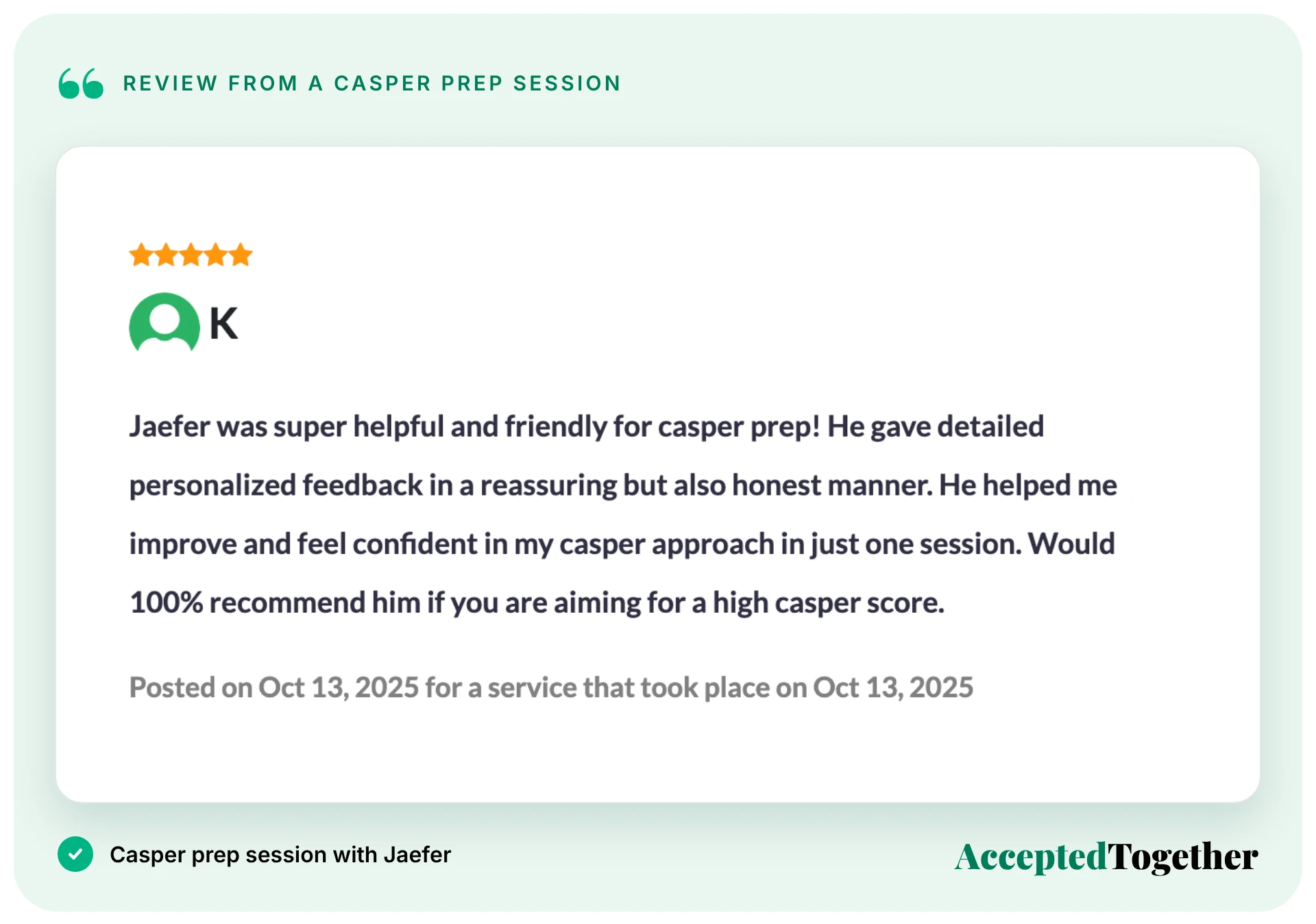
For example, Jaefer, a medical student at Western University who was also accepted at the University of Ottawa and McGill, offers one-on-one Casper prep. Here’s a recent review from one of his sessions:

How do you show emotional intelligence on Casper?
Emotional intelligence is the throughline of a strong Casper performance and of a career in medicine. Medicine is constant interaction with patients, colleagues, and families, so understanding people, empathizing with them, and building trust is the real job. Building it into your Casper test preparation over a few weeks helps on test day and well beyond it.
Reflect on the dynamics in your own life

When you read a scenario, think about similar situations you’ve actually lived through. If a scenario involves an employee who needs to challenge their manager, recall your own experiences with a boss. Remembering how hard it genuinely is to speak up to someone with authority helps you write a more grounded, realistic answer.
Show emotional intelligence, don’t just name it
The goal isn’t to sprinkle in buzzwords; it’s to make your reasoning visibly empathetic and fair. Raters can tell the difference between someone reciting “I’ll be non-judgmental” and someone whose answer actually weighs everyone’s feelings and situation. Use phrasing like the examples below as a natural way to show your thinking, not as boxes to tick:
- Empathy: “I understand the challenges Bill is facing may make it hard for him to confront his friend, so I’d approach him gently.”
- Support without judgment: “I’d want Priya to know I support her whatever she decides, and that I’m listening rather than judging.”
- Respect for diversity and inclusion: “I’d consider everyone involved and make sure any care or advice is culturally sensitive.”
The difference: each of these is tied to the specific people in the scenario and leads to an action. That’s what reads as real emotional intelligence: the empathy is doing work in your answer, not just decorating it.
Practice with feedback from strong performers
Role-play and practice scenarios, then get feedback on how well your emotional intelligence comes through. PrepMatch is useful for this, and you can also share answers with people who’ve scored well on Casper, like AcceptedTogether consultants, and ask them specifically whether your empathy and reasoning land the way you intended.
Where can you get help from someone who’s taken Casper?
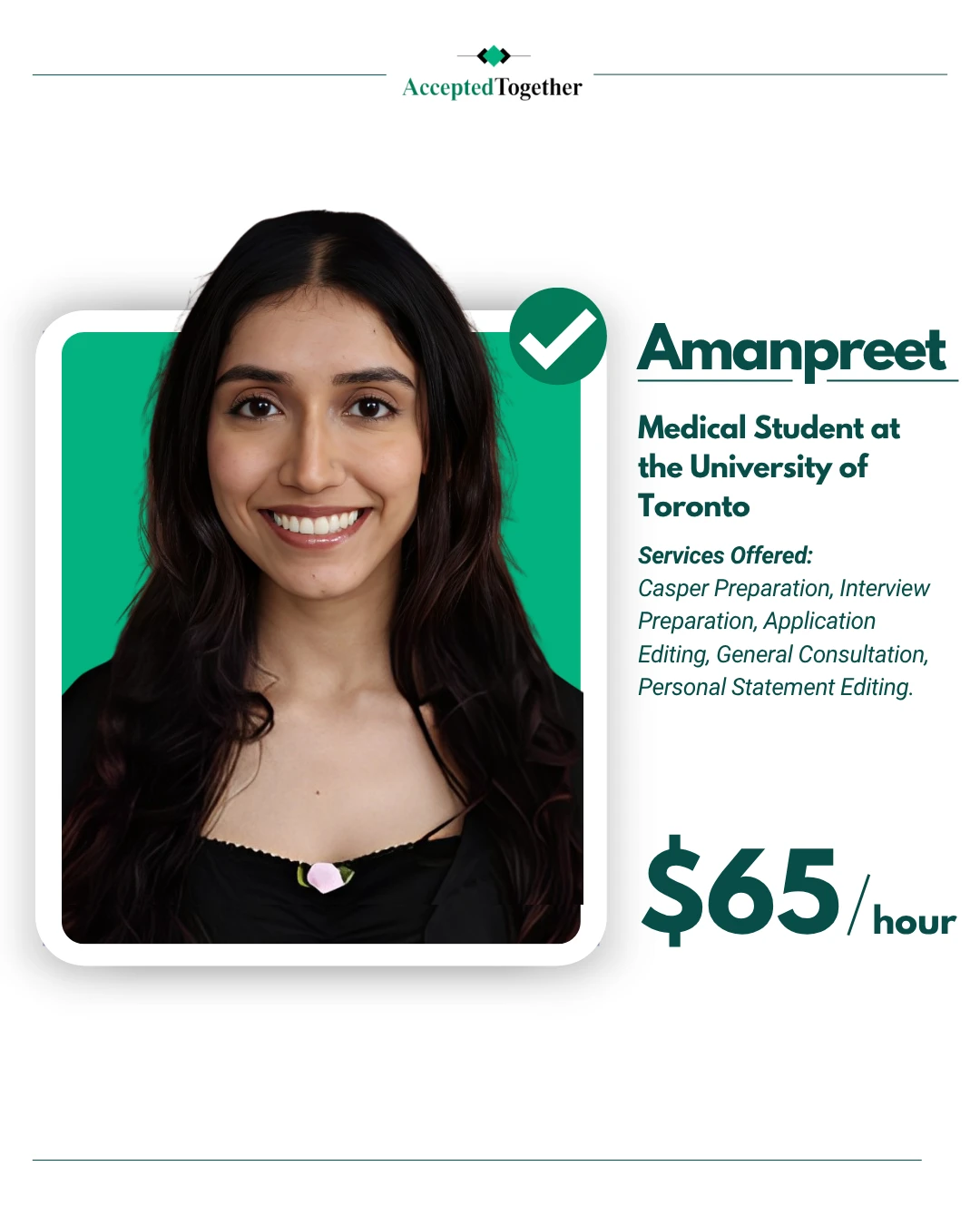
You can browse 250+ verified consultants on AcceptedTogether, each a current student or graduate of the programs they advise on, and message them before you book. Every consultant sets their own price, so you set your own budget.
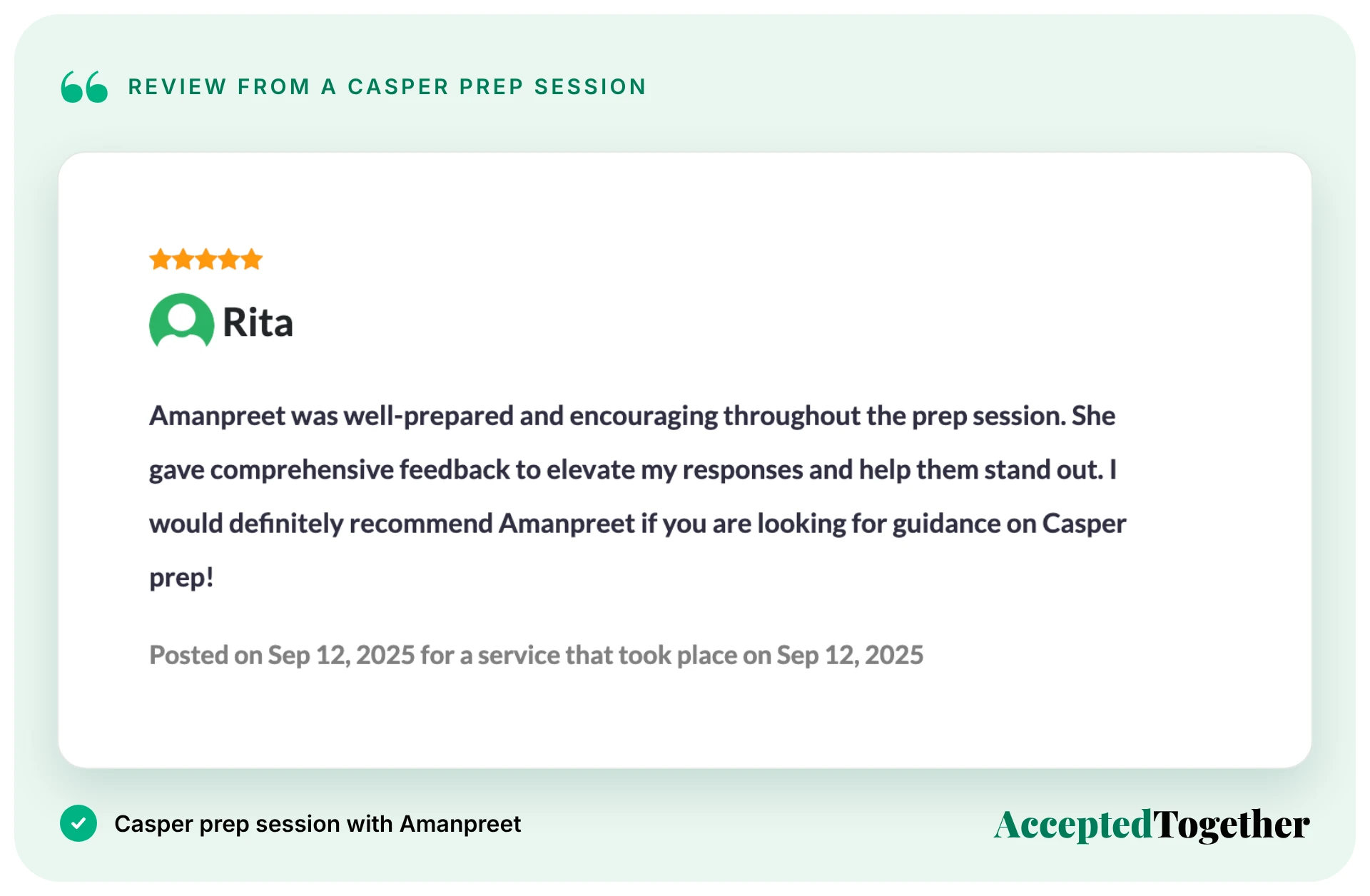
Here’s what one applicant said after a Casper prep session with Amanpreet, a medical student at the University of Toronto:
What else do applicants ask about Casper?
Applicants most often ask about Casper test length, scoring, rules and free prep resources. Here are short answers.
How long is the Casper test?
About 65–85 minutes, including optional breaks. There are 11 scenarios: 4 video-response and 7 typed-response.
How is the Casper test structured?
The video section comes first (4 scenarios, 2 questions each, 1 minute to record per answer), followed by the typed section (7 scenarios, 2 questions each, 3.5 minutes per scenario). There’s an optional 10-minute break after the video section and an optional 5-minute break midway through the typed section.
How is the Casper test scored?
You get a quartile ranking comparing you to other test-takers, from 1st (bottom 25%) to 4th (top 25%). You don’t see a raw score. Each scenario is rated by a different trained human rater, and typed questions are scored individually.
Can you prepare for the Casper test?
Yes. You can’t memorize answers, but you can take the official Acuity Insights practice test, practice timed scenarios on free platforms like PrepMatch, build a bank of personal stories, and work on typing speed.
What skills does the Casper test assess?
Non-academic ones: collaboration, communication, empathy, ethics, fairness, motivation, problem-solving, resilience, and self-awareness, with emotional intelligence tying many of them together.
Do spelling and grammar count on the Casper test?
No. Raters are specifically instructed not to penalize spelling or grammar on the typed section because of the tight timing, so focus on clear reasoning instead.
What’s the best free Casper prep resource?
The official practice test in your Acuity Insights account, plus PrepMatch, a free peer-to-peer platform with practice scenarios and community feedback on both the typed and video sections.
Which schools require the Casper test?
Many medical, nursing, pharmacy, dental, and veterinary programs across Canada, the US, and beyond, including several OMSAS schools. Always confirm each program’s specific requirement, since they can change by cycle. See our Casper guide for medical school applicants for more on which programs use it.
Can you take notes during the Casper test?
Yes, on blank paper. You can use blank sheets of paper, a pen or pencil, and a hard-copy dictionary. Pre-written notes, grammar or translation tools, and speech-to-text (without approved accommodations) are not allowed.
When do you get your Casper results?
Programs on your distribution list receive results about 2–3 weeks after your test. Your own quartile score appears in your Acuity Insights account about 4–5 weeks after you finish.
What is a good Casper score?
The 3rd or 4th quartile, meaning you scored above the median of applicants to similar programs. Casper is norm-referenced, so there is no fixed raw score to aim for.
Can you send Casper scores to more schools after the test?
Yes. You can add programs to your distribution list after you test, as long as each program’s deadline hasn’t passed. Check the Acuity Insights Dates and Fees page for current fees.
Is PrepMatch free?
Yes. PrepMatch is a free, peer-to-peer Casper practice platform with sample scenarios for both the typed and video sections, plus feedback from other users.
Is Casper like the MCAT?
No. The MCAT is a multiple-choice academic exam scored from 472 to 528. Casper is an open-response situational-judgment test that measures non-academic skills and reports a quartile.