
Last updated on August 27th, 2026 at 03:34 am
TLDR
OMSAS (the Ontario Medical School Application Service) is the single online portal you use to apply to all of Ontario’s medical schools. For the upcoming cycle, the application typically opens in early-to-mid July and closes at the start of October, with first-round offers going out in mid-May. You’ll submit one set of materials — transcripts, an Autobiographical Sketch (ABS), school-specific essays, and three references — no matter how many schools you apply to. Most people spend 1–2 months putting it together, so starting over the summer is the move.
Table of Contents
What is OMSAS?
OMSAS (the Ontario Medical School Application Service) is the central application service for medical schools in Ontario. Instead of applying to each school separately, you fill out one application through OMSAS and it gets sent to whichever Ontario med schools you choose. It’s run by the Ontario Universities’ Application Centre (OUAC).
There are now seven medical schools in the OMSAS system. The newest is the Toronto Metropolitan University (TMU) School of Medicine in Brampton, which welcomed its first class recently and runs a holistic, primary-care-focused admissions process. Here’s the full list:
| Medical school | MCAT required? | Quick note |
|---|---|---|
| University of Toronto (Temerty) | Yes | Highest GPA bar; well-known essays |
| McMaster (Michael G. DeGroote) | Yes — CARS only | Lottery-style weighting; CARS matters |
| Western (Schulich) | Yes | Has hard MCAT cut-offs |
| Queen’s University | Yes | Competitive GPA (recent average in the high 3.7s) |
| University of Ottawa | No | Strong GPA focus; bilingual options |
| NOSM University | No | Northern/rural context matters a lot |
| Toronto Metropolitan (TMU) | No | Newest school; holistic, equity-focused, no prerequisites |
This guide goes beyond the basics. The goal is to give you realistic, slightly-harder-to-find advice that helps you actually stand out to an admissions committee — not just check boxes. We’ll cover the timeline, the documents you need, and how to write the parts that make or break an application.
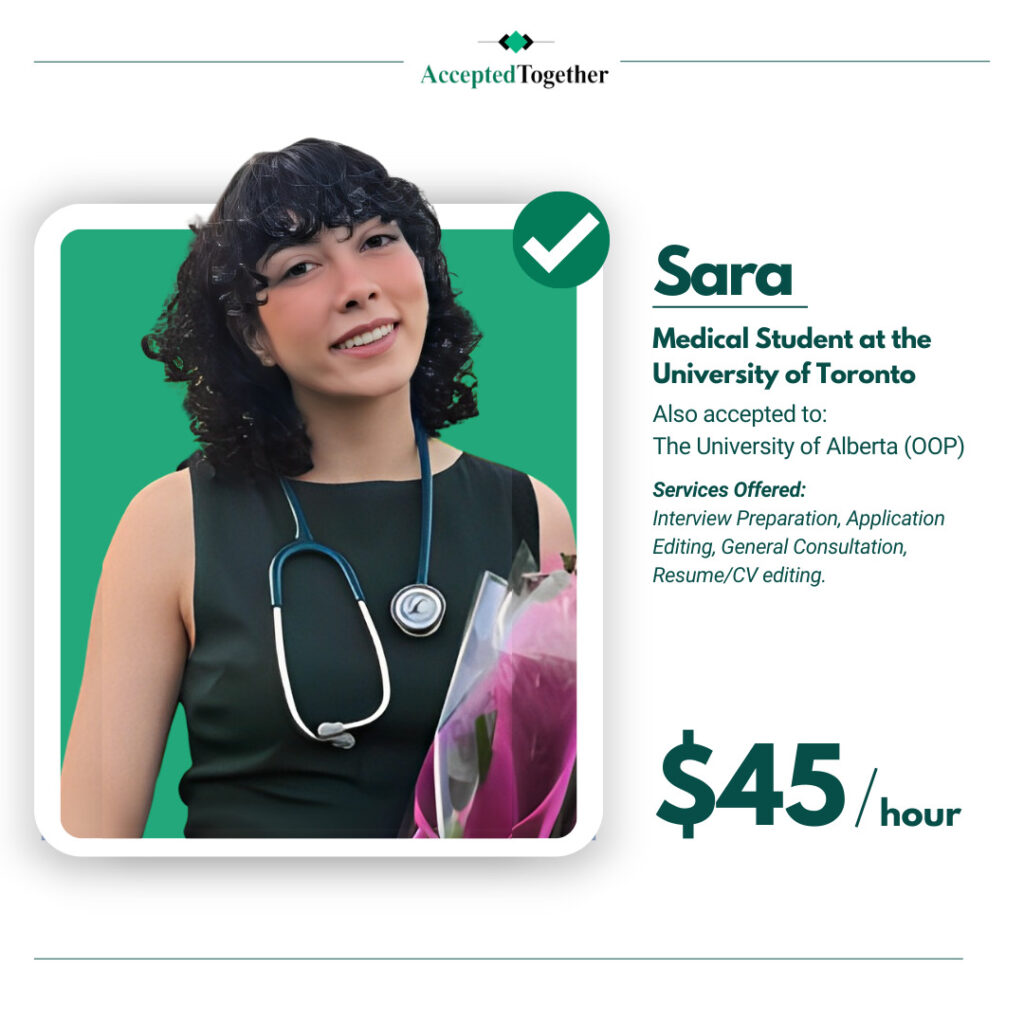
Click to see a mentor who’s been through this

OMSAS key dates for the upcoming cycle

OMSAS runs on a strict, predictable schedule, and the deadlines do not move — there are genuinely no exceptions. While the exact dates for the upcoming cycle are confirmed on the OUAC site each summer, the pattern has been rock-solid for years, so you can plan around it now.
| Milestone | Roughly when | Why it matters |
|---|---|---|
| Application opens | Early-to-mid July | Start building your ABS and essays right away |
| Fee waiver deadline | Late August | Apply early if cost is a barrier (more below) |
| Send reference requests by | Mid-September | Gives referees enough time before the cutoff |
| Application deadline | October 1, 4:30 PM ET | Strict. Application, references, payment, transcripts all due |
| MCAT scores due | Mid-to-late October | Request release ~2–3 business days early |
| First-round offers | Mid-May | Recent cycles sent first offers around May 12 |
| Heads up: TMU and a few other schools sometimes run slightly different sub-deadlines or extra steps (like asynchronous assessments). Always double-check each school’s page and your OMSAS Document Tracking so nothing slips through. |
How long does the application actually take?
Most people spend 1–2 months on it, though everyone’s pace is different. The ABS and essays are the time sinks. A realistic plan: start drafting in July, ask your referees early (beginning of summer is ideal), and aim to have a complete draft a few weeks before October so you have room to revise and get feedback.
Reach out to your referees first — they’re the part of your application you don’t fully control, and a rushed reference letter reads like one.
How much does OMSAS cost?
Budgeting for applications surprises a lot of people, so here’s the breakdown. There are two pieces: a one-time OMSAS service fee, and a separate fee for each school you apply to.
- OMSAS service fee: around $220, paid once per cycle no matter how many schools you pick.
- Per-school fee: roughly $130 for each medical school you add.
- Transcripts and extras: ordering transcripts and (if needed) international credential evaluations cost extra.
So applying to three schools lands somewhere in the $600+ range before transcripts. If that’s a real barrier, look into the Ontario Medical School Application Fee Waiver Program — it can subsidize the service fee and the cost of up to three schools (recently worth roughly $610 in savings). Apply early, because it has its own deadline in late August.
GPA requirements for Ontario medical schools
Every Ontario med school has a minimum GPA, and they vary — usually somewhere between 3.0 and 3.7 on the 4.0 scale. But hitting the minimum doesn’t get you in; it just keeps you in the running. Schools weigh GPA differently, and the average accepted GPA is often much higher than the published minimum.
Canadian schools convert your grades to the OMSAS scale, so don’t assume your home university’s GPA carries over directly. Check which OMSAS scale your school uses first, then run the numbers with our OMSAS GPA calculator to see where you actually stand.
A few real numbers worth knowing
- Queen’s University — this one surprises people: the average accepted GPA has recently sat in the high 3.7s.
- University of Toronto — one of the highest minimums (around 3.6 on the OMSAS scale) plus strong averages.
- McMaster — publishes class stats; remember Mac weighs your MCAT CARS score heavily rather than the full MCAT.
- TMU — sets a minimum OMSAS GPA (around 3.5) but takes a holistic approach, so GPA is one factor among many rather than the main ranking tool.
Bottom line: pull each school’s most recent stats before you finalize your list, and aim your applications where your numbers actually fit.
The CanMEDS framework (and how to use it well)
CanMEDS is a framework from the Royal College of Physicians and Surgeons of Canada that describes the qualities a good physician needs. It breaks down into seven roles: Medical Expert, Communicator, Collaborator, Leader, Health Advocate, Scholar, and Professional.
These roles cover the full range of skills medicine asks for, and admissions committees genuinely use them to score applications. So your job is to show that you embody them — across your ABS, essays, and references combined.
How to show CanMEDS in a balanced way
- Weave them into stories, don’t announce them. Show a moment where you led or collaborated instead of writing “I am a strong leader.” The reader should feel it without you saying it.
- Pull from real experiences. Volunteering, research, leadership roles, work — pick examples that each highlight different roles so you cover the whole framework. One strong story can show two roles at once (leading a committee = leadership + collaboration).
- Get feedback. Ask a mentor or friend to read your materials and tell you if anything feels forced or repetitive. A second set of eyes catches the parts that try too hard.
Examples of trying too hard
- Stating instead of showing. Writing that you have the “Medical Expert” role, without a single example of you applying knowledge, reads as empty. Committees want evidence, not labels.
- Letting CanMEDS eat your story. The framework matters, but don’t bend your whole narrative around it. Your application should still read like a real person with a coherent story — not a checklist. Don’t let CanMEDS flatten your voice.
| Pro tip: the most overused words in OMSAS essays are “collaborate,” “lead,” and “advocate.” Reviewers see them constantly. Try to demonstrate those qualities through what you did, without ever writing the word itself. |
licitly writing them out. Reviewers often roll their eyes when seeing the word “collaborate” overused!
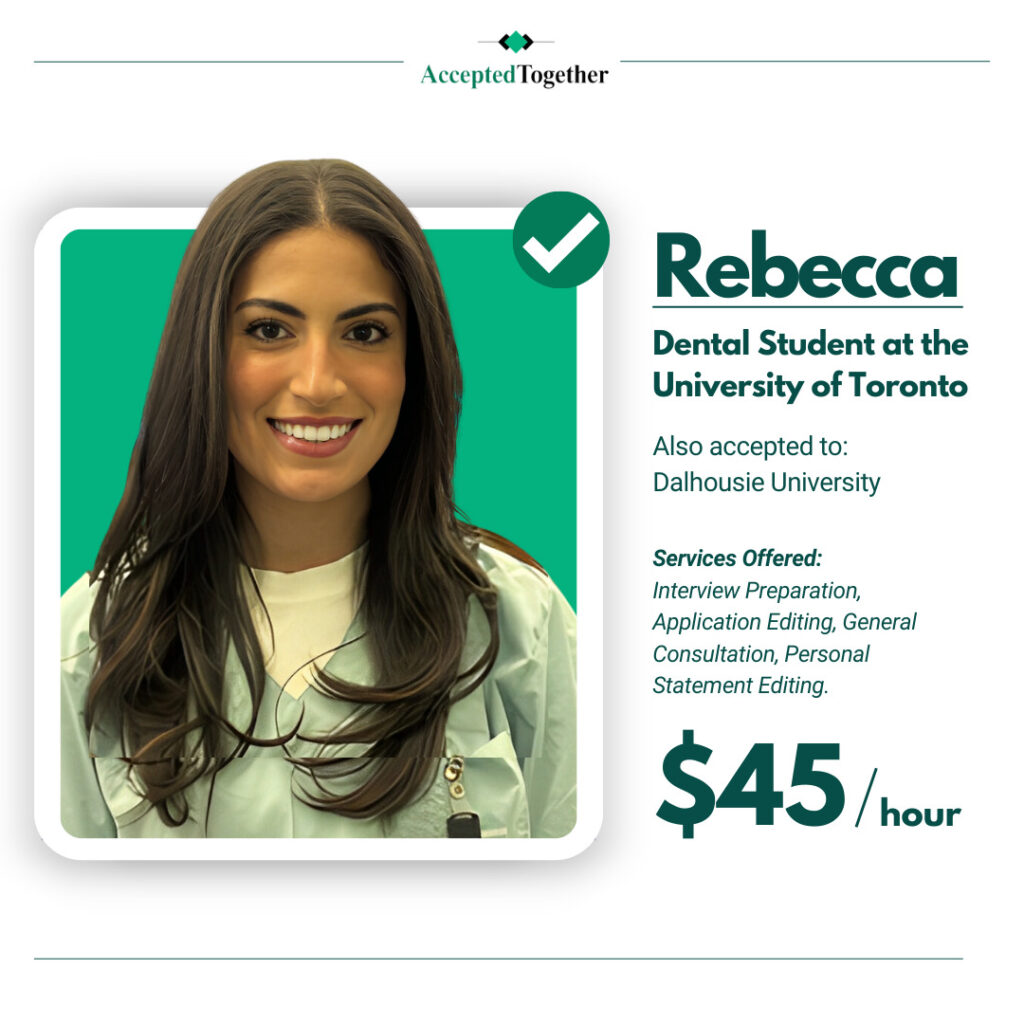
Want a mentor who’s been through this?
Click to see hundreds of consultants who can mentor you:
The Autobiographpical Sketch (ABS)

To see our comprehensive OMSAS ABS article, click here!
The ABS is your structured list of meaningful experiences — work, volunteering, research, extracurriculars, awards — since age 16. It’s where you show you’re well-rounded. And good news: you do not need an entry in every single category. Depth beats forced breadth. For a deeper dive, see our full OMSAS ABS guide.
How to condense an experience into 150 characters
The character limit is tight, so every word has to earn its place. Use strong action verbs and cut anything that isn’t essential. For example, instead of:
I volunteered at a local hospital where I assisted the hospital’s patients and supported hospital staff. Through the experience, I learned how to work under the stress and pressure required of me.
Tighten it to:
Assisted hospital patients & supported medical staff. Learned to work under pressure.
Shortcuts like “&” instead of “and” are fair game. Acronyms too — but only obvious ones. Everyone knows “CPR.” Almost nobody knows “hTTP” means hereditary thrombotic thrombocytopenic purpura, so spell those out.
Focus on what you did, not just what you learned. Committees want to see action and impact — specific things you accomplished — more than a reflection paragraph.
| Pro tip: build a quick spreadsheet with the seven CanMEDS roles as a checklist. As you list each ABS experience, tick off the roles it covers. By the end, make sure every role is checked at least once. It’s the easiest way to catch a gap before a reviewer does. |
What experiences to avoid
- Low-impact entries. Being a club member who showed up but never contributed doesn’t say much. Show involvement, not attendance.
- One-and-done events. Single-day activities rarely show commitment. Committees want sustained passion over time.
- Automatic GPA-based scholarships. Reviewers already know your grades are good — that’s why they’re reading your file. Don’t spend a precious entry restating it.
Quality over quantity, always. Pick experiences with real impact that show growth and map to the CanMEDS roles.
Is there a magic number of experiences?
Short answer: no. There’s no count that guarantees acceptance. Committees care far more about the impact and commitment in each entry than the total number. There’s no magic number — but there is a magic formula: choose quality experiences that align with CanMEDS and reflect genuine commitment, and you’re already ahead.
The Essays
To see our comprehensive OMSAS essays guide, click here!
Several schools — most famously the University of Toronto, plus Western’s Schulich and NOSM — ask for written essays on top of the ABS. The two best-known UofT ones are the Brief Personal Essays (BPEs) and the ABS essay. For a full breakdown, see our OMSAS essays guide and our UofT MD essays guide.
The BPEs ask two questions each cycle on big-picture topics — feedback, learning, social issues, how the world has changed. The ABS essay asks you to reflect on specific experiences that shaped you. The advice below works for all of them.
What recent UofT BPE prompts have looked like (the prompts change each year, so treat these as examples of the style, not the exact questions you’ll get):
Describe a time when you received feedback that stands out in your memory. Why did it stand out? What did you do with it, and how did it influence how you use feedback?
Describe a meaningful learning experience that happened outside a formal classroom (community service, work, extracurriculars). What was hard to learn, what resources did you use, and how did it shape how you learn now?
How to start the essay
The opening sets the tone and decides whether a tired reviewer keeps reading. Picture being on the committee, working through a huge stack of essays. What makes one stand out? A strong hook.
One reliable approach is a short, real anecdote — a vivid moment that lets the reader stand in your shoes and feel something. Another is a thought-provoking question that shows you can think critically. Either way, earn their attention in the first few lines. UofT in particular values well-rounded applicants who can write, so a sharp opening does double duty.
Build it around a narrative
We love books and movies because we love stories — and essay reviewers are no different. A narrative structure keeps the reader engaged from the hook all the way through, and it lets you show growth instead of just listing traits.
For example, you might open on a pivotal moment when one of your core beliefs shifted. Walk the reader through how and why your thinking changed, and let them feel the challenge and the lesson alongside you. That personal connection is what sticks — and it sets up everything that follows.
References/ Confidental Assessment Forms (CAF)
To read out comprehensive CAF referee guide, click here!
Your references come in as Confidential Assessment Forms (CAF) — structured forms a referee fills out about you. Strong ones can really lift an application. Choose people who know you well and can speak to your growth, not just big-name professors who barely know you. Our full CAF referee guide goes deeper.
Who makes a good referee?
Someone you’ve worked with closely and over time — a research supervisor, a volunteer coordinator, a mentor — who can describe how you handle challenges, grow, and work with others. The best references give the committee a holistic, specific picture of you, with real examples behind it.
Who makes a poor referee?
- Someone who barely knows your work or character — they can’t write anything specific, so it falls flat.
- Someone unprofessional or unreliable — slow to reply, or clearly not invested. That energy shows up in the letter.
- Someone too busy to do it justice — a rushed reference helps no one.
A common mistake: picking a professor who only taught you a course. Even if you chatted after class a few times, they usually can’t speak to much beyond “asked good questions.” Pick someone who’s actually seen you in action.
What you need to do
Make it easy for your referees. Send them your resume and a short summary of the experiences you’d love them to highlight — while making clear they’re free to write whatever they feel is honest and accurate. Ask early, keep the relationship warm, and you’ll get far stronger letters.
Casper Preparation

PrepMatch is probably the best free resource out there for Casper prep! Everyone who tries it, loves it. Image Source: PrepMatch.com
Most Ontario schools use Casper, a situational-judgment test that measures how you think through interpersonal and ethical scenarios. It’s a real part of your application, so don’t wing it. Our Casper preparation guide covers the details.
PrepMatch: the free resource worth knowing
PrepMatch is a peer-to-peer Casper prep platform — and it’s completely free, with no strings attached and hundreds of practice scenarios. You practice with other people writing the test, and crucially it covers both the typed responses and the video-response section, which trips a lot of people up. If you haven’t tried it, you’re leaving an easy advantage on the table.
Brainstorm your stories ahead of time
Casper throws scenarios at you fast — “describe a time you worked with someone you didn’t get along with” — and there’s rarely time to think of an example on the spot. So prepare a bank of experiences in advance. A good rule of thumb: have at least two stories for each CanMEDS role, including both positive moments and tougher ones (conflicts, mistakes, hard calls). Walking in with that bank ready keeps you calm and ahead of the clock.
Final thoughts
Applying to medical school through OMSAS is competitive and detail-heavy, and good time management genuinely matters — every component needs to be accurate and in on time. But the applicants who stand out aren’t the ones who simply check every box. They’re the ones who tell a coherent story, show the CanMEDS roles through real experiences, and start early enough to revise.
If you’d like a hand at any stage — brainstorming ABS entries and essays, choosing referees, or polishing a final draft — our consultants at AcceptedTogether do exactly this, each with their own pricing and packages. Find the right consultant for you here. You can also check our affordable medical school admissions consulting options in Canada article if you would like to see your best options if you need a helping hand with your application.
Every detail counts, so stay organized, give yourself time, and present your best self. You’ve got this — good luck!
Frequently
Asked Questions
OMSAS typically opens in early-to-mid July and closes at 4:30 PM ET on October 1. The deadline is strict — application, references, payment, and transcripts all need to be in. Confirm the exact dates on the OUAC website each summer.
Seven: University of Toronto, McMaster, Western (Schulich), Queen’s, University of Ottawa, NOSM University, and the newest, Toronto Metropolitan University (TMU) in Brampton.
It’s not advisable to discuss your MCAT score in your AMCAS Personal Statement. This section is intended for you to share your personal journey and qualities, not academic metrics. Your MCAT score will already be visible to admissions committees elsewhere in your application.
There’s a one-time OMSAS service fee of around $220, plus roughly $130 per school. Transcripts cost extra. A fee waiver program is available if cost is a barrier — apply early, as it has a late-August deadline.
It depends on the school. UofT, McMaster (CARS only), Western, and Queen’s require it. University of Ottawa, NOSM, and TMU do not. Always check each school’s current requirements.
Minimums range from about 3.0 to 3.7 on the 4.0 scale, but average accepted GPAs are usually higher. UofT’s minimum is around 3.6, and Queen’s recent average has been in the high 3.7s. Convert your grades using the OMSAS conversion table to see where you stand.
Most applicants spend 1–2 months. The ABS and essays take the most time, so starting over the summer and contacting referees early is the safest plan.
Each Autobiographical Sketch entry has a 150-character description limit, so concise, action-focused writing matters.
First-round offers of admission are sent in mid-May (recent cycles went out around May 12).