Last updated on March 4th, 2026 at 07:34 am
Table of Contents
Applying to veterinary school can feel overwhelming, especially with so many steps to keep track of—academic transcripts, recommendation letters, personal essays, test scores, and program research. That’s where the Veterinary Medical College Application Service, or VMCAS, comes in. This centralized system, run by the American Association of Veterinary Medical Colleges, allows applicants to complete one standardized application that can be sent to multiple veterinary schools. Instead of juggling separate applications for each program, candidates can organize their academic history, professional experiences, and achievements in one place.
The application itself covers several parts: coursework entry, official transcripts, standardized test scores where required, letters of evaluation, a personal statement, and documented experience in animal care or veterinary settings. Because of its structure, the platform makes it easier for schools to review applicants fairly and for students to keep deadlines in check. Key dates—such as when applications open, when program selection begins, and the final submission cutoff—are consistent year to year, but missing them can result in delays or a lost application cycle.
For prospective veterinarians, understanding how this system works, what information is required, and how to prepare before logging in is essential to submitting a strong and timely application.
Preparing Academically and Professionally

Prerequisite Courses
Before diving into the application process, it’s important to understand the academic foundation veterinary schools expect. Programs in Canada and the United States generally require a set of science-based courses that provide a solid background for advanced veterinary training. These typically include genetics, microbiology, chemistry, biochemistry, and animal biology. Alongside these, applicants are often required to complete mathematics, statistics, physics, and a selection of liberal arts or social science courses. Most schools also mandate English composition courses to ensure strong written communication skills.
Because each veterinary college has its own admission criteria, students are encouraged to review the prerequisites for every program they plan to apply to. Missing even a single required class can delay entry or eliminate eligibility for that cycle. The VMCAS platform will ask for a detailed record of coursework and official transcripts, so it’s essential to plan your undergraduate degree carefully. Many applicants major in fields such as biology, animal science, zoology, or biomedical science, which naturally align with these requirements. However, the choice of major itself is less important than completing the necessary courses with strong grades.
Undergraduate Preparation
Most veterinary schools expect applicants to complete a full bachelor’s degree before applying. While some universities allow early application after two years of undergraduate study, this pathway is uncommon and highly competitive, with only a very small percentage of students accepted. For the majority, completing four years of college before starting a Doctor of Veterinary Medicine program is the standard route.
Admissions committees closely examine overall GPA and science GPA. A competitive academic record demonstrates the ability to manage the demanding workload of veterinary school. Alongside coursework, it’s wise for students to consider standardized tests. Some programs request scores from the GRE, while others may accept or even require the MCAT. Although not every veterinary school mandates these exams, preparing for them can broaden the range of schools you may apply to through VMCAS.
In addition to strong academics, balancing extracurricular involvement with coursework can make an application more well-rounded. Clubs related to pre-veterinary studies, leadership roles in student organizations, and research projects are often considered in admissions decisions. Documenting these experiences clearly in the application gives reviewers a better picture of your preparation.
Experience
Beyond grades and coursework, veterinary schools place significant weight on hands-on experience. Hours spent working, volunteering, or shadowing in animal care environments provide critical exposure to the profession. This may include roles in small animal clinics, large animal practices, research labs, shelters, farms, or wildlife rehabilitation centers. Each type of setting demonstrates adaptability and builds a broader understanding of animal health.
Most schools require applicants to secure reference letters, often from veterinarians who can speak directly to the applicant’s readiness for the profession. Typically, at least two evaluations from licensed veterinarians are recommended, along with additional references from professors or supervisors in related fields. These letters must be requested and submitted through the VMCAS system, which tracks their receipt and links them to your application file.
When logging experiences into the application, students are encouraged to categorize their work carefully. Veterinary experience should be separated from general animal experience, with clear descriptions of responsibilities and hours completed. While listing every opportunity is important, applicants will also be asked to highlight their top five experiences. This gives committees insight into which roles had the greatest impact on personal growth and career goals.
Organizing this information early saves time when the application cycle opens. Keeping a journal or spreadsheet of experiences, supervisors, and contact information ensures accuracy when entering details into VMCAS. It also helps applicants reflect on what they have learned, which can strengthen personal essays and interviews later in the process.
Understanding VMCAS
What VMCAS Is
The Veterinary Medical College Application Service, known as VMCAS, is the centralized application platform managed by the American Association of Veterinary Medical Colleges. Instead of sending separate applications to every veterinary program, applicants can complete one comprehensive file that is distributed to all participating schools. This saves time, organizes application materials in a uniform way, and ensures veterinary colleges receive consistent information from each candidate. For students, it means fewer administrative hurdles and a clearer path to managing requirements across multiple programs.
This system is widely used in North America and has become the standard entry point for those planning to pursue a Doctor of Veterinary Medicine degree. Because schools rely on the data entered, accuracy is crucial. Any errors in coursework, transcripts, or contact information can delay processing or jeopardize the application cycle.
How It Works
The VMCAS process is structured into several sections, each focused on a specific part of the application. After creating an account, the first step is program selection. Applicants can research veterinary schools based on location, prerequisites, specializations, and admission criteria before choosing which ones to apply to. Once schools are selected, applicants proceed to complete personal information, academic history, and other required components.
One of the most time-intensive tasks is transcript entry. Students must request official transcripts from all colleges attended, then enter each completed course manually into the system. To reduce the workload, some students choose to pay for the Professional Transcript Entry service, which allows staff to input the coursework for them. This step ensures programs can calculate GPAs consistently across institutions.
The application also requires test scores when applicable. Some schools request GRE results, while others may consider MCAT or English language exams like TOEFL or IELTS for international applicants. Including these test results in the application is optional if a chosen program does not require them, but having them uploaded ensures eligibility for a wider range of schools.
Once academic data is in place, applicants move on to professional components of the file. This includes the personal statement, recommendation letters, and detailed logs of veterinary and animal-related experience. Each part plays a role in giving admissions committees a well-rounded view of the candidate.
Benefits
The main advantage of VMCAS is that it simplifies the veterinary school application process. Instead of repeating the same details across multiple forms, candidates submit one file that meets the baseline requirements for all participating programs. This uniformity allows schools to evaluate applicants fairly, as they are comparing similar information across the board.
For students, it is also a way to stay organized. The system tracks when transcripts arrive, when recommendation letters are uploaded, and when applications are marked as complete. Status updates are visible in the applicant’s dashboard, helping them monitor progress without constantly contacting schools.
Another benefit is flexibility. Applicants can highlight their strongest experiences, whether that be animal care, veterinary employment, research, or leadership. They can also showcase academic achievements and honors within the same application. Because all of this information is collected in one place, veterinary schools receive a clear picture of both academic preparation and practical experience.
Finally, the platform makes deadlines easier to manage. All schools follow the same general timeline, with the application opening in January, program selection starting in May, and submission closing in September. Applicants know exactly when materials are due, giving them the chance to plan ahead and avoid last-minute issues.
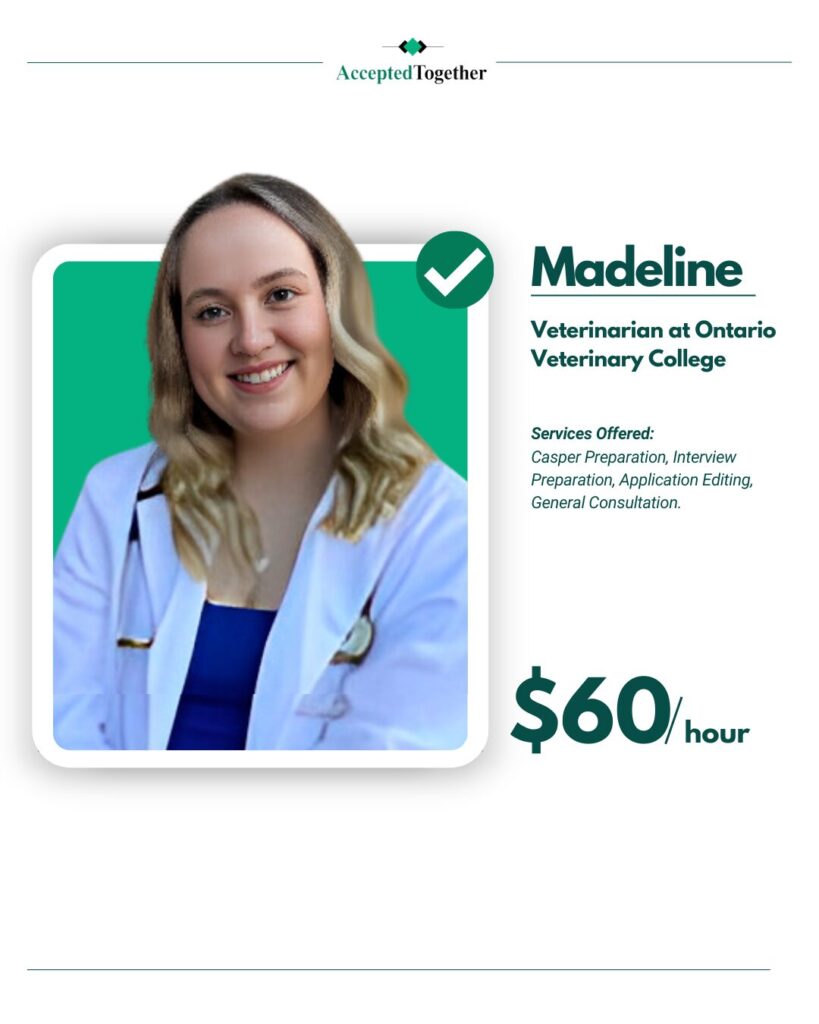
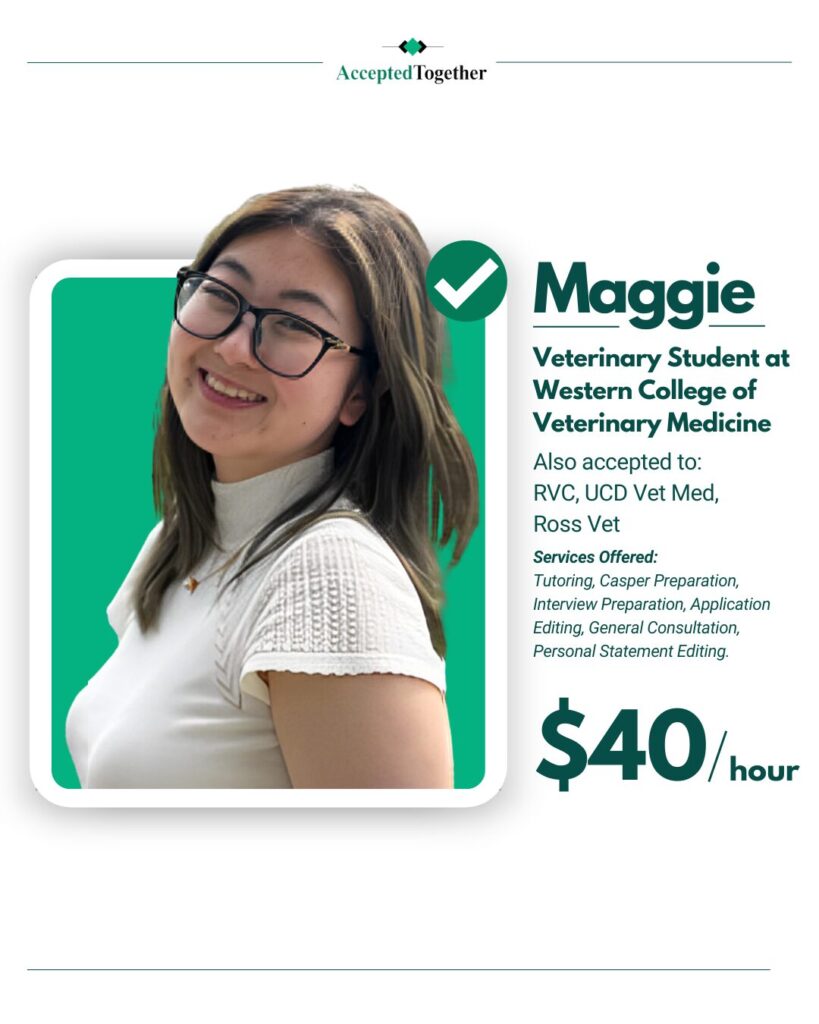
Click to see hundreds of consultants who can mentor you:
Creating and Managing Your VMCAS Application
Account Setup
The first step in building your veterinary school application is to create a VMCAS account. This profile is where all of your information, documents, and updates will be stored. Accuracy matters from the beginning. The contact details you provide—such as your email, phone number, and mailing address—will be shared with admissions offices. Any mistakes here could lead to missed communication. Applicants who have previously applied will need to create a new cycle account since old applications cannot simply be reactivated. Having this account in place early makes it easier to keep track of requirements as you move through the cycle.
Sections of the Application
Personal and Biographic Information
Once the account is active, the first section to complete is personal information. This includes your name, background details, citizenship, military service if applicable, and parent or guardian information. While it may feel straightforward, every answer is used to build a complete profile of who you are, so take care when entering data. Some fields are optional, such as race or ethnicity, but many veterinary schools collect this information for reporting purposes.
Academic History and Transcripts
One of the most time-consuming parts of VMCAS is documenting your academic history. Applicants must list every institution attended, whether it was a community college, a four-year university, or even if credits were transferred and no degree was earned. For each school, official transcripts must be sent directly to VMCAS. Once received, the system verifies the documents before they are shared with veterinary colleges.
The transcript entry section requires each course to be entered individually, with details such as course title, credit hours, and grade earned. This step ensures accurate GPA calculations across different programs. Students who want to save time may choose the Professional Transcript Entry service for an additional fee, which allows trained staff to enter coursework on their behalf. Regardless of which option is chosen, verifying accuracy is essential before submission.
Coursework and GPA Verification
GPA is a central factor in admissions decisions. VMCAS calculates standardized GPAs based on the information entered into the system and compares them with official transcripts. Any discrepancies could delay processing. Applicants should double-check course codes and grades carefully to prevent errors. Science GPA in particular carries significant weight, as it reflects readiness for the demanding curriculum in veterinary medicine.
Experiences and Achievements
Applicants also document veterinary-related activities, animal care roles, employment, community involvement, and leadership positions. These are entered by category and described with attention to responsibilities and skills learned. Beyond listing everything, applicants are asked to highlight their top five experiences. This section allows schools to see where applicants have invested their time and how they have developed a professional foundation. Achievements such as awards or scholarships can also be entered here, giving committees a fuller view of accomplishments.
Letters of Recommendation
Recommendation letters are a required part of the application. Through VMCAS, applicants request evaluations electronically, and referees upload them directly. Most veterinary programs require at least three letters, with some allowing up to six. Typically, at least one should come from a licensed veterinarian who can speak to your suitability for the profession. Other strong choices include professors, research supervisors, or employers in animal-related roles. Submitting these requests early ensures recommenders have time to meet deadlines.
Statement of Purpose
Every application includes a personal essay that explains your motivation for becoming a veterinarian. Limited to one page, this essay is not a place to restate transcripts or lists of experience but instead to give context to your decision to pursue veterinary medicine. VMCAS provides guidelines encouraging applicants to focus on defining moments, clarity of purpose, and what they will bring to the field. Because the essay cannot be edited after submission, starting early and revising carefully is key.
Key Deadlines and Application Processing
Application Timeline
Applying to veterinary programs requires careful attention to timing. The VMCAS cycle begins in January, when the application portal opens for the year. At this stage, students can begin entering personal information and building their application profile. By early May, applicants can start selecting veterinary programs, which is an important step since no application can move forward without at least one chosen school.
During the summer, several other deadlines come into play. For example, students who want to use the Professional Transcript Entry service must request it by early August. This ensures enough time for staff to process transcripts and enter coursework before the application closes. The final submission date typically falls in mid-September, marking the end of the cycle. Applicants who miss this cutoff must wait until the next year to apply.
There is also an additional short window in early October for those whose applications are marked as “undelivered.” This status means something critical was missing or incorrect, such as incomplete transcript entries or missing information. During this grace period, applicants can fix the issue and resubmit. Because of these strict deadlines, planning ahead is essential.
Verification
Once an application is submitted, it does not immediately go to veterinary schools. Instead, VMCAS places the file in line for verification. This process involves comparing the coursework that applicants entered manually with the official transcripts sent by their colleges. Staff review every entry to ensure grades, credit hours, and course titles match the documents provided.
Verification can take up to 10 business days, depending on how many applications are in the system. Applications are verified in the order they are received, so submitting early can help avoid delays. If errors are found—such as incorrect course codes or mismatched grades—the application may be returned as undelivered, requiring correction. Only once verification is complete will the application status move forward, and the file will be made available to the selected programs.
Because this stage is so detailed, applicants should double-check transcript entries before submitting. Missing courses or inaccurate data can slow things down considerably. Using the Professional Transcript Entry service does not eliminate the verification step; it simply shifts the responsibility for data entry to staff.
Status Updates
Throughout the process, applicants can monitor progress through their VMCAS dashboard. Each section of the application has a status, and updates appear as documents are received and reviewed. For example, once transcripts arrive and are matched to an account, the date of receipt appears in the system. The same applies to recommendation letters, which must be submitted electronically by referees through the designated portal.
The overall application status moves through several stages: in-progress, received, complete, and verified. “In-progress” means the applicant is still working on sections. “Received” indicates the application has been submitted but not all materials have been matched. “Complete” shows that the required transcripts, recommendation letters, and fees are in place, and the file is ready for verification. Finally, “verified” confirms the application has passed the transcript review process and has been sent to the veterinary schools.
Applicants should regularly log in to track updates and ensure no part of their file is missing. Since veterinary schools may also request supplemental applications or additional documents beyond VMCAS, keeping an eye on communication from each program is equally important.
Corrections
Occasionally, an application may be flagged as undelivered after submission. This usually happens when transcripts do not align with the coursework entries, or when critical pieces such as recommendation letters or fees are incomplete. In such cases, applicants receive a notification and must make corrections before resubmitting.
The correction window is limited, often no later than early October, so immediate action is required. If the problem is not resolved within the allowed time, the application will not be reviewed that cycle. This is why applicants are strongly encouraged to submit well before the September deadline—leaving time for issues to be spotted and fixed without risking the entire application year.
Costs and Fee Assistance
Application Fees
Applying to veterinary school through VMCAS comes with costs that should be factored into any applicant’s budget. The fee structure is set up on a per-program basis. Submitting an application to the first program costs $227, while each additional program adds $124. Because many students apply to multiple veterinary schools to increase their chances of admission, these costs can add up quickly.
Applicants need to be strategic when deciding how many programs to include in their VMCAS application. While applying broadly can open more opportunities, it also raises the overall price. Building a clear list of programs that match your GPA, prerequisites, and career goals before submitting can help avoid unnecessary expenses. It’s also worth remembering that some schools may charge supplemental application fees outside of VMCAS, further increasing the total cost of applying.
Additional Services
In addition to standard application fees, there are optional services that come with their own charges. The most common is the Professional Transcript Entry service. This allows trained staff to enter your coursework into the system rather than requiring you to do it yourself. The price varies depending on the number of transcripts being processed. One to three transcripts costs $77, four to six costs $105, and seven or more costs $150.
While this service can save time, it is not required. Applicants who are confident entering their courses manually may choose to save the fee. However, those managing a heavy course load from multiple institutions may find it worthwhile to pay for the service and reduce the chance of errors in transcript entry.
Beyond transcript entry, other optional expenses can arise. Some applicants may need to take the GRE, MCAT, TOEFL, or IELTS, and registering for these exams requires additional fees. Though these tests are not required by every veterinary school, students targeting programs that still request them should factor the cost of test registration into their planning.
Fee Assistance Programs
Recognizing that application fees can be a burden, VMCAS provides a limited fee assistance program. These waivers are designed for applicants who demonstrate financial need, come from service backgrounds, or meet criteria for international support. The assistance can significantly reduce costs, but funding is limited and offered on a first-come, first-served basis.
To apply for fee assistance, candidates must submit documentation showing eligibility. Because the program closes once available funds are distributed, early application is important. Students planning to request support should gather necessary documents—such as proof of income or service status—well before the VMCAS cycle opens.
Even with a waiver, applicants may still be responsible for supplemental application fees charged by individual veterinary schools. It’s essential to read each program’s admission requirements carefully to understand the total cost.
Budgeting for the Application Cycle
Planning financially for the application cycle is just as important as preparing academically. Between VMCAS submission fees, optional services, test registration, and school-specific fees, the total cost of applying can be significant. Creating a budget early helps applicants avoid surprises later in the process.
Applicants should also account for related expenses beyond application costs. For example, traveling for interviews, paying for transcript requests from universities, or covering postage for any additional documents can add to the budget. Keeping track of each payment as it is made is helpful, especially when applying to several schools.
Because veterinary education is already a major financial investment, approaching the application process with a clear plan is wise. Understanding how VMCAS structures fees, knowing when optional services are worth paying for, and exploring assistance options can reduce stress and ensure applicants use their resources effectively.
Tips for a Strong Application

Start Early
One of the most effective ways to strengthen a vet school application is to begin the process early. The VMCAS cycle opens months before the final deadline, and waiting until the last minute creates unnecessary stress. Early preparation allows time to gather transcripts from all institutions, confirm prerequisite coursework, and request recommendation letters. It also helps when unexpected issues arise—such as delays in transcript delivery or slow responses from evaluators. Submitting well before September ensures applications have time to move through the verification process without risking rejection because of incomplete materials.
Quality of Experiences
Admissions committees look closely at veterinary and animal-related experiences to understand an applicant’s readiness for the profession. Listing hundreds of hours without reflection is less effective than carefully selecting experiences that demonstrate growth and responsibility. When entering experiences into VMCAS, applicants should provide clear descriptions of their roles and highlight what they learned from each setting. This could include skills gained in small animal clinics, livestock work, laboratory research, or volunteer service in shelters. The system also asks applicants to identify their top five experiences, which is a chance to emphasize roles that shaped their interest in veterinary medicine and prepared them for the demands of vet school.
Personal Statement
The essay is another crucial part of the vet school application. VMCAS provides one page for applicants to explain why they want to pursue a Doctor of Veterinary Medicine degree. Instead of retelling the résumé, the personal statement should connect experiences to future goals. Applicants can use this space to discuss defining moments, challenges overcome, or specific aspects of veterinary practice that inspire them. Since the essay cannot be changed after submission, drafting multiple versions, seeking feedback, and editing carefully are all smart strategies. Clarity and authenticity are more important than flowery language or trying to impress with complex phrasing.
Professional Conduct
Professionalism plays a role throughout the entire process. Schools pay attention to how applicants communicate with admissions offices, professors writing recommendation letters, and supervisors verifying experience. Respectful and timely communication makes a positive impression and can reinforce the applicant’s suitability for a career in veterinary medicine. Within the VMCAS platform itself, accuracy and honesty are critical. Misrepresenting experience, inflating hours, or failing to follow directions can raise concerns and potentially harm chances of admission.
Professionalism also extends to preparing references. Recommenders should be given clear instructions and enough time to complete evaluations before the deadline. Applicants should thank evaluators for their support and keep them updated once submissions are confirmed. These small but meaningful actions reflect accountability and maturity.
Organization and Strategy
Finally, approaching the process with a plan improves the quality of the application. Tracking deadlines for each school, budgeting for application fees, and setting reminders to follow up on transcripts and recommendation letters are all part of staying organized. Some applicants create spreadsheets to manage this information, while others rely on checklists within the VMCAS system. Whatever the method, organization helps prevent missed requirements.
Strategy also matters when choosing schools. Applying to every program is costly, but applying to too few may limit opportunities. Reviewing prerequisites, acceptance rates, and program strengths can help applicants target the schools that best fit their background and goals. Combining this research with a well-prepared application increases the likelihood of success.
Applying to veterinary school requires careful planning, attention to detail, and a clear understanding of the steps involved. The VMCAS platform helps streamline the process by bringing transcripts, recommendation letters, academic history, and veterinary experience into one system. By staying on top of coursework entry, preparing a thoughtful personal statement, and monitoring deadlines, applicants can make sure their vet school application is complete and competitive.
Each part of the process, from documenting animal care hours to requesting evaluations, offers an opportunity to demonstrate readiness for veterinary training. Organization is key—tracking deadlines, planning for fees, and confirming the receipt of transcripts and reference letters all reduce the chance of last-minute problems. Applicants who use the system to highlight their strengths, whether through strong academic performance, relevant experience, or meaningful extracurricular activities, give admissions committees a clearer view of their potential.
Ultimately, success with VMCAS comes down to preparation, accuracy, and persistence. Understanding how the application cycle works, budgeting for costs, and managing time effectively can make the experience more straightforward. With a focused approach, candidates can submit an application that reflects both their academic preparation and their commitment to the veterinary profession.
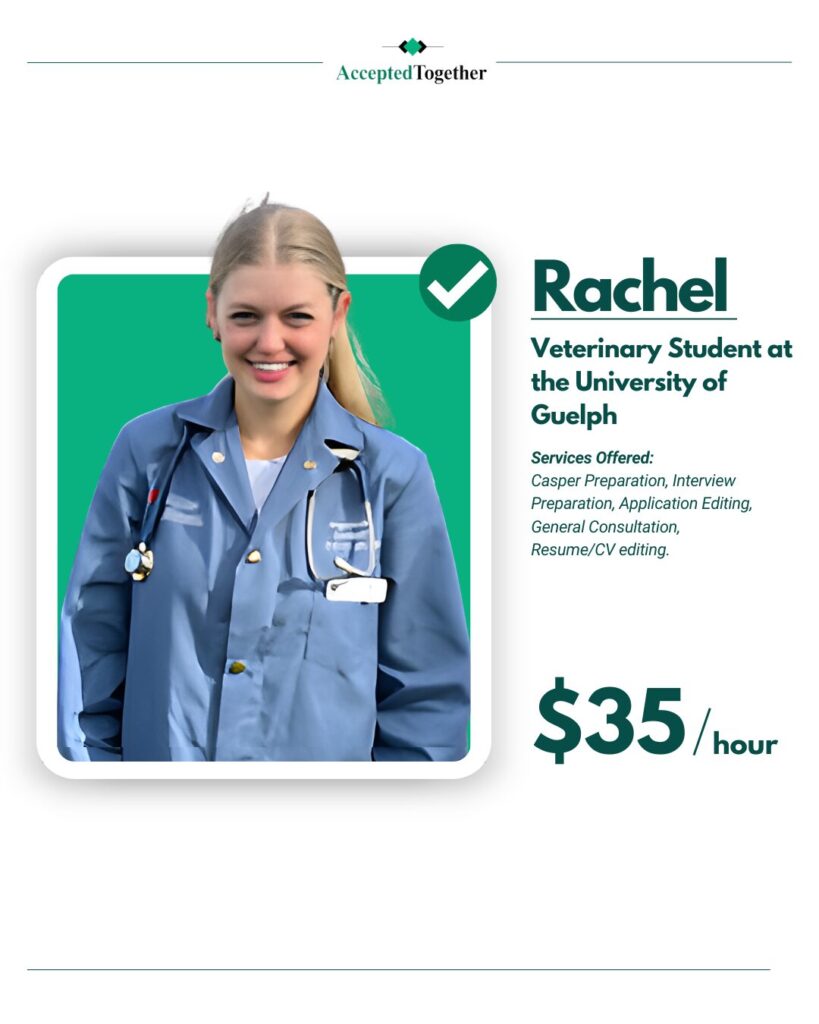
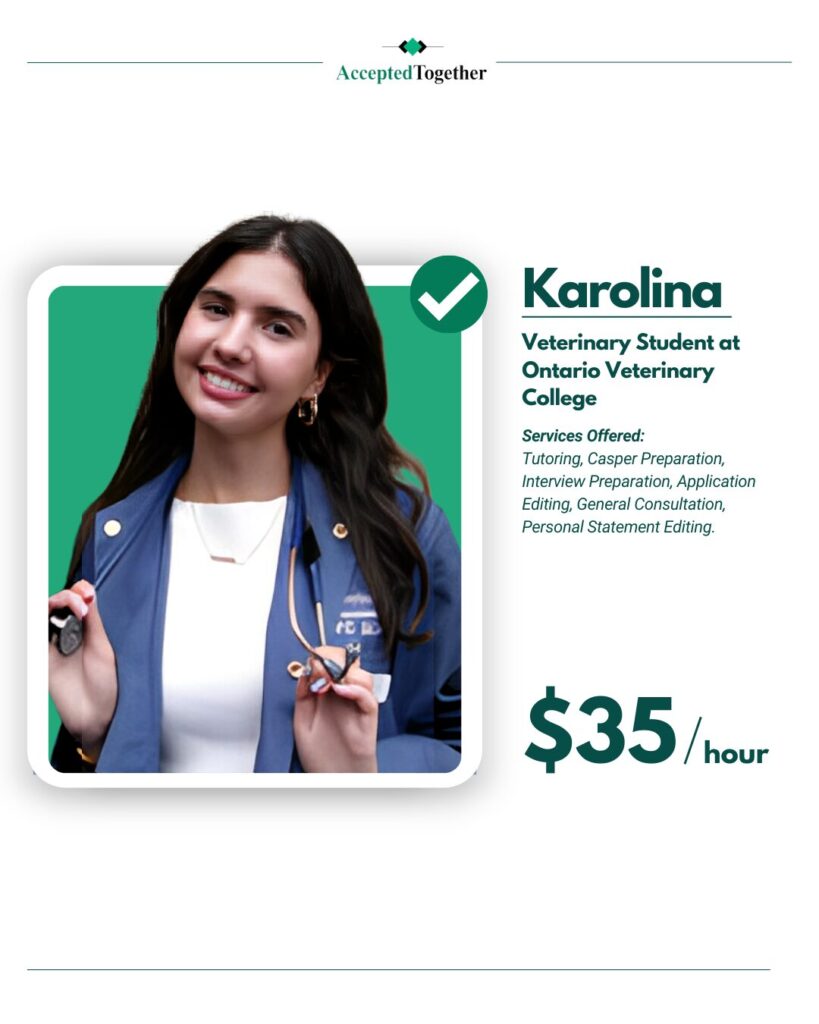
Click to see hundreds of consultants who can mentor you:
Frequently
Asked Questions
VMCAS, or the Veterinary Medical College Application Service, is the centralized platform applicants use to apply to participating veterinary schools. Instead of sending multiple separate applications, candidates complete one file that is distributed to all chosen programs. This helps organize transcripts, coursework, recommendation letters, and personal statements in a uniform format, making the process more efficient for both applicants and admissions committees.
Yes, several Canadian veterinary schools participate in VMCAS, but each has its own policies and seat availability. For example, the University of Guelph, University of Prince Edward Island, and University of Saskatchewan accept applications from international students, though spots are limited and competition is intense. In fact, only a small number of seats are available for non-Canadian applicants, with most international spots going to U.S. students. Because requirements such as prerequisite courses, GPA expectations, and test score policies vary, applicants should carefully review each school’s admissions page before applying through VMCAS.
The application typically opens in January, and applicants can begin selecting veterinary programs in May. The final submission deadline usually falls in September, with a short correction period available in early October for applications marked as “undelivered.” Submitting early is recommended, since verification of transcripts and coursework can take time and late submissions risk missing the cycle.
The first program application costs $227, and each additional program costs $124. Optional services, such as Professional Transcript Entry, come with added fees that range from $77 to $150 depending on the number of transcripts processed. Applicants should also be aware that some schools charge supplemental fees outside of VMCAS, which can increase the total cost of the application cycle.
Applicants are expected to document veterinary-related experiences, general animal care roles, research, community involvement, and leadership activities. These experiences should be clearly described with responsibilities, hours, and skills gained. The application also asks for a list of the top five most meaningful experiences, which allows candidates to highlight the roles that best reflect their preparation for veterinary training.
Applicants must request official transcripts from every college or university attended, regardless of whether a degree was earned. Each course then needs to be manually entered into the application with details such as course title, credits, and grade. VMCAS verifies this information against the official transcripts, and discrepancies can delay or return an application, so accuracy is critical.
Most veterinary schools require at least three letters of recommendation, though some programs allow more. At least one should come from a licensed veterinarian who has worked directly with the applicant, while others may come from professors, supervisors, or employers in related fields. Letters are submitted electronically through VMCAS, so it is important to ask evaluators early to ensure they meet deadlines.
Not all programs require standardized test results, but some schools still request GRE or MCAT scores. International applicants may also need to provide English language test scores such as TOEFL or IELTS. Including these results in the application can make candidates eligible for a wider range of schools, even if not every program lists them as mandatory.
After submission, VMCAS places the application in line for verification. Staff review coursework entries against official transcripts to ensure accuracy, which can take up to 10 business days. Once verified, the application is released to the selected veterinary schools, which may then follow up with requests for supplemental applications or interviews.