Last updated on January 9th, 2026 at 06:28 am
Program Overview & Institution Identity
Official Program Name
The University of Illinois College of Medicine (UI COM) is the official designation for this prestigious medical institution, founded in 1882. The school operates as one of the largest and most renowned public medical schools in the United States.
Program Duration & Structure
UI COM offers a traditional 4-year MD program structured in three distinct phases:
- Phase 1 (Years 1-2): 20-month pre-clerkship curriculum covering foundational basic sciences
- Phase 2 (Year 3): Core clinical clerkships
- Phase 3 (Year 4): Advanced clinical rotations, sub-internships, and electives
The curriculum follows an integrated, organ-system based approach that seamlessly blends basic sciences with clinical applications from day one.
Location and Campus Details
UI COM operates across three campus locations throughout Illinois:
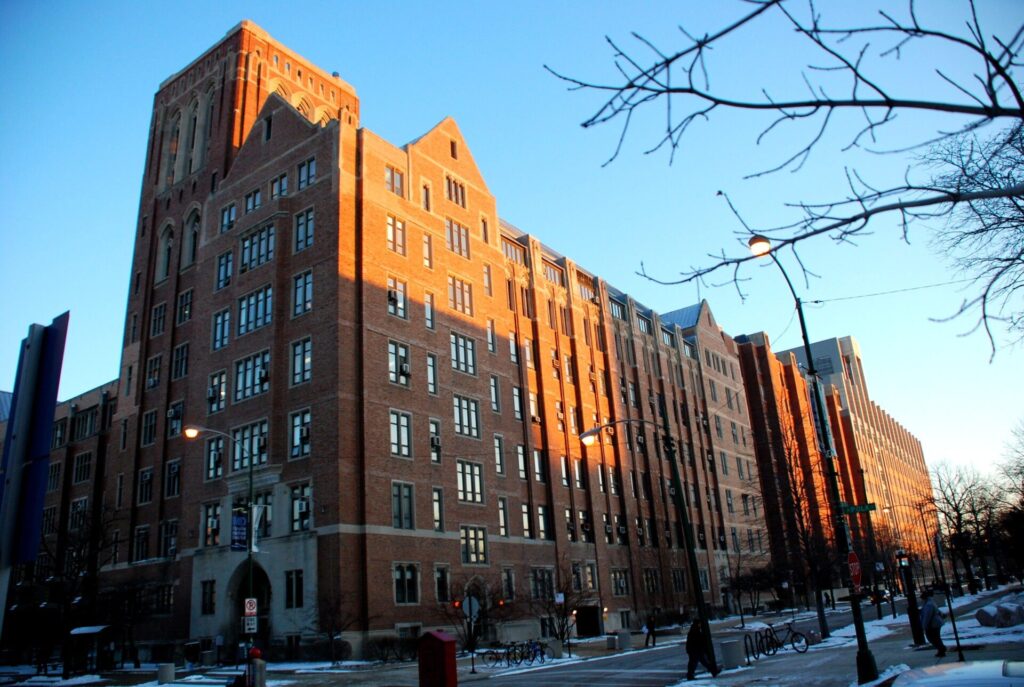
- Chicago Campus: The largest campus located in Chicago’s University Medical District
- Peoria Campus: Central Illinois location
- Rockford Campus: Northern Illinois location
Students are assigned to campuses after acceptance, with the integrated curriculum delivered simultaneously across all three locations. The Chicago campus serves as the primary location with over 800 students and 900+ faculty members.
Accreditation Status
UI COM has been fully accredited by the Liaison Committee on Medical Education (LCME) since the LCME’s inception in 1942. The school underwent its most recent full survey for re-accreditation in April 2018 and is preparing for its next comprehensive review in 2026. This accreditation ensures graduates are eligible for residency training throughout the United States.
Ranking and Recognition
- US News Medical School Rankings: #77 among research medical schools
- Largest Medical Schools: #2 nationally by enrollment
- Public Medical Schools: #37 nationally
- Research Excellence: Ranks in top 1/3 of NIH-funded institutions
- Carnegie Foundation: One of 4 Illinois universities with highest research productivity designation
- Graduate Impact: 1 in 6 physicians in Illinois received training from UI COM
Admission Requirements
Academic Prerequisites
Minimum Degree Requirements
- Bachelor’s Degree: Required from an accredited US or Canadian college or university prior to matriculation
- Credit Hours: No specific minimum, but must complete all prerequisite courses
- GPA Requirement: No minimum GPA requirement, though successful applicants typically maintain competitive grades
Required Courses
Biological and Physical Science Prerequisites:
- Two courses of general biology with laboratory
- Two courses of general chemistry or equivalent with laboratory
- Two courses of organic chemistry with accompanying laboratory*
- One course of biochemistry (must be completed at a four-year institution)
- Two courses of general physics with laboratory
- One course of advanced-level biology (junior/senior level at four-year institution)
*The second semester of organic chemistry can be waived if not required for biochemistry at your university.
Behavioral/Social Science Prerequisites:
- Three courses in behavioral/social sciences (Psychology, Ethics, Economics, Gender Studies, Sociology, etc.)
GPA Requirements
- No minimum GPA requirement specified
- Average admitted student GPA: 3.77 (median: 3.8)
- Competitive range: Most successful applicants have GPAs above 3.6
- Science vs. Overall GPA: Both calculated and considered in holistic evaluation
Standardized Testing
MCAT Requirements
- MCAT Required: All applicants must take the MCAT
- Score Validity: MCAT scores cannot be more than 3 years old at time of enrollment
- Average MCAT Score: 512 (median)
- No minimum MCAT requirement, though scores are used in holistic evaluation
- Multiple Attempts: Best eligible score used for admission consideration
- Valid Test Dates: For 2025-2026 cycle, tests from August 2023 through final 2025 test date accepted
Additional Testing
UI COM does not require additional standardized tests such as:
- CASPer (Situational Judgment Test)
- GRE
- Other institutional assessments
Extracurricular Activities & Experience Requirements
UI COM employs a holistic evaluation system that considers:
- Clinical Experience: Direct patient care exposure valued
- Research Experience: Both basic science and clinical research considered
- Volunteer Work: Community service and healthcare-related volunteering
- Leadership Experience: Demonstrated leadership in various capacities
- Diversity of Experiences: Well-rounded applicants preferred
State Residency Preferences: As a public institution, UI COM shows strong preference for Illinois residents, with approximately 66% of seats reserved for in-state applicants.
Application Process & Timeline
Application System
UI COM participates in AMCAS (American Medical College Application Service), the standard application system for MD programs.
Key Deadlines
- AMCAS Application Deadline: November 1, 2025
- Secondary Application: Sent to eligible candidates after initial screening
- Interview Season: Invitations typically sent beginning in fall, continuing through spring
Required Documents
- Primary Application: Complete AMCAS application
- Transcripts: All post-secondary coursework verified through AMCAS
- Letters of Recommendation: Required number varies by campus
- Personal Statement: Standard AMCAS personal statement
- Secondary Application: School-specific supplemental application
Application Fees
- Primary Application: Standard AMCAS fees apply
- Secondary Application: Additional fee required upon invitation
Interview Process
UI COM utilizes various interview formats depending on campus assignment. Interview invitations are extended on a rolling basis throughout the application cycle.
Admission Statistics & Success Rates
Overall Acceptance Rate
3.09% – UI COM maintains a highly competitive acceptance rate with 297 students matriculating from 9,610 applicants in the most recent cycle.
Application Volume and Class Size
- Total Applicants: 9,610 (2025 admission cycle)
- Matriculated Students: 297
- Interview Invitation Rate: 1.64%
Demographics of Admitted Students
Geographic Distribution
- Illinois Residents: 195 students (65.7%)
- Out-of-State Students: 102 students (34.3%)
- Acceptance Rate by Residency:
- Illinois residents: 11.67%
- Out-of-state: 1.28%
Gender Distribution
- Male Students: 120 (40%)
- Female Students: 173 (58%)
- Male to Female Applicant Ratio: 43:57
Academic Statistics
- Average GPA: 3.77
- Median GPA: 3.8
- Average MCAT: 512
- Median MCAT: 512
Comparison Data
Compared to national averages:
- UI COM acceptance rate (3.09%) vs. National average (4.02%)
- UI COM MCAT (512) vs. National average (513)
- UI COM GPA (3.77) vs. National average (3.84)
Tuition & Financial Information
Current Tuition Rates by Residency Status
2025-2026 Academic Year Costs
- Illinois Residents: $48,450 (tuition) + $6,095 (fees) = $54,545 total
- Out-of-State Students: $82,350 (tuition) + $6,095 (fees) = $88,445 total
Total Cost of Attendance (COA)
Chicago Campus – 2025-2026
Illinois Residents:
- Tuition & Fees: $54,545
- Living Costs: $24,000
- Books & Supplies: $2,100
- Personal Expenses: $4,800
- Transportation: $2,150
- Total COA: $87,595
Out-of-State Students:
- Tuition & Fees: $88,445
- Living Costs: $24,000
- Books & Supplies: $2,100
- Personal Expenses: $4,800
- Transportation: $2,150
- Total COA: $121,495
Peoria & Rockford Campuses
Similar structure with slightly lower living costs ($20,400 vs. $24,000).
Program Length Cost Analysis
Total 4-Year Program Cost:
- Illinois Residents: Approximately $350,000-$380,000
- Out-of-State Students: Approximately $485,000-$515,000
Financial Aid Options
- Federal Student Loans: Stafford and Grad PLUS loans available
- Need-Based Aid: Limited institutional need-based assistance
- Merit Scholarships: Competitive merit-based awards available
- Work-Study: Limited opportunities available
- External Scholarships: Students encouraged to pursue outside funding
Average Federal Loan Fees: Added to COA for borrowers
- Graduate PLUS Loan Fees: $1,200
- Stafford Loan Fees: $400
Living Expenses
Cost of Living in Chicago: Higher than Peoria/Rockford campuses
- Housing options near campus available
- Public transportation readily accessible
- Urban amenities increase overall living costs
Click To See Hundreds Of Consultants Who Can Mentor You:
Curriculum & Program Structure
Program Duration and Structure
UI COM follows a traditional 4-year curriculum divided into three phases:
Phase 1 (Years 1-2): Pre-Clerkship – 20 months, 74 credit hours
Block Courses:
- Block 1: Body Systems & Homeostasis I (5 credits)
- Block 2: Pathogenesis (6 credits)
- Block 3: Skin Muscle & Movement (5 credits)
- Block 4: Circulation & Respiration (7 credits)
- Block 5: Digestion & Homeostasis II (5 credits)
- Block 6: Brain & Behavior (8 credits)
- Block 7: Regulation & Reproduction (4 credits)
Supporting Courses:
- Doctoring and Clinical Skills (DoCS): Hands-on clinical skills training
- Synthesis Course: Integration and reflection
- Medical Colloquia: Professional development and healthcare systems
Phase 2 (Year 3): Core Clinical Clerkships – 44 credit hours
Required Core Rotations:
- Internal Medicine: 8 weeks
- Surgery: 8 weeks
- Pediatrics: 6 weeks
- Obstetrics and Gynecology: 6 weeks
- Psychiatry: 6 weeks
- Family Medicine: 6 weeks
- Neurology: 4 weeks
Phase 3 (Year 4): Advanced Clinical Training – 38 credit hours
Graduation Requirements:
- Sub-Internship: 4 weeks (primary patient responsibility)
- Acute Care (ICU/Emergency Medicine): 4 weeks
- Physician-Assessed Patient-Facing Courses: 12 weeks
- Transition to Residency: 2 weeks
- Open Electives: 16 weeks
Educational Philosophy and Teaching Methods
- Integrated Approach: Basic sciences integrated with clinical applications
- Problem-Based Learning: Emphasis on clinical reasoning
- Technology Integration: State-of-the-art simulation facilities
- Three-Campus System: Simultaneous curriculum delivery across locations
- Diverse Clinical Exposure: Urban and rural healthcare settings
Clinical Training
Early Clinical Exposure: Clinical skills training begins in Year 1 through DoCS
Hospital Partnerships:
- University of Illinois Hospital (Chicago)
- Multiple affiliated hospitals across three campuses
- Community clinics and healthcare centers
Geographic Distribution:
- Urban settings (Chicago)
- Rural settings (Peoria, Rockford)
- Diverse patient populations
Special Programs
- Rural Medical Education Program (RMED)
- Urban Medicine Program (UMED)
- Global Medicine Program (GMED)
- Innovation Medicine Program (IMED)
- Clinical Executive Medicine (CEMED)
Combined Degree Options
- MD/PhD (Medical Scientist Training Program)
- MD/MPH (Master of Public Health)
- MD/MBA (Master of Business Administration)
- MD/MS in Clinical and Translational Science
- MD/MS in Biomedical Engineering
Residency Preparation
UI COM offers 28 residency programs and 82 fellowship programs across its three campuses, providing numerous opportunities for graduates to continue training within the UI system.
Pre-Medical Preparation
Undergraduate Program Recommendations
Major Flexibility: No preferred major – UI COM values diverse academic backgrounds
Science Foundation: Strong performance in prerequisite science courses essential
Liberal Arts: Encourage broad educational experiences beyond sciences
Academic Planning
Course Sequencing:
- Complete prerequisites early to allow for MCAT preparation
- Take biochemistry at a four-year institution (required)
- Advanced biology course must be upper-level at four-year institution
GPA Optimization:
- Maintain strong performance in prerequisite courses
- Consider academic rigor in course selection
- Address any academic deficiencies proactively
Clinical Experience Requirements
Direct Patient Care: Seek meaningful clinical exposure
Healthcare Settings: Hospitals, clinics, volunteering opportunities
Duration: Quality over quantity, but sustained involvement preferred
Documentation: Maintain detailed records of clinical experiences
Research Experience
UI COM values research experience but does not mandate specific requirements:
- Basic Science Research: Laboratory-based investigations
- Clinical Research: Patient-oriented studies
- Public Health Research: Population-based studies
- Publications: Not required but can strengthen application
MCAT Preparation
Test Timeline: Allow adequate preparation time (3-6 months minimum)
Score Validity: Remember 3-year limit on score validity
Retake Policy: Best score used for evaluation
Preparation Resources: Utilize diverse study materials and practice tests
Gap Year Considerations
UI COM welcomes non-traditional applicants:
- Career Changes: Previous professional experience valued
- Academic Enhancement: Use gap years to strengthen credentials
- Experience Building: Clinical, research, or volunteer experiences
- Prerequisites: Undergraduate coursework remains valid (no expiration)
Frequently Asked Questions
What is University of Illinois College of Medicine’s average GPA and MCAT score?
The average GPA for admitted students is 3.77, with a median of 3.8. The average and median MCAT scores are both 512. However, UI COM uses holistic evaluation, considering all aspects of your application beyond test scores.
How competitive is University of Illinois College of Medicine compared to other medical schools?
UI COM is highly competitive with a 3.09% acceptance rate, making it more selective than the national average of 4.02%. The school ranks among the most competitive public medical schools in the country.
Does University of Illinois College of Medicine prefer in-state applicants?
Yes, as a public institution, UI COM shows strong preference for Illinois residents. Approximately 66% of admitted students are Illinois residents, with in-state applicants having an 11.67% acceptance rate versus 1.28% for out-of-state applicants.
What makes University of Illinois College of Medicine different from other medical schools?
UI COM distinguishes itself through:
Three-campus system offering diverse clinical experiences
Largest public medical school in the US by enrollment
Integrated curriculum delivered simultaneously across campuses
Strong research focus with top 1/3 NIH funding ranking
Urban and rural training opportunities
Does University of Illinois College of Medicine accept international students?
UI COM accepts out-of-state, Canadian, and international applicants, though international students face additional challenges due to limited financial aid options and visa requirements.
When should I apply to University of Illinois College of Medicine?
Submit your AMCAS application by June 1st for optimal consideration, with the absolute deadline of November 1st. Earlier submission is advantageous for this highly competitive program.
What clinical experience do I need for University of Illinois College of Medicine?
While no minimum hours are specified, UI COM values meaningful clinical exposure demonstrating commitment to medicine. Focus on quality experiences with direct patient interaction over quantity.
Does University of Illinois College of Medicine require research experience?
Research experience is not required but can strengthen your application. UI COM values diverse research experiences including basic science, clinical, and public health research.
How many letters of recommendation does University of Illinois College of Medicine require?
Specific requirements vary by campus, but typically include letters from science faculty, healthcare professionals, and others who can speak to your qualifications and character.
What is University of Illinois College of Medicine’s curriculum like?
The curriculum features:
Phase 1: Integrated organ-system approach with early clinical skills
Phase 2: Core clinical clerkships across specialties
Phase 3: Sub-internships, electives, and residency preparation