Last updated on January 9th, 2026 at 06:33 am
Program Overview & Institution Identity
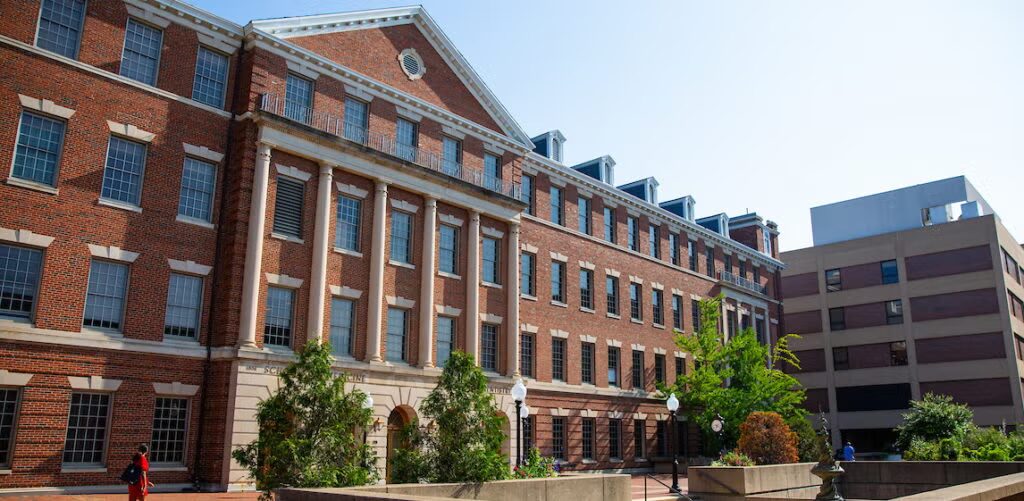
Georgetown University School of Medicine (GUSOM), located in Washington, DC, is a prestigious private medical institution that has been shaping physicians and biomedical scientists since its founding. The school operates under the Jesuit tradition of Cura Personalis (care of the whole person), emphasizing not only academic excellence but also the development of compassionate, ethical healthcare professionals.
Official Program Structure
Georgetown University School of Medicine offers a traditional 4-year Doctor of Medicine (MD) program designed to graduate physicians with a comprehensive generalist professional education. The curriculum integrates scientific, clinical, professional, and “high touch” competencies needed for patient-centered care, all guided by the values of the Georgetown community.
Location and Campus
Georgetown University School of Medicine is situated in the heart of Washington, DC, providing students with unique access to the nation’s capital and its vast healthcare infrastructure. The urban campus offers students exposure to diverse patient populations and numerous clinical opportunities across the metropolitan area.
Accreditation Status
GUSOM is fully accredited by the Liaison Committee on Medical Education (LCME), a joint organization of the American Medical Association (AMA) and the Association of American Medical Colleges (AAMC). The school has maintained continuous LCME accreditation since 1949, with its most recent reaccreditation granted in February 2019. The next accreditation review is scheduled for 2027.
Combined Degree Programs
Georgetown offers several combined degree options for students seeking additional qualifications:
- MD/PhD (Medical Scientist Training Program)
- MD/MBA (Master of Business Administration)
- MD/MPH (Master of Public Health)
Admission Requirements
Academic Prerequisites
Georgetown University School of Medicine requires applicants to complete a bachelor’s degree from an accredited institution. The following prerequisite courses are required:
Science Prerequisites:
- 2 semesters of Biology with laboratory (typically Foundations of Biology I and another biology course such as Foundations of Biology II, Genetics, Mammalian Physiology, or Microbiology)
- 2 semesters of General Chemistry with laboratory
- 2 semesters of Organic Chemistry with laboratory
- 2 semesters of Physics with laboratory
- 1 semester of Biochemistry (Biological Chemistry) – now required at many medical schools including Georgetown
Mathematics Requirements:
- 2 semesters of Mathematics (at least one semester each of calculus and statistics is recommended; AP credit can satisfy one of these courses)
Additional Requirements:
- At least 1 semester of English
GPA Requirements
Based on the 2024 entering class statistics:
- Median GPA: 3.9
- Mean Overall GPA: 3.76
While Georgetown doesn’t publish a strict minimum GPA requirement, successful applicants typically demonstrate strong academic performance with GPAs well above 3.5. The admissions committee evaluates both overall GPA and science GPA as part of their holistic review process.
MCAT Requirements
2024 Entering Class MCAT Statistics:
- Median MCAT Score: 515
- Mean MCAT Score: 513
Georgetown requires all applicants to take the MCAT and submit valid scores. The school does not accept GRE scores as a substitute for the MCAT. Most successful applicants score in the 90th percentile or higher.
Additional Testing
Georgetown does not require the CASPer test or other additional standardized assessments beyond the MCAT.
International Applicants
Georgetown has specific eligibility requirements for international applicants. To be considered for admission, international applicants must be:
- Non-citizens of the United States who are eligible for federal financial aid, including:
- Lawful permanent residents with a Permanent Resident Card
- Conditional permanent residents
- Refugees, asylees, or certain recipients of Form I-94 from DHS
- DACA recipients
- Citizens of the Republic of Palau, Marshall Islands, or Federated States of Micronesia
Note: Traditional international students (those requiring F-1 or J-1 visas) are not eligible for admission to Georgetown’s MD program.
Application Process & Timeline
Application System
Georgetown University School of Medicine participates in the American Medical College Application Service (AMCAS). All applicants must submit their primary application through AMCAS.
Key Application Deadlines (2025-2026 Cycle)
MD Program Deadlines:
- November 1, 2025: AMCAS Application deadline
- November 15, 2025: All transcripts must be received by AMCAS (not postmarked)
- December 15, 2025: Secondary Application deadline (11:59 PM EST – no exceptions) with $140 application fee
- December 15, 2025: All recommendation letters must be received by AMCAS
MD/PhD Program Deadlines:
- November 1, 2025: AMCAS Application deadline
- November 15, 2025: All transcripts and secondary application with $140 fee
- November 15, 2025: All recommendation letters must be received by AMCAS
Secondary Application
Georgetown sends secondary applications by invitation only. The secondary application fee is $140 and must be submitted by December 15, 2025, at 11:59 PM EST with no exceptions.
Letters of Recommendation
Georgetown requires letters of recommendation submitted through AMCAS. The specific number and type of letters required are detailed in their secondary application materials.
Interview Process
Georgetown conducts interviews for selected applicants. Based on recent statistics, approximately 1,053 applicants were interviewed from a pool of 14,480 applications for the 2024 entering class. Interview invitations are typically sent starting in October, with interviews conducted through the winter months.
Admission Statistics & Success Rates
Overall Acceptance Rate
Georgetown University School of Medicine is highly competitive, with an acceptance rate of approximately 1.40% based on recent data. For the 2024 entering class:
- Total Applications: 14,480
- Applicants Interviewed: 1,053
- Matriculating Class Size: 203
Class Demographics (2024 Entering Class)
- Average Age: 24 years
- Age Range: 20-45 years
- Female/Male/Decline to State: 135/67/1
- Advanced Degree Holders: 21%
- Underrepresented in Medicine (URIM): 15%
- Colleges & Universities Represented: 87
- States Represented: 28 plus the District of Columbia
- Countries Represented: 6 including the United States
Geographic Distribution
Georgetown, as a private institution, accepts students from across the United States and eligible international students. Only about 2.5% of students are from Washington, DC, meaning geographic origin does not significantly impact admission chances.
Tuition & Financial Information
Current Tuition Rates
As a private medical school, Georgetown charges the same tuition for all students regardless of residency status:
- Annual Tuition (2024-2025): $74,133
Total Cost of Attendance
The total cost of attendance includes tuition, fees, and estimated living expenses in Washington, DC. Students should budget for:
- Tuition: $74,133
- Estimated living expenses: Varies based on housing choices and lifestyle
- Health insurance, technology fees, and other mandatory fees
- Books, equipment, and clinical supplies
Financial Aid Options
Georgetown offers comprehensive financial aid support through its Office of Admissions and Financial Aid.
Need-Based Financial Aid:
- Georgetown offers institutional need-based scholarships and grants
- All students wishing to apply for need-based aid must complete:
- Georgetown School of Medicine Financial Aid Application
- FAFSA (Free Application for Federal Student Aid)
- CSS Profile
Important Financial Aid Deadlines:
- February 6, 2026: All financial aid applications must be submitted by 11:59 PM EST to be considered for institutional aid
Federal Loans:
- Students can apply for federal student loans
- Deadline for federal loans-only packages: March 1, 2026
External Scholarships:
Georgetown provides information about numerous external scholarship opportunities, including national programs, specialty-specific scholarships, and diversity scholarships.
Click To See Hundreds Of Consultants Who Can Mentor You:


Curriculum & Program Structure
Educational Philosophy
Georgetown’s medical education is guided by the Jesuit tradition of Cura Personalis (care of the whole person), integrating psychological, socioeconomic, cultural, and spiritual dimensions of health into medical training.
Medical Education Competencies
Georgetown’s curriculum is built around six core domains:
- Medical Knowledge (MK)
- Patient Care (PC)
- Interpersonal Communication Skills (ICS)
- Professionalism
- Practice-Based Learning
- Systems-Based Practice
Pre-Clinical Phase (Years 1-2)
The pre-clinical curriculum focuses on foundational sciences and early clinical exposure. Students engage in:
- Basic science courses covering anatomy, physiology, biochemistry, pathology, and pharmacology
- Integration of clinical scenarios with basic science learning
- Early patient interactions and clinical skills development
- Research opportunities and scholarly projects
Clinical Phase (Years 3-4)
Third Year Core Clerkships:
Students complete required clinical rotations in major medical specialties.
Fourth Year Requirements:
- Two Acting Internships (8 weeks total):
- One required Acting Internship in Internal Medicine Wards or Medical ICU
- One selective Acting Internship from approved specialties
- Emergency Medicine (4 weeks):
- Including ACLS certification
- Can be completed in first or second block for students interested in Emergency Medicine
- Electives (24 weeks):
- Student choice electives
- Up to 4 weeks can be used for USMLE Step 2 preparation
- Both intramural and extramural (away) rotations available
- Clinical Pharmacology (1 week):
- Typically scheduled in late April
Residency Match Performance
Georgetown students have strong residency match rates, though specific statistics vary by specialty. The school provides comprehensive career counseling and residency preparation support through its clinical advising program.
Pre-Medical Preparation
Recommended Undergraduate Preparation
Academic Foundation:
- Complete all prerequisite courses with strong grades (A’s and B’s preferred)
- Maintain a competitive overall GPA (3.7+ recommended)
- Consider additional advanced science courses beyond minimum requirements
MCAT Preparation:
- Plan to take the MCAT in your junior year or early senior year
- Aim for a score of 510+ to be competitive
- Consider retaking if initial score is below 505
Clinical Experience:
- Gain substantial clinical exposure through:
- Hospital volunteering
- Clinical research positions
- Shadowing physicians
- Healthcare-related employment
Research Experience:
- Participate in research projects (basic science, clinical, or public health)
- Consider presenting findings at conferences
- Publications are beneficial but not required
Extracurricular Activities:
- Demonstrate leadership roles
- Show commitment to community service
- Maintain involvement in meaningful long-term activities
Timeline Recommendations:
- Freshman-Sophomore Years: Complete prerequisite courses, begin clinical exposure
- Junior Year: Take MCAT, intensify clinical and research experiences
- Senior Year: Apply to medical school, complete remaining prerequisites
Frequently Asked Questions
Does Georgetown University School of Medicine look at extracurriculars?
Yes, Georgetown uses a holistic admissions approach that evaluates applicants based on academic achievements, character, maturity, and motivation. The admissions committee considers the entire academic record, MCAT performance, letters of recommendation, extracurricular activities, and personal interviews.
What is Georgetown University School of Medicine’s average GPA and MCAT score?
For the 2024 entering class:
Median GPA: 3.9 (Mean: 3.76)
Median MCAT: 515 (Mean: 513)
How competitive is Georgetown University School of Medicine compared to other medical schools?
Georgetown is extremely competitive with an acceptance rate of approximately 1.40%. This ranks it among the most selective medical schools in the United States, comparable to other top-tier private medical schools.
Does Georgetown University School of Medicine prefer in-state applicants?
No, as a private institution, Georgetown does not give preference to Washington, DC residents. Only about 2.5% of each class is from DC, and students are admitted based on merit regardless of geographic origin.
What makes Georgetown University School of Medicine different from other medical schools?
Georgetown’s distinguishing features include:
Jesuit tradition of Cura Personalis (care of the whole person)
Location in Washington, DC with access to diverse healthcare systems
Strong emphasis on ethics and service
Comprehensive support systems for student success
Combined degree program options
When should I apply to Georgetown University School of Medicine?
Applications open in early summer through AMCAS. The deadline is November 1, 2025, for the 2026 entering class. It’s recommended to submit applications early in the cycle for the best chance of consideration.
Does Georgetown University School of Medicine accept international students?
Georgetown has limited acceptance of international students. Only non-U.S. citizens who are eligible for federal financial aid can be considered, including permanent residents, refugees, DACA recipients, and citizens of certain Pacific nations. Traditional international students requiring F-1 or J-1 visas are not eligible.
What clinical experience do I need for Georgetown University School of Medicine?
While Georgetown doesn’t specify minimum clinical experience requirements, successful applicants typically have substantial healthcare exposure through volunteering, research, shadowing, or employment in healthcare settings. Quality and depth of experience matter more than total hours.
Does Georgetown University School of Medicine require research experience?
Research experience is not explicitly required but is highly valued. Georgetown evaluates research backgrounds as part of their holistic admissions approach, and most successful applicants have some research experience.
How many letters of recommendation does Georgetown University School of Medicine require?
Georgetown requires letters of recommendation submitted through AMCAS. The specific requirements are detailed in their secondary application materials and typically include letters from science faculty, non-science faculty, and clinical mentors.
What is Georgetown University School of Medicine’s curriculum like?
Georgetown offers a traditional 4-year curriculum with two years of pre-clinical study followed by two years of clinical rotations. The curriculum emphasizes integration of basic sciences with clinical medicine and includes early patient contact. The fourth year includes required acting internships and extensive elective opportunities.
Where do Georgetown University School of Medicine graduates match for residency?
Georgetown graduates match across all medical specialties at competitive residency programs nationwide. The school provides comprehensive career counseling and residency preparation support. Specific match statistics vary by graduation year and specialty choice.
How much does Georgetown University School of Medicine cost?
Annual tuition for the 2024-2025 academic year is $74,133 for all students. Total cost of attendance, including living expenses in Washington, DC, is significantly higher. Georgetown offers need-based financial aid and helps students access federal loan programs.
What financial aid is available at Georgetown University School of Medicine?
Georgetown offers need-based institutional scholarships and grants. Students can also access federal loan programs. The school provides comprehensive financial aid counseling and helps students identify external scholarship opportunities. International students are not eligible for need-based institutional aid.
Does Georgetown University School of Medicine offer interviews to all qualified applicants?
No, Georgetown uses a selective interview process. For the 2024 entering class, approximately 1,053 applicants were interviewed from a pool of 14,480 applications. Interview invitations are based on holistic review of academic credentials, MCAT scores, experiences, and personal characteristics.