
Last updated on January 9th, 2026 at 06:34 am
Program Overview & Institution Identity
Official Program Name & Location
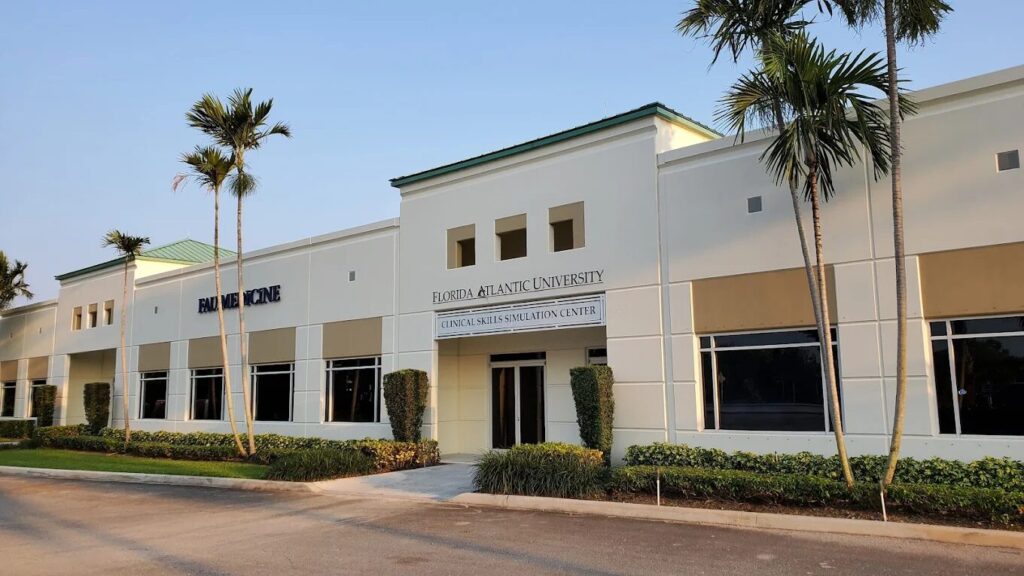
The Charles E. Schmidt College of Medicine at Florida Atlantic University is a public medical school located in Boca Raton, Florida. Situated on FAU’s vibrant urban campus, the medical school serves the culturally rich region of South Florida and beyond.
Program Duration & Structure
The Schmidt College of Medicine offers a traditional 4-year MD program following an innovative “Integrated Patient Focused Curriculum.” This curriculum is designed around the principle that future physicians should learn essential basic science information in the context of patient care, patient case studies, and clinical skills practice.
Unique Curriculum Features
- Early clinical exposure: Introduction to patients and community beginning in year 1
- Longitudinal integrated clerkships: Third-year modules with continuity relationships
- Small class size: Only 79 students per entering class, ensuring personalized attention
- Balanced learning approach: Maximum 10 hours of didactic lectures per week during pre-clinical years
- Integrated competency assessments: Throughout all four years
Accreditation Status
The program is fully accredited by the Liaison Committee on Medical Education (LCME), the nationally recognized accrediting authority for medical education programs leading to the MD degree in the United States and Canada. This accreditation ensures graduates are eligible for USMLE examinations and ACGME-accredited residency programs.
Combined Degree Programs
FAU Schmidt College of Medicine offers several dual degree options:
- MD/MBA: Business administration track
- MD/PhD: Research-focused physician-scientist training
- BS/MD: Accelerated pathway for exceptional undergraduates
Admission Requirements
Academic Prerequisites
Minimum Degree Requirements:
Applicants must hold a bachelor’s degree from an accredited institution before matriculation. While there’s no specific major requirement, students must complete prerequisite coursework demonstrating strong foundation in sciences.
Required Prerequisite Courses:
Based on MCAT content and medical school preparation standards, applicants should complete:
- Biology: Molecular biology, genetics, cell biology
- Chemistry: General chemistry and organic chemistry with labs
- Physics: One year with laboratory experience
- Mathematics: Statistics and calculus recommended
- Biochemistry: Essential for medical school success
- English: Strong communication skills required
GPA Requirements:
- Mean GPA of admitted students: 3.83
- Mean BCPM (Biology, Chemistry, Physics, Math) GPA: 3.80
- Competitive threshold: Students with GPAs below 3.0 face significant disadvantages
- The school uses holistic review, but strong academic credentials are essential
Standardized Testing
MCAT Requirements:
- Mean MCAT score: 513 (compared to national average of 511)
- Median MCAT score: 516 (highly competitive)
- Competitive range: Scores below 125 in any section significantly reduce chances
- Multiple scores: The school considers the highest score but may review all attempts
- Validity period: MCAT scores are valid for several years, but recent scores are preferred
No Additional Testing Required:
Unlike some medical schools, FAU Schmidt College of Medicine does not require CASPer testing or other situational judgment tests beyond the MCAT.
Experience Requirements
Clinical Experience:
Direct patient contact is highly valued. The admissions committee looks for meaningful clinical exposure demonstrating understanding of healthcare delivery and patient care.
Research Experience:
While not mandatory, research experience strengthens applications. The school values various types of research including basic science, clinical, and public health research.
Community Service:
Demonstrated commitment to serving others, particularly underserved communities, aligns with the school’s mission in South Florida.
Leadership Experience:
Evidence of leadership capabilities in academic, professional, or community settings.
Application Process & Timeline
Application System
FAU Schmidt College of Medicine participates in the AMCAS (American Medical College Application Service) system for primary applications.
Key Deadlines
- AMCAS Application Deadline: November 15, 2025
- Secondary Application Deadline: December 31 (strict cutoff)
- Interview Season: Mid-September through February
- Interview Days: Scheduled on Mondays, Tuesdays, and Thursdays
Application Steps
Step 1: AMCAS Application
Complete and submit the primary application through AMCAS, including:
- Transcripts from all institutions
- MCAT scores
- Work and activities descriptions
- Personal statement
- Letters of recommendation
Step 2: Secondary Application
All verified AMCAS applicants receive invitations to complete the secondary application online. The $30 non-refundable fee can be paid by credit card. Fee waivers are automatically applied for AAMC Fee Assistance Program recipients.
Step 3: Holistic Review Process
Each completed application undergoes comprehensive screening by admissions committee evaluators considering:
- Academic credentials (GPA, MCAT)
- Personal attributes and values
- Community service commitment
- Research experience
- Quality of clinical exposure
- Life experiences and diversity factors
Step 4: Interview Process
Selected applicants receive interview invitations based on screening scores. Interviews are full-day events providing comprehensive school exposure.
Required Documents
- Letters of Recommendation: Specific requirements detailed on school website
- Official Transcripts: All post-secondary institutions
- MCAT Scores: Official scores through AMCAS
- Secondary Application Essays: Reflective analyses of personal experiences
Admission Statistics & Success Rates
Overall Competitiveness
Acceptance Rate: Approximately 1.9% (79 matriculants from 4,235 applications)
This makes FAU Schmidt College of Medicine highly competitive among Florida medical schools.
Class Profile Statistics
- Total Applications Received: 4,235
- Students Matriculated: 79
- Out-of-State Students: 25% (about 20 students)
- In-State Preference: 75% Florida residents
- Students with Graduate Degrees: 15%
Academic Profile of Admitted Students
- Mean Overall GPA: 3.83
- Mean BCPM GPA: 3.80
- Mean MCAT Score: 513
- Median MCAT Score: 516
Geographic Distribution
As a public Florida institution, FAU Schmidt College of Medicine gives strong preference to Florida residents, with only 25% of seats available to out-of-state applicants. The school does consider out-of-state Canadian students on a case-by-case basis.
Comparison with Other Florida Medical Schools
FAU’s statistics are competitive within the Florida medical school landscape, with MCAT scores above national averages and selectivity comparable to other state institutions.
Tuition & Financial Information
Current Tuition Rates (2024-2025)
- In-State (Florida Residents): $31,830 per year
- Out-of-State: $67,972 per year
- International Students: Same as out-of-state rates
Additional Fees
Students should budget for additional costs including:
- Student services fees
- Technology fees
- Laboratory and equipment fees
- Health insurance (if not covered elsewhere)
- Clinical rotation expenses
Total Cost of Attendance
Beyond tuition, students need to consider:
- Living Expenses: Boca Raton housing and daily expenses
- Transportation: Clinical site travel
- Books and Supplies: Medical textbooks and equipment
- Personal Expenses: Food, entertainment, personal care
Estimated Total 4-Year Investment:
- In-State Students: Approximately $127,320 (tuition only)
- Out-of-State Students: Approximately $271,888 (tuition only)
Financial Aid Options
The College of Medicine offers comprehensive financial assistance including:
Merit-Based Scholarships:
Various scholarship opportunities for academically exceptional students
Need-Based Aid:
Federal financial aid programs including:
- Federal Direct Loans (subsidized and unsubsidized)
- Federal Grad PLUS loans
- Work-study opportunities
External Scholarships:
Students encouraged to pursue external funding sources
Financial Aid Services:
The Office of Medical Student Financial Aid provides counseling on:
- Application processes
- Budgeting and money management
- Debt management strategies
- Individual financial planning
Click To See Hundreds Of Consultants Who Can Mentor You:


Curriculum & Program Structure
Educational Philosophy
The Integrated Patient Focused Curriculum emphasizes learning basic sciences within clinical contexts, preparing students for modern medical practice through:
- Problem-based learning approaches
- Small group sessions balanced with independent study
- Clinical correlations and simulations
- Concept-focused rather than fact-memorization learning
Pre-Clinical Years (Years 1-2)
Year 1 & 2 Structure:
- Foundational Sciences: Integrated anatomy, physiology, pharmacology, pathology
- Clinical Skills: Early patient exposure and community engagement
- Weekly Schedule: Maximum 10 hours of lectures, dedicated study time, 2-3 half-days of clinical experience
- Assessment: Integrated competency evaluations
Teaching Methods:
- Problem-based learning sessions
- Laboratory experiences
- Clinical correlations
- Simulation-based learning
- Small group discussions
Clinical Years (Years 3-4)
Third Year:
- Longitudinal integrated clerkships: Continuous patient relationships
- Core rotations: Internal medicine, surgery, pediatrics, obstetrics/gynecology, psychiatry, family medicine
- Community partnerships: Training across South Florida healthcare systems
Fourth Year:
- Elective rotations: Specialty exploration
- Research opportunities: Scholarly projects
- Residency preparation: Career planning and USMLE Step 2 preparation
Residency Match Success
FAU graduates have achieved strong residency match rates, securing positions in prestigious programs across Florida and nationally. Recent Match Day celebrations highlight placements in competitive specialties and top-ranked residency programs.
Pre-Medical Preparation Guidance
Optimal Academic Planning
Undergraduate Major Selection:
While no specific major is required, successful applicants come from diverse academic backgrounds. Science majors provide strong MCAT preparation, but the school values intellectual diversity.
Course Sequencing Strategy:
- Early Years: Complete prerequisite sciences with strong performance
- Junior/Senior Years: Advanced coursework, research participation, clinical exposure
- MCAT Preparation: Plan test date allowing retake if necessary before application deadlines
Clinical Experience Development
Quality over Quantity: Seek meaningful patient interaction opportunities
Diversity of Settings: Hospital, clinic, community health experiences
Documentation: Maintain detailed records of hours and learning experiences
Long-term Commitment: Sustained involvement demonstrates genuine interest
Research Experience
Types Valued:
- Basic science research
- Clinical research
- Public health studies
- Community-based participatory research
Getting Started:
- Contact FAU faculty directly
- Explore summer research programs
- Consider gap year research positions
- Aim for presentations or publications when possible
Extracurricular Development
Leadership Opportunities:
- Student organization leadership
- Community service coordination
- Healthcare advocacy
- Mentoring programs
Service Learning:
- Community health initiatives
- Health education programs
- Volunteer clinical work
- International service experiences
Application Timeline Planning
Junior Year:
- Complete prerequisite coursework
- Begin MCAT preparation
- Develop clinical and research experiences
- Build relationships for recommendation letters
Senior Year/Post-Graduation:
- Take MCAT (spring junior year or early senior year ideal)
- Submit AMCAS application by November deadline
- Complete secondary applications promptly
- Interview preparation and participation
Frequently Asked Questions
What is FAU Schmidt College of Medicine’s average GPA and MCAT score?
The mean GPA for admitted students is 3.83 overall and 3.80 BCPM. The mean MCAT score is 513, with a median of 516, making it highly competitive.
Does FAU Schmidt College of Medicine require specific prerequisite courses?
While specific prerequisites aren’t listed, students need strong preparation in biology, chemistry, physics, mathematics, and biochemistry to succeed in the curriculum and on the MCAT.
How competitive is FAU Schmidt College of Medicine compared to other medical schools?
With an acceptance rate of approximately 1.9%, FAU is highly competitive. It’s among the more selective medical schools in Florida.
Does FAU Schmidt College of Medicine prefer in-state applicants?
Yes, as a public institution, 75% of seats go to Florida residents. Out-of-state applicants face more competition for the remaining 25% of positions.
Does FAU Schmidt College of Medicine accept international students?
The school considers international applicants, with specific consideration for Canadian students on a case-by-case basis.
When should I apply to FAU Schmidt College of Medicine?
Submit your AMCAS application well before the November 15 deadline. Early submission is advantageous as the school practices rolling admissions review.
What clinical experience do I need for FAU Schmidt College of Medicine?
While there’s no minimum requirement, meaningful direct patient contact experiences are essential. Quality and reflection on experiences matter more than total hours.
Does FAU Schmidt College of Medicine require research experience?
Research isn’t mandatory but strengthens applications significantly. The school values diverse research experiences including basic science, clinical, and community health research.
How many letters of recommendation does FAU Schmidt College of Medicine require?
Specific requirements are detailed on the school’s admissions website. Generally, letters should demonstrate academic ability, clinical readiness, and personal character.
What is FAU Schmidt College of Medicine’s curriculum like?
The Integrated Patient Focused Curriculum emphasizes early clinical exposure, problem-based learning, and small class sizes (79 students). Students begin patient contact in year 1 with longitudinal relationships continuing through training.
Where do FAU Schmidt College of Medicine graduates match for residency?
Graduates successfully match in competitive residency programs across Florida and nationally, including top-ranked institutions. Recent Match Days show placements in diverse specialties.
How much does FAU Schmidt College of Medicine cost?
Current tuition is $31,830 for in-state students and $67,972 for out-of-state students annually. Additional costs include living expenses, books, and clinical supplies.
What financial aid is available at FAU Schmidt College of Medicine?
The school offers need-based federal financial aid, merit scholarships, and work-study opportunities. The Office of Medical Student Financial Aid provides comprehensive counseling services.
Does FAU Schmidt College of Medicine offer interviews to all qualified applicants?
No, interviews are selective based on holistic review of completed applications. Meeting minimum statistics doesn’t guarantee an interview invitation.
Does FAU Schmidt College of Medicine look at extracurriculars?
Yes, the school conducts holistic review considering community service, leadership, research, clinical experience, and personal attributes equally with academic credentials.
What makes FAU Schmidt College of Medicine different from other medical schools?
Key differentiators include the Integrated Patient Focused Curriculum, early clinical exposure, small class size, strong South Florida community partnerships, and emphasis on serving diverse populations.
This guide provides comprehensive information about admissions to the Charles E. Schmidt College of Medicine at Florida Atlantic University. For the most current information, always consult the official medical school website and contact the admissions office directly with specific questions.