Last updated on January 9th, 2026 at 06:34 am
Program Overview & Institution Identity
Official Program Name and Duration
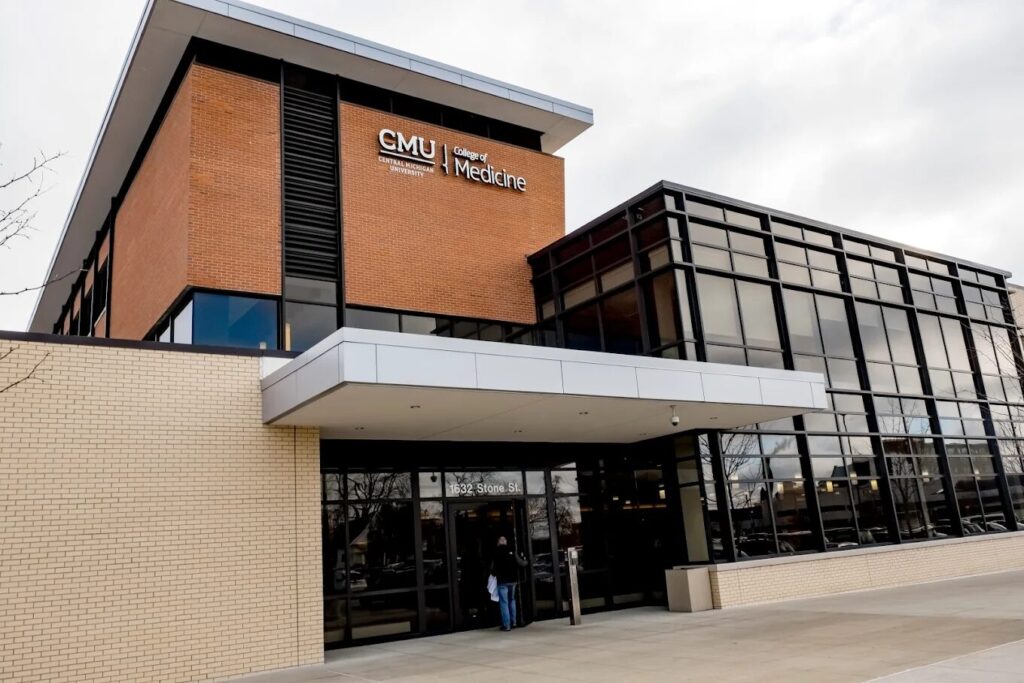
The Central Michigan University College of Medicine is a public medical school offering a traditional 4-year MD program. Located in Mount Pleasant, Michigan, with clinical training primarily in Saginaw and throughout rural and underserved areas of Michigan, the CMU College of Medicine was founded in 2013 and received full LCME accreditation in 2017.
The program follows a traditional structure with two years of pre-clinical education on the Mount Pleasant campus and two years of clinical training at affiliated hospitals and healthcare systems throughout Michigan.
Location and Campus Details
Mount Pleasant Campus: The first two years of medical education take place on Central Michigan University’s main campus in Mount Pleasant, Michigan. Students benefit from modern facilities, advanced learning technologies, and the extensive resources of a comprehensive university.
Saginaw Clinical Campus: Years three and four clinical training is primarily based in Saginaw, Michigan, with rotations at various affiliated hospitals and healthcare systems. The rural and community-based focus aligns with the school’s mission to serve underserved populations.
Accreditation Status
The CMU College of Medicine holds full accreditation from the Liaison Committee on Medical Education (LCME), the nationally recognized accrediting body for MD programs in the United States. This accreditation ensures graduates are eligible to take the USMLE examinations and apply for residency training programs.
Mission and Unique Features
The school’s mission is to “prepare physicians focused on improving access to high quality health care in Michigan with an emphasis on rural and medically underserved regions.” This mission is reflected in several unique curricular features:
- Comprehensive Community Clerkship (CCC): A 16-week longitudinal integrated clerkship in primary care, primarily in rural or urban underserved areas
- Rural health focus: Strong emphasis on training physicians for rural and underserved communities
- Community partnerships: Extensive clinical partnerships throughout Michigan
Ranking and Recognition
While specific US News rankings were not available in the current data, the CMU College of Medicine has achieved notable recognition:
- 100% residency match rate for the Class of 2025 (second consecutive year)
- Over 50% of graduates remain in Michigan for residency training
- 74% of students pursue primary care specialties, aligning with the school’s mission
Admission Requirements
Academic Prerequisites
Minimum Degree Requirements
- Bachelor’s degree from an accredited institution
- Strong record of academic performance across diverse coursework
- No specific major requirement – the school encourages students from varying academic backgrounds
Required Courses
Basic Science Requirements (Minimum):
- Two semesters of biological science courses with laboratory sections (courses such as anatomy, biology, genetics, physiology, and microbiology fulfill this requirement)
- Two semesters of organic chemistry with at least one laboratory OR one semester of organic chemistry and one semester of biochemistry with at least one laboratory section
Additional Coursework Recommendations
The admissions committee expects competitive applicants to demonstrate academic strength in the following areas:
- Biochemistry
- Genetics
- Human anatomy
- Human physiology
- Mathematics or statistics
- Organic chemistry
- Physics
- Social sciences
GPA Requirements
- Minimum GPA: 3.25 overall GPA required
- Median GPA of admitted students: 3.84 (2024 entering class)
- Competitive range: Most successful applicants have GPAs significantly above the minimum
- The school considers both overall GPA and science GPA in their holistic review process
Standardized Testing
MCAT Requirements
- MCAT required: All applicants must submit MCAT scores
- Median MCAT score: 508 for the 2024 entering class
- Score validity: MCAT scores taken within the last 3 years are accepted
- Latest acceptable test date: September test date for the current application cycle
- Retake policy: If students have multiple MCAT scores, the school will use the set of scores with the highest overall score
Additional Testing
No additional standardized testing (such as CASPer) is required for admission to CMU College of Medicine.
Extracurricular Activities & Experience Requirements
Clinical Experience Requirements
- Minimum requirement: 200 hours of documented, medically-related experience
- Types of experience: These experiences should provide understanding of physician roles in clinical and community settings, patient and population health issues, and healthcare team function
- Acceptable experiences: Both volunteer and paid medical clinical experiences fulfill this requirement
Holistic Evaluation Criteria
The admissions committee evaluates applicants on multiple personal characteristics including:
- Compassion for others
- Altruism
- Preparation for medicine
- Communication skills
- Leadership abilities
- Personal maturity
- Cultural competence
- Integrity
- Reliability
- Positive work habits
- Adaptability
- Teamwork
- Self-discipline
- Resilience and persistence
- Logic and critical thinking skills
State Residency Preferences
As a public institution, CMU College of Medicine shows strong preference for Michigan residents:
- 2024 entering class: 82 Michigan residents out of 104 total students (79%)
- Out-of-state students: 20 students (19%)
- International students: 2 Canadian residents (2%)
Application Process & Timeline
Application System
The Central Michigan University College of Medicine uses the American Medical College Application Service (AMCAS) for primary applications. All applicants must submit their initial application through AMCAS.
Application Deadlines
- Primary Application Deadline: November 1, 2025
- MCAT Deadline: September test date scores must be received before the primary application deadline
- Transcript Deadline: All transcripts must be submitted through AMCAS by the primary deadline
Required Documents
Letters of Recommendation
- Minimum: 3 letters of recommendation (or 1 committee letter)
- Maximum: 5 letters of recommendation
- Requirements: Each letter must be written by someone who knows the applicant through a professional relationship and has firsthand knowledge of their qualifications
- Submission: All letters must be submitted through the AMCAS Letter Service
Personal Statement and Essays
The application includes the standard AMCAS personal statement plus school-specific secondary application essays.
Secondary Applications
- Selection process: Only select applicants receive secondary application invitations
- Secondary application fee: $100 (waived for AMCAS fee waiver recipients)
- Timeline: Secondary applications are sent after primary applications are received
- Recommended turnaround: Submit within 2 weeks of receiving the invitation
Interview Process
Interview Format and Statistics
- Interview format: Virtual interviews (as of the 2023 cycle)
- Interview invitations: Approximately 477 applicants interviewed out of 7,529 total applicants (6.3% interview rate)
- Interview season: August through March
- Interview style: Traditional interview format with faculty and student interviewers
Post-Interview Process
- Acceptance timeline: Decisions are made on a rolling basis from December through March
- Waitlist procedures: Applicants may remain on a waitlist until the start of the academic year
- Deposit requirements: Accepted students must submit deposits according to AMCAS deadlines
Admission Statistics & Success Rates
Overall Acceptance Rate
Acceptance Rate: Approximately 1.38% based on 2024 data
- Total applicants: 7,529 (2024 cycle)
- Students interviewed: 477 (6.3% of applicants)
- Students matriculated: 104
- Post-interview acceptance rate: Approximately 22% (104 accepted from 477 interviewed)
Class Size and Demographics
Class Profile (2024 Entering Class)
- Total class size: 104 students
- Gender distribution: 68 female (65%), 36 male (35%)
- Average age: 24 years
- Age range: 20-40 years
- Students with advanced degrees: 13 students
- Underrepresented in medicine: 10%
Geographic Distribution
- Michigan residents: 82 students (79%)
- Out-of-state students: 20 students (19%)
- Canadian residents: 2 students (2%)
- States with highest representation: California (4), Illinois (4), Florida (3), New York (2)
Academic Statistics
- Median GPA: 3.84
- Median MCAT: 508
- Undergraduate institutions represented: 41 schools
- Michigan institutions represented: 13 schools
Comparison with National Averages
The CMU College of Medicine is highly competitive, with acceptance rates significantly below national averages for public medical schools. The median MCAT of 508 places the school in the competitive range nationally.
Tuition & Financial Information
Current Tuition Rates (2025-26 Academic Year)
Tuition by Residency Status
- Michigan residents: $47,710 per year
- Out-of-state students: $70,793 per year
- Fees: $175 per year (both resident and non-resident)
Total Cost of Attendance (2025-26)
For Michigan Residents
- Tuition: $47,710
- Fees: $175
- Living expenses: $18,032
- Transportation: $4,743
- Computer supplies and equipment: $1,800
- Miscellaneous personal expenses: $1,000
- Loan fees: $1,835
- Total Cost of Attendance: $75,295
For Out-of-State Students
- Tuition: $70,793
- Fees: $175
- Living expenses: $18,032
- Transportation: $4,743
- Computer supplies and equipment: $1,800
- Miscellaneous personal expenses: $1,000
- Loan fees: $2,820
- Total Cost of Attendance: $99,363
Program Length Cost Analysis
- 4-year total cost (Michigan residents): Approximately $301,180
- 4-year total cost (out-of-state): Approximately $397,452
- Additional costs: First-year students have higher computer and equipment costs (~$2,800)
Financial Aid Options
Federal Financial Aid
- Students are eligible for federal loan programs including Direct Unsubsidized Loans and Grad PLUS loans
- FAFSA must be completed annually
- CMU school code: 002243
Scholarships and Grants
- Merit-based scholarships available through the university
- Need-based aid programs
- Scholarship Universe platform opens February 3, 2025, for incoming students
- Application deadline for scholarships: April 4, 2025
Living Expenses
The cost estimates assume off-campus living arrangements. Mount Pleasant offers a relatively affordable cost of living compared to major metropolitan areas, helping to keep overall expenses manageable.
Click To See Hundreds Of Consultants Who Can Mentor You:
Curriculum & Program Structure
Program Duration and Structure
The CMU College of Medicine follows a traditional 4-year MD program structure:
- Years 1-2: Pre-clinical education (Mount Pleasant campus)
- Years 3-4: Clinical education (primarily Saginaw and affiliated sites throughout Michigan)
Educational Philosophy and Teaching Methods
Pre-Clinical Curriculum (Years 1-2)
The curriculum is based on adult, self-directed learning methodologies and features:
Integrated Systems-Based Learning:
- Traditional disciplines (anatomy, biochemistry, genetics) are studied in integrated fashion
- Patient presentation approach to learning
- Systems-based organization rather than discipline-specific courses
Teaching Methodologies:
- Small group, case-based discussions
- Interactive team-based learning (TBL)
- Active lectures
- Laboratory experiences
- Longitudinal clinical skills course with standardized patients
New StAGES Curriculum:
The Student-centered curriculum for Academic Growth, Engagement, and Success (StAGES) was implemented for the class starting fall 2024:
- More thoughtful transition to medical school
- Improved content alignment
- Evidence-based teaching methodologies
- Emphasis on active learning in team atmosphere
Year 1 Course Sequence
- Introduction to Human Structure: 6 weeks
- Cellular and Molecular Principles of Medicine: 4 weeks
- Hematopoietic, Lymphatic, and Immune Systems: 4 weeks
- Cardiovascular System: 4 weeks
- Respiratory System: 4 weeks
- Renal and Genitourinary Systems: 4 weeks
- Gastrointestinal System: 4 weeks
- Endocrine System: 4 weeks
- Reproductive System: 4 weeks
- Musculoskeletal System and Rheumatology: 4 weeks
Clinical Training (Years 3-4)
Third Year Requirements
Required Clerkships (each 4-8 weeks):
- Hospital Medicine (Internal Medicine)
- Surgery
- Pediatrics
- Psychiatry
- Obstetrics and Gynecology
- Comprehensive Community Clerkship (CCC): 16-week longitudinal integrated clerkship in primary care
Comprehensive Community Clerkship (CCC):
- Unique 16-week longitudinal integrated primary care experience
- Located primarily in rural or urban underserved areas of Michigan
- Features longitudinal patient care
- Focuses on access to care challenges
- Aligns with school’s mission to serve underserved populations
Fourth Year Requirements
- Emergency Medicine: 4-week rotation
- Sub-internship: Required 4-week advanced clinical experience
- Elective rotations: 28 weeks of electives
- Total electives available: Over 60 different elective opportunities
Grading System
- Years 1-2: Credit/No Credit
- Years 3-4: Credit/No Credit or Credit with Honors
Special Programs and Opportunities
Combined Degree Programs
- MD/MBA: Available for students interested in healthcare administration and business
Research Opportunities
- Research electives available throughout the curriculum
- Scholarly project requirements
- Faculty mentorship in various research areas
International and Away Rotations
- Participation in AAMC Visiting Student Learning Opportunities (VSLO) network
- Up to 12 weeks of “away” elective clerkships at institutions nationwide
- International learning opportunities through CMU’s Office of Study Abroad
Residency Preparation
- Match Rate: 100% for Class of 2025 (second consecutive year)
- Primary Care Focus: 74% of graduates pursue primary care specialties
- Geographic Distribution: Over 50% remain in Michigan for residency
- USMLE Support: Comprehensive preparation and support for board examinations
Pre-Medical Preparation
Undergraduate Program Recommendations
Academic Major Flexibility
The CMU College of Medicine encourages students from diverse academic backgrounds:
- No preferred undergraduate major
- Value breadth of experience and diverse perspectives
- Encourage personal interests to guide major selection
- Strong performance in prerequisite courses more important than specific major
Academic Planning Strategy
Optimal Course Sequencing:
- Complete basic sciences early to allow time for MCAT preparation
- Consider taking advanced science courses beyond minimums
- Include coursework in social sciences and humanities
- Plan for prerequisites to be completed before MCAT testing
GPA Optimization:
- Focus on strong performance in science prerequisites
- Consider academic workload balance
- Seek academic support resources when needed
- Maintain consistent performance across all coursework
Clinical Experience Planning
Meeting the 200-Hour Requirement
Types of Clinical Experience Valued:
- Hospital volunteering
- Clinical shadowing with physicians
- Medical scribe positions
- Emergency medical technician (EMT) work
- Clinical research with patient contact
- Community health work
Quality vs. Quantity Focus:
- Meaningful, sustained experiences preferred over brief exposures
- Understanding of healthcare team dynamics important
- Exposure to underserved populations valuable
- Reflection on experiences through essays and interviews
Research Experience Recommendations
Research Background Evaluation
- Research experience valued but not required
- Types of research: Basic science, clinical, public health, health services
- Publications helpful but not necessary
- Focus on learning experience and skill development
Research Planning
- Consider summer research programs
- Seek mentorship from faculty
- Present research at conferences when possible
- Understand research methodology and findings
Extracurricular Activity Planning
Building a Well-Rounded Profile
Community Service and Volunteering:
- Long-term commitment preferred over brief activities
- Focus on underserved populations aligns with school mission
- Leadership roles within volunteer organizations valued
Leadership Development:
- Student government participation
- Organization leadership positions
- Community leadership roles
- Teaching and mentoring experiences
Standardized Test Preparation
MCAT Planning
Study Timeline Recommendations:
Plan for potential retake if necessary
Begin preparation 3-6 months before test date
Take practice exams under timed conditions
Consider prep courses or tutoring if needed
Plan for potential retake if necessary