Table of Contents
If the Personal Statement is the “soul” of your application, the Letters of Recommendation (LORs) are the “proof.”
As we hit March 2026, you are entering the highest-leverage window for securing your letters. Professors are finalizing their spring syllabi, physicians are dealing with spring break shifts, and your peers are all about to flood their inboxes with requests. If you wait until May, you aren’t just late—you’re asking a burnt-out professor to do you a favor during finals week.
In this guide, we’ll break down the 2026 strategy for building a “letter squad” that doesn’t just say you’re a good student, but convinces admissions committees that you are a future colleague.
The Hierarchy: Committee Letter vs. Individual Letters
Before you send a single email, you must check your undergraduate institution’s Pre-Health Advising website. U.S. medical schools have a very specific “ranking” for how they want to receive your letters.
- The Committee Letter (Gold Standard): If your school offers a Pre-Health Committee letter, use it. This is a composite document written by your advisors that summarizes your entire undergraduate career and includes your individual letters as attachments. Bypassing this when it’s available is a “yellow flag” to admissions committees—they will wonder why your own school didn’t want to officially vouch for you.
- The Letter Packet: Some schools don’t write a summary but will “bundle” your individual letters together and send them as a single file. This is also highly preferred.
- Individual Letters: If your school does not have a committee (common at many large state universities), you will simply upload your letters individually to the AMCAS, AACOMAS, or TMDSAS portals.
Building Your “Letter Squad”: Who to Ask?

Most MD programs in the U.S. expect a “standard” set of 3 to 5 letters. While AMCAS (MD) allows for a maximum of 10 letters, For the 2026–2027 cycle, AACOMAS has finally aligned with AMCAS by increasing its evaluation limit to 10 letters. This is a significant change from previous years, where DO applicants were capped at 6.. Quality always beats quantity, but knowing your “roster” is essential. Here is the ideal roster:
The Science Faculty (2 Letters)
You need two letters from professors who taught you in BCPM courses (Biology, Chemistry, Physics, or Math).
- The Goal: To prove you can handle the academic “firehose” of medical school.
- Strategy: Don’t just ask the professor of the class where you got an A+. Ask the professor of the class where you struggled, went to office hours, and eventually succeeded. That narrative of resilience is worth more than a “top of the class” generic note.
The Non-Science Faculty (1 Letter)
This could be from a Humanities, Social Science, or even an Arts professor.
- The Goal: To show you are a well-rounded human with “soft skills.”
- Strategy: Admissions committees want to see that you can communicate, think critically, and empathize—skills often better observed in a discussion-heavy English or Sociology course than in a 400-person Organic Chemistry lecture.
The Clinical/Physician Letter (1 Letter)
This is non-negotiable for DO schools (usually requiring a letter from a DO) and highly recommended for MD schools.
- The Goal: To confirm you know what being a doctor actually looks like.
- Strategy: If you’ve shadowed or worked as a scribe/MA, this letter should focus on your bedside manner and your ability to remain professional in a clinical environment.
The “X-Factor” Letter (Optional)
This is from a Research PI, a Volunteer Coordinator, or a former Boss.
- The Goal: To highlight your leadership, work ethic, or specific unique talents.
Click to see hundreds of consultants who can mentor you:
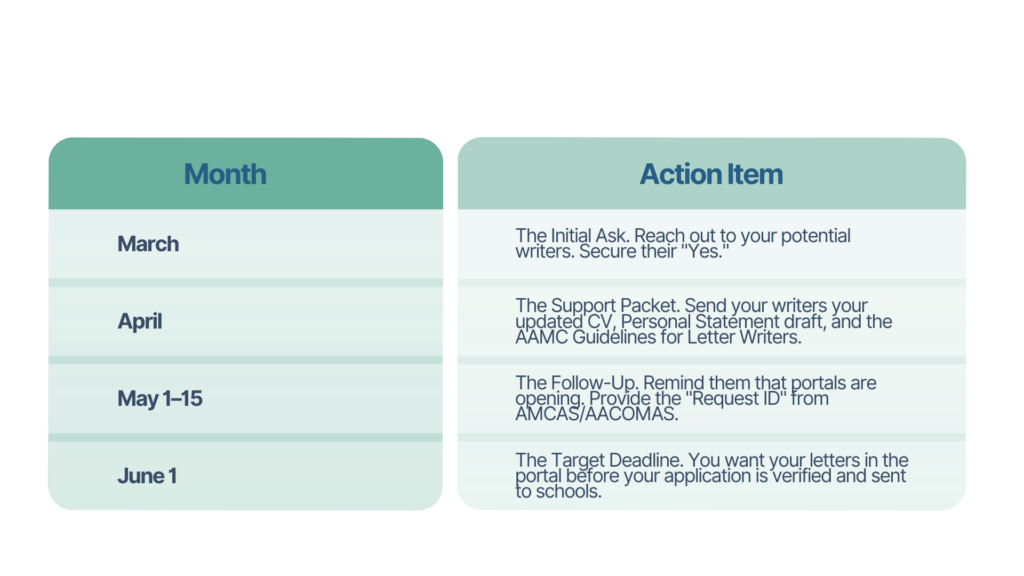
The 2026 Timeline: From “Ask” to “Upload”
How to Ask (Without Being Cringe)
The “Ask” should ideally happen in person or via a scheduled Zoom call. In 2026, many professors still prefer a face-to-face (even digital) connection before committing.
The “Script”
Don’t just ask: “Can you write me a letter?” Ask: “Would you feel comfortable writing me a strong letter of recommendation for my medical school application?”
That word “strong” is your protection. If a professor hesitates, it’s a gift—it means they can’t write you a great one, and you’re better off finding someone else.
The “Letter Packet” for Writers
Once they say yes, make their life easy. Send them a single PDF containing:
- Your Resume/CV.
- Your Personal Statement (Draft is fine).
- A “Reminder Sheet”: Remind them which class you took with them, what grade you got, and one specific project or conversation you had that stood out.
- AAMC Guidelines: Provide the AAMC Guidelines for Writing a Letter of Evaluation. This helps them focus on the 15 Core Competencies schools care about.
Click to see hundreds of consultants who can mentor you:

Technology Tools: Interfolio vs. The Portals
In 2026, you have two main ways to manage your letters:
- Interfolio (Recommended): This is a “dossier” service. Your writers upload their letters here once, and Interfolio keeps them on file. You can then “deliver” them to AMCAS, AACOMAS, and TMDSAS.
- Pro: They check for “red flags” like missing signatures or lack of official letterhead.
- Con: There is a small annual fee.
- Direct Upload: You generate a “Letter Request Form” in the application portal (AMCAS, etc.) and email it to your writer. They upload it directly to the AAMC/Liaison server.
- Pro: Free.
- Con: If the writer forgets the signature or letterhead, you won’t know until the school rejects the letter weeks later.
Your Next Step
Securing your “Yes” from writers is the priority this week. Once you’ve sent those initial emails, the next big hurdle is the Work and Activities section—where you’ll need to turn your 1,000+ hours of clinical work into 700-character stories.
Frequently
Asked Questions about
Letters of Recommendation
YES. Always. If you do not waive your right (via the FERPA waiver), admissions committees will assume the letter is “biased” because the writer knew you would see it. A non-confidential letter carries almost zero weight.
In 2026, it is common for a TA to write the letter if they know you better, but it must be co-signed by the lead Professor. A letter signed only by a grad student is often not accepted as a “Science Faculty” letter.
Don’t panic. You can submit your primary application without your letters. They are not required for the “Verification” process. However, your application will not be considered “Complete” by individual schools until the letters arrive, which usually happens in July when secondaries are sent out.
For the 2026–2027 cycle, letters should ideally be dated between 2024 and 2026. If you have a letter from 2022, reach out to the writer and ask them to “re-date” it and update any minor details.