

Last updated on January 9th, 2026 at 06:34 am
Table of Contents
What is Casper?

To have a successful Casper preparation, you need to understand what the test is. Casper, which stands for Computer-based Assessment for Sampling Personal Characteristics, is an innovative situational-judgement test (SJT) developed by Acuity Insights (originally called Altus Assessments). It was initially used by Canadian medical schools during the admissions process, including McMaster University, Queen’s University, and the University of Ottawa, in addition to the application submitted through the Ontario Medical School Application Service (OMSAS), to evaluate the personal and professional reasoning skills of medical school applicants. It has since expanded to many non-medical specialties (e.g. dentistry, veterinary medicine) and is now spread out through the United States and the world!
It is an online, open-response situational judgment test that measures core competencies such as collaboration, communication, empathy, ethical decision-making, problem-solving, self-awareness, resilience, and professionalism. The Casper test is designed to go beyond academic achievements and examine the interpersonal and emotional intelligence of applicants. It assesses how well individuals respond to challenging situations and hypothetical scenarios to evaluate their suitability for medical school and a career in medicine.
2025/26 CASPER FORMAT (NEW)
High-level changes effective as of 2025-2026:
- Total test time now approximately 65–85 minutes (about a 20% reduction).
- Total scenarios reduced to 11: 4 video-response and 7 typed-response.
- Each scenario now has only 2 questions (typed scenarios formerly had 3).
- Typed questions are scored individually (previously one aggregate per scenario).
- Typed response time decreased to 3.5 minutes for the 2 questions (was 5 minutes for 3).
- Video response timing remains 1 minute per question (no change noted).
- Expect a brief mid-test break (verify on test day).
Previously there were 14 scenarios split across video and typed sections with video scenarios followed by two questions and typed scenarios by three questions, taking approximately 90–110 minutes including optional breaks.
The test is divided into two sections: the first is a video response section where you will now be presented with four scenarios with each scenario having two open-ended questions where you will be given a minute to record yourself verbally responding to each. The second section is a typed response section where you will be presented with seven scenarios each having to open-ended questions presented on the same page and you have to type your answers. You now allocate 3.5 minutes total for two written answers instead of 5 minutes for three, demanding faster structuring without sacrificing empathy or ethical clarity.These were recent changes in 2025-2026 from the previous year!

The number of Casper scenarios has been reduced for 2025-2026. Source: Acuity Insights 2025/2026
WHY THE NEW FORMAT MATTERS STRATEGICALLY
1. Greater Weight per Response
Fewer scenarios plus per-question scoring in typed sections means each typed answer now exerts a clearer, isolated influence (previously three typed answers funneled into one score).
2. Compressed Typed Timing
You now allocate 3.5 minutes total for two written answers instead of 5 minutes for three, demanding faster structuring without sacrificing empathy or ethical clarity.
3. Precision Over Preamble
Limited time heightens the need to start with a direct, action-oriented opening sentence that names the core issue and stakeholders.
4. Distinct Answers
Because each typed question is scored independently, avoid blending content meant for one across both; treat them as separate micro-prompts, each with its own clear structure.
5. Carryover of Video Cadence
Verbal responses still emphasize concise, empathic organization within one minute.
6. Typing Efficiency Still Leverage
Improving typing accuracy and speed preserves cognitive bandwidth for higher-order reasoning under tighter constraints.
The Quartiles
The Casper uses a unique scoring system known as quartiles, with the fourth quartile being the highest ranking you can get. Applicants will only know their quartile ranking and not their raw score. You will know, once you get the score, which of the quartiles you are in:
- 1st quartile – your score is in the 0-24 percentile in comparison to your peers
- 2nd quartile – your score is in the 25-49 percentile in comparison to your peers
- 3rd quartile -your score is in the 50-74 percentile in comparison to your peers
- 4th quartile -your score is in the 75-100 percentile in comparison to your peers.
Click to see hundreds of consultants who can mentor you:


Preparing for Casper
Since Casper is known for its ability to assess personal and professional reasoning skills, many applicants wonder if it is possible to prepare for this unique test. The answer is yes. Although Casper is designed to evaluate one’s interpersonal and emotional intelligence, there are several strategies that can help applicants perform their best on the test.
Understanding What the Casper Test is Assessing
The first step to preparing for the Casper test or any other SJT is understanding what exactly the test is assessing. The Casper is a situational-judgement test and is thus a psychological evaluation that assesses a candidate’s interpersonal skills, ethical conduct, critical thinking, and communication abilities. It aims to assess the personal characteristics, like emotional intelligence and social intelligence, that are crucial for success in the medical field.
The Casper test differs from more traditional academic assessments like the MCAT; while tests such as the MCAT primarily assesses knowledge and academic aptitude, the Casper test focuses on assessing non-academic qualities that are essential for success in the medical field. As such, the process of preparing for the Casper test will look very different from the process of preparing for academic examinations.
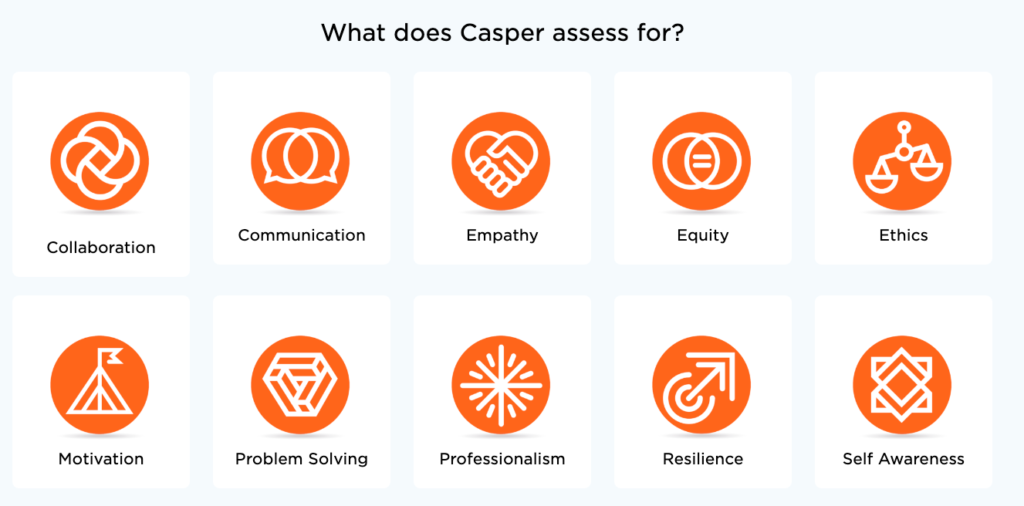
These are all the non-academic qualities that Casper tests according to Acuity Insights. Source: Acuity Insights.
You can see above all the different non-academic qualities that the Casper tests. For example, the SJT evaluates an applicant’s ethical conduct. It presents hypothetical situations or scenarios that require candidates to make decisions based on ethical principles. This helps assess their ability to approach challenging situations with integrity, considering the best interests of all stakeholders involved. In addition, the Casper test evaluates communication skills.
It assesses how effectively candidates can express their thoughts, ideas, and opinions in a concise and coherent manner. This is essential for healthcare professionals who must effectively communicate with patients, colleagues, and other stakeholders. That said, it is worth noting that raters are asked not to evaluate test takers’ grammar or spelling on the typed response section, given the time constraints of the test.
One of the key competencies that the Casper test assesses is emotional intelligence. It combines several of the qualities above (e.g. empathy, self-awareness, and communication). It evaluates an applicant’s ability to perceive, understand, and manage their own emotions, as well as effectively recognize and respond to the emotions of others. This is essential for healthcare professionals (MDs, RNs, pharmacists, etc.) who need to establish strong relationships and provide empathetic care to their patients.
Familiarizing Yourself with the Format
Before taking the Casper test, it is crucial to familiarize yourself with its format. Understand the differences between the video-based and text-based sections. The video-based scenarios involve watching a short video where actors portray real-life situations. After watching the video, you will be presented with two open-ended follow-up questions to answer.
The text-based scenarios, on the other hand, consist of written prompts that describe a hypothetical situation or ethical dilemma. After reading these prompts, you are expected to answer a series of two questions. The Casper test progresses from one scenario to the next automatically, so you will not need to manually navigate between webpages.
Familiarizing yourself with the format of the Casper test is crucial to ensure a smooth experience on test day. Being comfortable with the video-based and text-based scenarios, understanding the time constraints, and being familiar with the online platform can eliminate uncertainties and help calm your nerves. By preparing ahead and becoming acquainted with the Casper test format, you can improve your overall performance on test day and showcase your skills effectively.
Practice, Practice, Practice

PrepMatch is the best free resource for Casper prep! Image source: PrepMatch.com
Ultimately, the best way to prepare for the Casper test is to practice. As the test assesses emotional intelligence and interpersonal skills, practicing different scenarios and questions can greatly improve your test-taking skills and help you get used to employing critical thinking skills within tight time constraints. Here are some ways that you can practice and enhance your performance on the Casper test:
Take the official practice test: The Altus account provides a practice test that closely mimics the actual Casper test. Taking this practice test allows candidates to become familiar with the test format, time limits, and the types of questions they can expect. It is an excellent opportunity to practice analyzing scenarios and formulating clear answers.
Complete practice questions: PrepMatch.com is a website offers sample Casper questions that can be used for practice. It is absolutely FREE! These practice questions cover a range of scenarios and ethical dilemmas, helping candidates build critical thinking and decision-making skills. Answering these practice questions can offer valuable insights into the type of responses that are expected. PrepMatch has a community of raters who give you feedback on your answers. You can also give feedback on the answers of peers to help you think like a reviewer. We have also developed a list of free Casper scenarios that you can check out here!
Simulate testing conditions: Replicate test conditions by setting a time limit for practicing questions. Use online resources with timed practice questions or create your own scenarios to address. To practice for the video response section, record yourself and watch the recordings to evaluate your performance and identify weaknesses you’d like to address. This simulation helps candidates develop the ability to think quickly and respond effectively under pressure.
Brainstorming experiences ahead of time: When preparing for the Casper assessment, it’s crucial to brainstorm and identify experiences ahead of time that you can reflect upon during the test. Casper may ask questions like “Talk about a time when you worked with someone you didn’t get along with,” so having relevant experiences in mind will help you provide a well-rounded response.
A good rule of thumb is to have at least two experiences for the following roles: “Communicator”, “Collaborator”, “Leader”, “Health Advocate”, “Scholar”, “Professional”. These are the roles that every healthcare professional must have (famously known as the “CanMED” roles across Canadian medical schools). This will ensure that you can showcase a variety of skills and competencies that are important to professional schools.
Remember to include both positive experiences, such as times when you got along well with someone, and negative experiences, such as times when you faced challenges working with others. There’s often not enough time to think of experiences during Casper so having those experiences in your mind ahead of time will allow you to be ahead of the game.
In addition to practicing scenarios and questions, it is crucial to work on your typing skills. The Casper test requires candidates to provide typed responses within very strict time constraints, so practicing typing accurately and efficiently is essential. Improving typing speed can greatly impact the depth and quality of the responses candidates are able to provide during the test.
Click to see hundreds of consultants who can mentor you:


The Importance of Emotional Intelligence

Emotional intelligence not only plays a critical role in the Casper test, it is also essential for success in any healthcare profession. The healthcare field involves constant interactions with patients, colleagues, and other stakeholders. Understanding others, empathizing with their emotions and experiences, and building strong personal and professional relationships are vital skills for a successful career in medicine. By focusing on developing emotional intelligence during Casper preparation, individuals are not only increasing their chances of performing well on the test, but also preparing themselves for the emotional demands of the medical profession.
How do you develop emotional intelligence for Casper or other SJTs over the span of a few weeks? Here are some of our tips:
- Try to do some self-reflection on biases and dynamics in your life. When considering the scenarios in Casper, reflecting on personal power dynamics can be helpful. For example, if being an employee that needs to challenge their manager is present in a scenario, consider your own experiences with bosses. Understanding the difficulty of standing up to authority can provide clarity when providing answers.
- Make sure to practice writing that demonstrates your emotional intelligence. By constantly directly mentioning certain concepts and buzzwords, the reviewer will know that you are using your emotional intelligence in the scenario. Here are some examples:
- Demonstrating empathy- “I understand the challenges that Bill is undergoing in the scenario may make it hard for him to confront his friend”
- Demonstrate supportive language– some buzzwords statements include “I want to be non-judgemental when approaching the situation”, “I want to make sure I express to Priya that I support her no matter what she decides”, “I want to balance the needs of all characters”, “I want to make sure I am actively listening”
- Demonstrating respect for diversity, equity, and inclusion- “I want to consider all individuals involved in the scenario”, “I need to provide culturally-sensitive care”
- Participate in role-playing exercises to simulate challenging scenarios and practice appropriate responses. By using PrepMatch, you are going to encounter lots of opportunities to express emotional intelligence in your answers. You can share your answers with individuals who have done well on Casper (e.g. such as our AcceptedTogether consultants!) and directly ask them to comment on how you express emotional intelligence in your answers.
Whether you are writing your Casper for Canadian medical schools (e.g. OMSAS schools, Dalhousie, etc.), American medical schools, RN programs, or any of the other programs that require it, we wish you to reach the sought-after 4th quartile!
If you wish for some Casper coaching, don’t hesitate to reach out to any of our AcceptedTogether consultants by clicking here. Our consultants can work with you to help you figure out how to perform your best when test day comes.