Last updated on April 8th, 2026 at 06:38 am
Table of Contents
TL;DR: The 2026 AADSAS Summary
- Key Launch Dates: Portal opens for data entry on May 12, 2026; Official submission begins June 2, 2026.
- New DAT Scale: As of March 2025, the DAT has moved to a 200–600 scale (10-point increments).
- The “Rule of 6”: You must designate exactly 6 “Most Important” experiences from your total list.
- Letter Update: Evaluators must now complete a Likert-scale rating on 10 core competencies in addition to the traditional narrative letter.
- Experience Categories: There are now 8 distinct types, including a new specific split for Virtual vs. In-Person Shadowing.
Why the 2026–2027 Dental Application Cycle is a New Frontier
As we approach the launch of the 2026–2027 ADEA AADSAS (Associated American Dental Schools Application Service) cycle, the landscape of dental admissions has undergone its most significant technical shift in a decade. Admissions committees are no longer just filtering for high GPAs; they are leveraging new data points like structured letter evaluations and a more precise DAT scoring scale to identify “clinically ready” candidates.
For applicants, this means your primary application cannot just be a “resume dump.” It must be a strategically curated portfolio. In this masterclass, we will deconstruct every quadrant of the AADSAS portal to ensure your application is verified, competitive, and submitted before the first wave of interviews in August.
The 2026 Critical Timeline: “Rolling Admissions” is Your Best Friend
In dentistry, Timing = Probability. Most dental schools operate on a rolling basis, meaning they review applications as they arrive. If you apply in June, you are competing for 100% of the available interview seats. By September, you might be competing for the final 10%.
May 12, 2026: The “Soft Launch”
The portal opens this day for Data Entry Only. You cannot submit yet, but you should treat this as your “prep month.”
- Transcript Clearing: Order your official transcripts immediately. AADSAS cannot begin the 2–4 week verification process until every single transcript from every college you’ve attended (including dual-enrollment in high school) is received.
- The “Verified” Advantage: Most successful applicants to Top 20 programs (like UPenn or Harvard) are “Verified” by July 1st.
June 2, 2026: The “Submission Gate”
This is the first day you can click “Submit.” You do not need your DAT scores or all your letters to be “in” to submit. As long as your transcripts are in the system, you should submit to enter the verification queue.
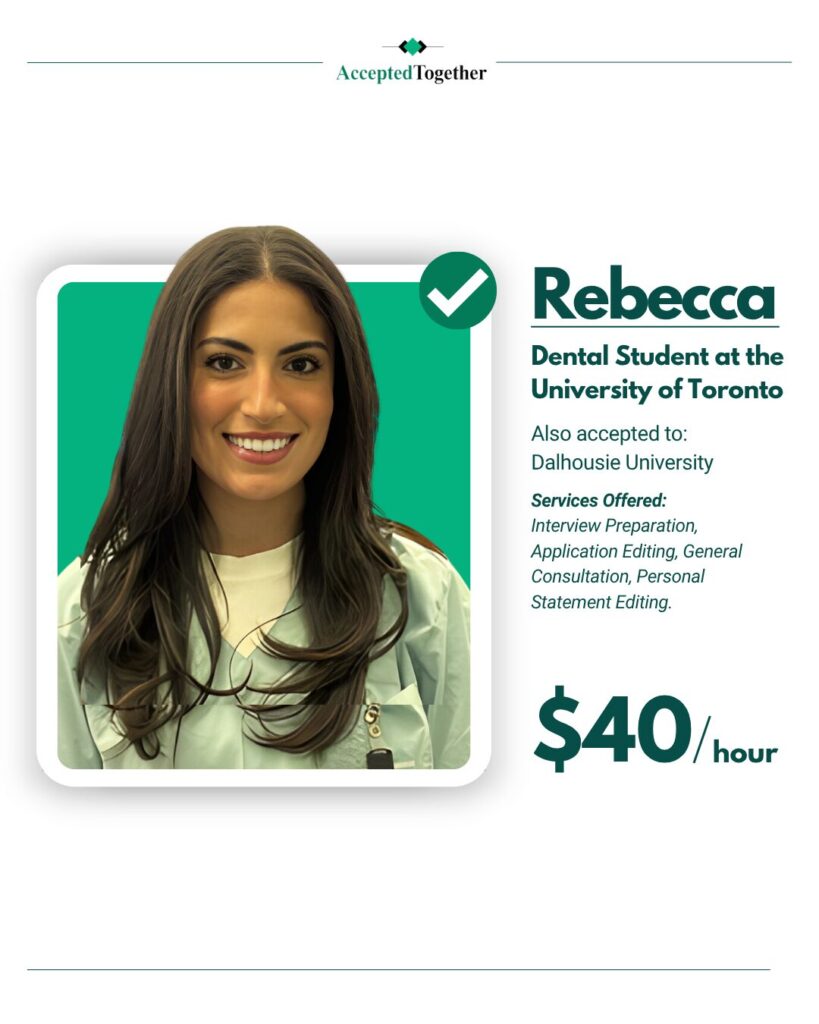
Click to see hundreds of consultants who can mentor you:

The New 200–600 DAT Scoring Scale
One of the biggest “shocks” for the 2026 cycle is the new DAT scoring system. The American Dental Association (ADA) officially moved from the old 1–30 scale to a 200–600 scale in March 2025.
What does a “Good” score look like now?
Under the new psychometric model, scores are reported in 10-point increments. While schools are still adjusting their “average” targets, here is the 2026 concordance:
- Competitive: 420+ (Equivalent to the old 20)
- Elite: 460+ (Equivalent to the old 22)
- High-Yield: 480+ (Equivalent to the old 23/24)
Important Update: In 2026, you will not receive an unofficial score report at the testing center. You must wait for the ADA to conduct a more detailed analysis, meaning you won’t see your scores for 10–14 days. Plan your test date accordingly!
Quadrant 3: Mastering the 8 Experience Categories
A common pitfall is miscategorizing your hours. In the 2026–2027 cycle, AADSAS has refined its categories to give schools a clearer picture of your “Chairside Exposure.”
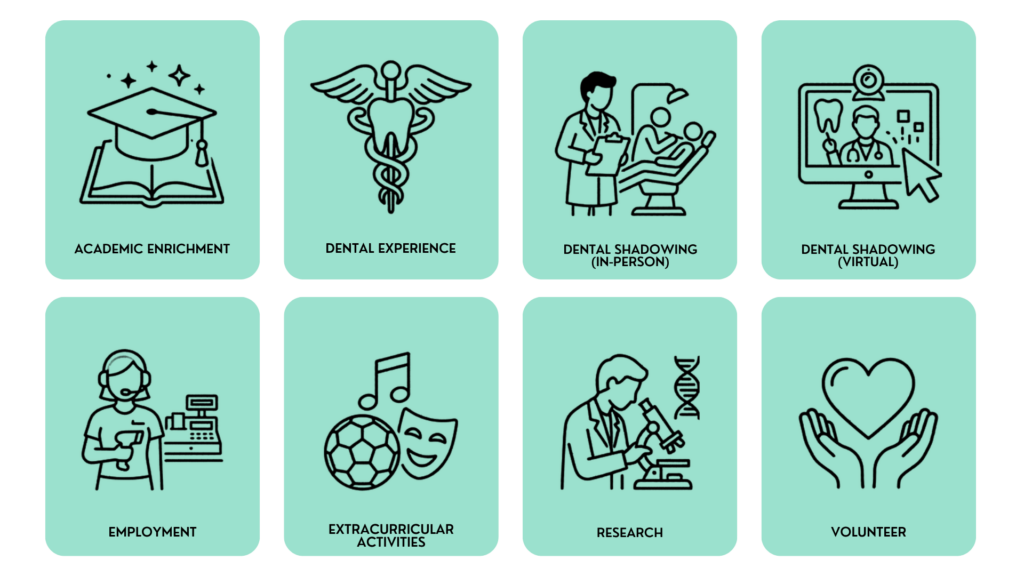
The 2026 Experience List:
- Academic Enrichment: Summer programs (like SHPEP) or Post-bacc activities.
- Dental Experience: Paid or unpaid work other than shadowing (e.g., Dental Assisting, Front Desk, Sterilization Tech).
- Dental Shadowing (In-Person): Traditional “over-the-shoulder” observation.
- Dental Shadowing (Virtual): New for 2026. Schools now want these separated. While Virtual Shadowing is accepted, most Top 50 schools require at least 50–100 hours of In-Person experience.
- Employment: Any non-dental paid work (shows reliability and grit).
- Extracurricular Activities: Clubs, sports, and hobbies. This is where you prove your Manual Dexterity (piano, painting, model building).
- Research: Highly prioritized by research-intensive schools (UCSF, Michigan, Columbia).
- Volunteer: Community service outside of the dental office.
The “Rule of 6” Strategy
You are allowed an unlimited number of entries, but you must select exactly 6 to highlight as “Most Important.” These six receive a dedicated section on the PDF that admissions officers read first. Your 6 should include:
- 1 Strong Shadowing Entry (In-Person)
- 1 Manual Dexterity Entry (The “Hands” Story)
- 1 Leadership Entry
- 1 Sustained Volunteer Entry
- 2 “Wildcard” entries that show your unique personality (e.g., a long-term job or a unique research project).
The “Likert-Scale” Letter of Evaluation (LOE) Update
This is the most critical “Gold Mine” tip for the 2026 cycle. Previously, letters were just open-ended PDFs. Now, your letter writers must complete a Structured Evaluation within the AADSAS portal.
The 10 Competencies Evaluators Rate You On:
- Integrity & Ethics
- Reliability & Dependability
- Service Orientation
- Social & Interpersonal Skills
- Teamwork
- Capacity for Improvement
- Resilience & Adaptability
- Cultural Competence
- Oral Communication
- Critical Thinking
AcceptedTogether Strategy: When you ask for a letter, don’t just send your resume. Send a “Competency Cheat Sheet.” Remind your writer of a specific time you showed resilience or teamwork so they can confidently mark you as “Exceeds Expectations” on the Likert scale.
Manual Dexterity: The 2026 “Secret” Metric
Dental schools are surgical programs. If you cannot prove your fine motor skills, your 400-point DAT won’t save you. In 2026, AdComs are looking for “Tactile Sensitivity.”
In your Extracurricular or Personal Statement sections, use “Micro-Action” verbs:
- Bad: “I like to paint.”
- Good (2026-Ready): “Mastering oil painting required the development of minute muscular control and spatial awareness, specifically in the application of fine-point brushwork and the management of varying tactile pressures.”
Common AADSAS Pitfalls to Avoid
- The “Dental Experience” vs. “Shadowing” Confusion: If you are a Dental Assistant, put those hours under Dental Experience, not Shadowing. Shadowing is passive; Experience is active.
- The “Character Creep” in Descriptions: You have 1,000 characters for each experience. Use the first 200 for “What I did” and the last 800 for “What I learned/Impact.”
- Formatting Errors: AADSAS does not have a spell-check. One typo in your “Most Important” section can signal a lack of attention to detail—a trait no dentist should have.
Conclusion: Start Your 2026 Engine Today
The primary application is the “Filter.” If you pass the filter with a clean, strategic, and early AADSAS submission, you move on to the real battle: the Secondaries and Interviews. By mastering the 200–600 DAT scale and the “Rule of 6,” you are already ahead of 90% of the applicant pool.
Frequently
Asked Questions about
ADEA AADSAS Application
Yes! This is the most common 2026 strategy. Submit on June 2nd to get your transcripts verified. Once you take the DAT in July or August, the scores will automatically upload to your verified application.
The average “AcceptedTogether” student applies to 12–15 schools. Applying to more than 20 often leads to “Secondary Burnout,” where the quality of your school-specific essays drops significantly.
No. If you failed a class and got an ‘A’ on the retake, AADSAS averages both grades. This is why your “Verified GPA” is often lower than your university GPA.
Yes, but be careful. Because of the new Likert-scale questions, it is highly recommended to have your writers submit directly through the AADSAS portal so they can answer the mandatory competency questions properly.
This is a 2026-specific prompt that replaces the old “Disadvantaged Status” label. It’s a space to explain any hurdles (financial, family, or geographic) that impacted your academic journey.