Last updated on January 9th, 2026 at 06:27 am
Program Overview & Institution Identity
University of Texas Southwestern Medical School (UT Southwestern) stands as one of the premier medical education institutions in the United States, located in Dallas, Texas. As a public institution with an urban campus setting, UT Southwestern offers a rigorous 4-year Doctor of Medicine (MD) program that consistently ranks among the nation’s top medical schools.
Program Duration: The standard MD program is 4 years, featuring an innovative curriculum structure that begins clinical rotations in January of the second year – earlier than most medical schools.
Location and Campus: Situated in Dallas, Texas, UT Southwestern provides students access to a thriving metropolitan area with extensive clinical training opportunities. The urban campus setting offers diverse patient populations and world-class healthcare facilities.
Accreditation Status: UT Southwestern is fully accredited by the Liaison Committee on Medical Education (LCME), ensuring the highest standards of medical education and enabling graduates to sit for USMLE examinations and apply for residency training nationwide.
Combined Degree Options: The school offers prestigious combined degree programs including MD/MBA, MD/MPH, and MD/PhD, allowing students to pursue specialized pathways aligned with their career goals.
Admission Requirements
Academic Prerequisites
UT Southwestern maintains rigorous academic standards for prospective medical students. The school requires completion of specific prerequisite courses with a minimum grade of C or better:
Minimum Degree Requirements:
- Bachelor’s degree strongly recommended
- Minimum of 90 semester hours (134 quarter hours) from a regionally accredited U.S. or Canadian college or university
Required Courses:
- Biology: 14 semester credit hours including formal laboratory experience (12 lecture hours + 2 lab hours minimum)
- Chemistry: 12 semester credit hours including 4 hours of general chemistry with lab and 8 hours of organic chemistry with lab
- Biochemistry: 3 semester credit hours
- Physics: 8 semester credit hours including laboratory for science majors
- English: 6 semester credit hours approved by the English department
GPA Requirements:
- Median GPA: 3.95 for admitted students
- Class of 2028 Average GPA: 3.89
- All prerequisite courses must be completed with a grade of C or better
Standardized Testing
MCAT Requirements:
- Median MCAT Score: 517 for admitted students
- Class of 2028 Average MCAT: 516
- MCAT scores are typically valid for 3 years
- Students taking the MCAT in July, August, or September should note that application review may be delayed until scores are received
CASPer Test:
UT Southwestern requires the CASPer (Computer-Based Assessment for Sampling Personal Characteristics) examination to assess personal and professional characteristics beyond academic metrics. The last acceptable CASPer test date is October 21, 2025, with scores distributed by November 3, 2025.
Extracurricular Activities & Experience Requirements
UT Southwestern employs a holistic admissions approach that evaluates:
- Research experience in basic science, clinical, or public health fields
- Clinical exposure through volunteering, shadowing, or employment in healthcare settings
- Community service demonstrating commitment to helping others
- Leadership experience in various capacities
- Diversity of experiences showing well-rounded personal development
Texas Residency Preference: As a public Texas institution, UT Southwestern gives preference to Texas residents, with approximately 82% of each class consisting of in-state students.
Click To See Hundreds Of Consultants Who Can Mentor You:


Application Process & Timeline
Application System
UT Southwestern uses the Texas Medical and Dental Schools Application Service (TMDSAS) rather than AMCAS, making the application process unique among medical schools.
Key Application Deadlines:
- Primary Application Opens: May 1, 2025
- Primary Application Deadline: October 1, 2025
- Secondary Application Deadline: October 15, 2025
- Supporting Documents Deadline: October 15, 2025
Required Documents
Primary Application Components:
- Completed TMDSAS application
- Official transcripts from all attended institutions
- MCAT scores
- Letters of evaluation/recommendation
- Personal statement
- Work and activities descriptions
Secondary Application:
Students receive secondary application access after TMDSAS transmits the primary application. The secondary application requires additional essays and school-specific questions.
Interview Process
Interview Format: UT Southwestern conducts interviews from July through the spring, with invitations extended via email beginning in July.
Interview Statistics: The school typically interviews a select number of candidates from the applicant pool, with interviews serving as a critical component of the selection process.
Post-Interview Process: Offers of admission begin on October 15, 2025, with rolling admissions continuing through the cycle.
Admission Statistics & Success Rates
Overall Competitiveness
Acceptance Rate: Approximately 3.96% (222 students admitted from 5,604 TMDSAS applications in recent cycles), making UT Southwestern one of the most competitive medical schools in the nation.
Class Size:
- Standard class size: 227 students (Class of 2028)
- First-year enrollment: 222 students
Demographics of Admitted Students
Class of 2028 Profile:
- Average Age: 23 years
- Home States: Students represent 37 different states
- First Generation College Students: 7%
- Multilingual Background: 36% spoke a non-English language in their childhood home
- Graduate Degrees: 10% hold Master’s degrees
- Undergraduate Majors: 59 different majors represented
Geographic Distribution:
- Texas Residents: 82% of enrolled students
- Out-of-State Students: 18% of enrolled students
- Students attended 74 different undergraduate schools across 24 states
Academic Statistics:
- GPA Range: Successful applicants typically have GPAs of 3.89 or higher
- MCAT Range: Competitive scores typically 516 or above
- Both metrics represent highly competitive thresholds well above national averages
Tuition & Financial Information
Current Tuition Rates
2025-2026 Academic Year:
- Texas Residents: $25,122 per year
- Out-of-State Students: $38,737 per year (approximately $13,615 premium for non-residents)
Total Cost of Attendance
Estimated Annual Costs for Texas Residents:
- MS1: $66,176 total cost of attendance
- MS2: $66,009 total cost of attendance
- MS3: $69,332 total cost of attendance
- MS4: $64,929 total cost of attendance
Cost Breakdown (MS1 Example):
- Tuition & Fees: $25,122
- Housing & Meals: $26,630
- Health Insurance: $3,438
- Transportation: $3,100
- Personal Expenses: $2,500
- Books & Supplies: $1,500
- Laptop/Technology: $2,500
- Loan Fees: $1,386
Program Length Cost Analysis
Total 4-Year Program Cost:
- Texas Residents: Approximately $266,446
- Out-of-State Students: Approximately $318,846
Cost Comparison: UT Southwestern offers exceptional value, with tuition significantly lower than the average private medical school ($58,889) and even below the average public medical school ($37,080) according to AAMC data.
Financial Aid Options
Application Process: Students need only complete the Free Application for Federal Student Aid (FAFSA) to be considered for all available aid.
Aid Sources:
- Merit-based scholarships awarded by UT Southwestern
- Need-based financial aid through federal programs
- External scholarships from foundations and community organizations
- Federal loan programs including Direct Unsubsidized Loans and Grad PLUS loans
Living Expenses: Dallas offers a relatively affordable cost of living compared to other major metropolitan areas with medical schools, helping to keep overall education costs manageable.
Curriculum & Program Structure
Program Duration and Structure
UT Southwestern features an innovative 4-year curriculum that integrates basic sciences and clinical medicine throughout the educational experience, with several distinguishing characteristics:
Educational Philosophy:
- Integration of basic sciences and clinical disciplines throughout all four years
- Emphasis on individualized learning pathways
- Early clinical exposure beginning in January of the second year
- Active learning methodologies including team-based learning, simulations, and small-group sessions
Pre-Clinical Years (First 18 Months)
Foundational Phase:
- Strong foundation in basic sciences
- Introduction to clinical medicine
- Integrated approach combining traditional lectures with interactive learning
- Academic Colleges Program providing specialized faculty mentorship
Key Features:
- Elimination of redundancies in coursework
- Enhanced opportunities for active learning
- Frontiers in Medicine course following clerkships
- 12-week required scholarly activity producing an evaluable product
Clinical Training
Clerkship Period: 48 weeks of required core rotations starting in January of the second year:
- Internal Medicine: 8 weeks
- Surgery: 8 weeks
- Pediatrics: 6 weeks
- Obstetrics/Gynecology: 6 weeks
- Psychiatry: 6 weeks
- Ambulatory Care: 6 weeks
- Neurology: 4 weeks
- Family Medicine: 4 weeks
Clinical Training Facilities:
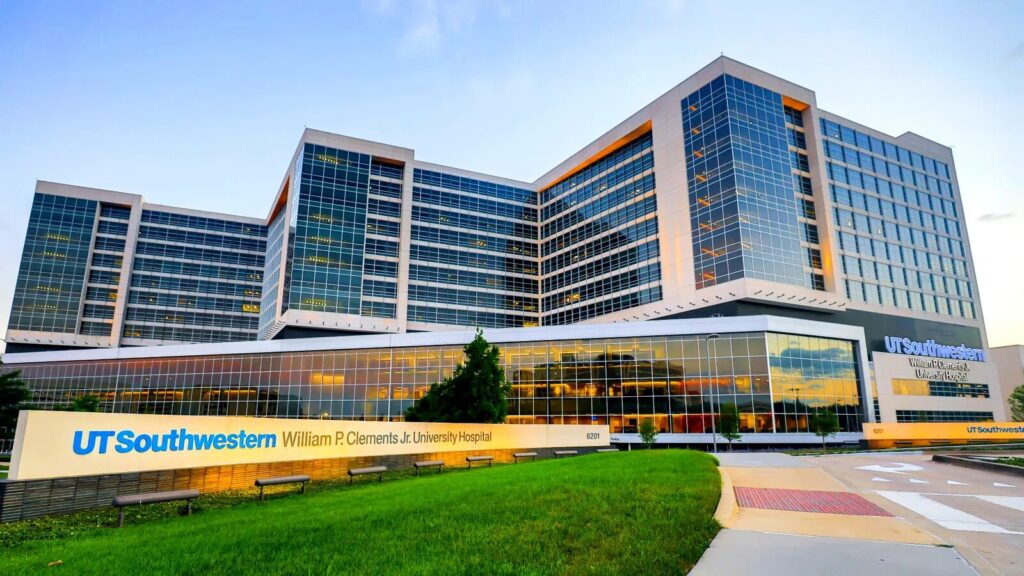
- William P. Clements Jr. University Hospital: 460-room state-of-the-art facility
- Parkland Memorial Hospital: 862-bed county hospital serving diverse populations
- Children’s Health℠ Children’s Medical Center: Comprehensive pediatric care
- Dallas Veterans Affairs Medical Center: Federal healthcare facility
Special Programs
Combined Degrees:
- MD/PhD: Medical Scientist Training Program
- MD/MPH: Combined medical and public health degree
- MD/MBA: Business administration combined degree
Distinction Tracks: Expanded opportunities for specialized pathways allowing students to graduate with distinction in specific areas.
Residency Preparation
Match Statistics:
- Nearly 100% match rate to residency programs (significantly above national average of 94%)
- Approximately 50% of graduates match to hospitals affiliated with U.S. News & World Report’s top 25 medical schools
- 50+ students annually match to UT Southwestern-affiliated residency programs
Popular Specialties: Graduates successfully match into highly competitive specialties including internal medicine, pediatrics, anesthesiology, surgery, emergency medicine, and many others.
Match Destinations: Students match to prestigious programs including Massachusetts General, Johns Hopkins, Mayo Clinic, and numerous other top-tier institutions nationwide.
Pre-Medical Preparation
Undergraduate Program Recommendations
Major Selection: UT Southwestern welcomes students from diverse academic backgrounds, with the Class of 2028 representing 59 different undergraduate majors including:
- Science majors: Biochemistry, Biology, Chemistry, Physics, Neuroscience
- Non-science majors: Economics, History, Philosophy, Psychology, Anthropology
Academic Planning:
- Complete all prerequisite courses with strong performance (C or better)
- Maintain competitive GPA (targeting 3.89+ based on admitted student averages)
- Balance science requirements with diverse academic interests
Clinical Experience Requirements
Recommended Experiences:
- Clinical volunteering in hospitals or healthcare settings
- Physician shadowing across multiple specialties
- Healthcare employment positions
- Quality over quantity: Meaningful, sustained involvement preferred over brief exposures
Research Experience
UT Southwestern values research experience but does not mandate specific requirements. Students benefit from:
- Basic science research in laboratory settings
- Clinical research projects
- Public health research initiatives
- Publication opportunities, though not required for admission
Standardized Test Preparation
MCAT Strategy:
- Target score: 516+ (based on admitted student averages)
- Plan test timing carefully – avoid late testing dates that delay application review
- Consider retaking if initial score falls significantly below competitive range
CASPer Preparation:
- Register early for CASPer exam
- Understand that CASPer assesses personal and professional characteristics
- Practice scenario-based reasoning and ethical decision-making
Application Timeline Planning
Recommended Timeline:
- Junior Year: Complete prerequisites, begin MCAT preparation
- Spring Junior Year: Take MCAT, research schools, connect with recommenders
- Summer before Senior Year: Complete primary and secondary applications
- Senior Year: Interview season, complete final prerequisites
Frequently Asked Questions
Does UT Southwestern look at extracurriculars?
Yes, UT Southwestern employs a holistic admissions approach that considers research experience, clinical exposure, community service, leadership, and personal characteristics beyond academic metrics. The school requires the CASPer test specifically to assess personal and professional qualities.
What is UT Southwestern’s average GPA and MCAT score?
For the Class of 2028, the average GPA is 3.89 and the average MCAT score is 516. The median scores for admitted students are GPA 3.95 and MCAT 517, indicating the highly competitive nature of the applicant pool.
How competitive is UT Southwestern compared to other medical schools?
UT Southwestern is among the most competitive medical schools nationally, with an acceptance rate of approximately 3.96%. This places it in the highest tier of selectivity, comparable to Ivy League medical schools.
Does UT Southwestern prefer in-state applicants?
As a public Texas institution, UT Southwestern gives significant preference to Texas residents, with approximately 82% of each incoming class consisting of in-state students. Out-of-state acceptance is highly competitive.
What makes UT Southwestern different from other medical schools?
UT Southwestern distinguishes itself through early clinical exposure (starting January of year 2), innovative curriculum integration, exceptional residency match rates, affordable tuition for a top-tier school, and access to world-class clinical facilities in Dallas.
When should I apply to UT Southwestern?
Applications open May 1, 2025, through TMDSAS with a primary deadline of October 1, 2025. Early submission is recommended as the school practices rolling admissions and seats fill quickly.
Does UT Southwestern accept international students?
While UT Southwestern may consider international applicants, preference is given to U.S. citizens and permanent residents, particularly Texas residents. International applicants face additional challenges in securing clinical rotations and residency matches.
What clinical experience do I need for UT Southwestern?
While there’s no specific hour requirement, successful applicants typically have meaningful clinical exposure through volunteering, shadowing, or employment in healthcare settings. Quality and depth of experience matter more than quantity.
Does UT Southwestern require research experience?
Research experience is valued but not required. However, given the competitive applicant pool, most successful candidates have some research background, whether in basic science, clinical, or public health research.
How many letters of recommendation does UT Southwestern require?
UT Southwestern requires letters of evaluation submitted through TMDSAS. The specific number and requirements are detailed in the TMDSAS application instructions, typically including academic and professional references.
What is UT Southwestern’s curriculum like?
The curriculum features a 4-year integrated approach with early clinical exposure starting in January of the second year. It includes 48 weeks of required clinical rotations, Academic Colleges mentorship, and a required 12-week scholarly activity.
Where do UT Southwestern graduates match for residency?
Nearly 100% of graduates match to residency programs, with approximately 50% matching to hospitals affiliated with top 25 medical schools according to U.S. News rankings. Graduates match to prestigious institutions including Massachusetts General, Johns Hopkins, and Mayo Clinic.
How much does UT Southwestern cost?
For 2025-2026, tuition is $25,122 for Texas residents and $38,737 for out-of-state students. The total cost of attendance is approximately $66,176 for Texas residents in the first year, making it one of the most affordable top-tier medical schools.
What financial aid is available at UT Southwestern?
Students can access merit-based scholarships, need-based aid, and federal loans by completing the FAFSA. The school offers competitive aid packages, and Dallas’s relatively low cost of living helps keep overall expenses manageable.
Does UT Southwestern offer interviews to all qualified applicants?
No, interviews are selective and extended by invitation only. Interview invitations begin in July and continue through the academic year, with the school interviewing only a portion of qualified applicants due to the high volume of competitive applications.