
Table of Contents
Choosing your medical school list was the “where,” but your Personal Statement is the “why.”
As we hit mid-March 2026, most of you are likely staring at a blinking cursor on a blank page. It’s a daunting task: you have exactly 5,300 characters (about one page) to convince a committee of doctors and admissions experts that you have the emotional maturity, clinical exposure, and intellectual stamina to survive the next four years—and the forty years of practice that follow.
In this guide, we’re going to move past the generic “I want to help people” advice and look at how to build a narrative that actually sticks in a 2026 admissions cycle.
Click to see hundreds of consultants who can mentor you:
What Makes a Personal Statement “Medical School Ready”?
A great personal statement is not a chronological resume. The admissions committee has already seen your transcript and your activity list; they don’t need a paragraph-form version of your CV. Instead, a 2026-ready essay acts as an interpretive lens. It tells the committee how to read the rest of your application.
The “Why Medicine” Thesis
Your essay needs a clear “North Star.” By the end of the first paragraph, the reader should understand your specific motivation. Are you driven by the marriage of high-level science and human advocacy? Or perhaps by the challenge of navigating health disparities in rural communities?
The Key: Your thesis shouldn’t just be “I like science and people.” It should be: “My experience in X showed me the limitations of Y, and I am pursuing medicine to provide Z.”
Show, Don’t Tell (The Evidence-Based Approach)
If you say you are “compassionate,” that’s a claim. If you describe a moment where you sat with a grieving patient in the ED for twenty minutes while the rest of the floor was buzzing, that’s evidence.
In 2026, admissions committees are looking for “Evidence-Based Admissions.” They want to see that you have tested your desire to be a doctor in the real world and haven’t run away yet.
2026 Personal Statement Trends: Reflection Over Recitation
One of the biggest shifts we’ve seen in the last two years is the move away from “adventure stories.” You don’t need to have climbed a mountain or saved a life in a dramatic accident to have a great essay.
The Power of Small Moments
Some of the strongest essays from the 2025 cycle focused on quiet, reflective moments:
- Helping a non-English speaking patient navigate a complex discharge.
- The frustration of seeing a patient return to the clinic because they couldn’t afford their insulin.
- The meticulous, often repetitive nature of bench research and what it taught you about patience.
The “AI Trap” of 2026
We have to talk about it: Generative AI. While tools like Gemini or ChatGPT are great for brainstorming or fixing a clunky sentence, using them to write your essay is a massive risk. Admissions committees now use sophisticated AI-detection patterns. More importantly, AI tends to write in “clichés”—it produces “average” content.
To stand out, your essay needs voice. It needs the specific, slightly messy, highly personal details that a machine simply cannot invent. If your essay sounds like it could have been written by any of the other 55,000 applicants, it’s not doing its job.
Click to see hundreds of consultants who can mentor you:
Sample Personal Statement Analysis
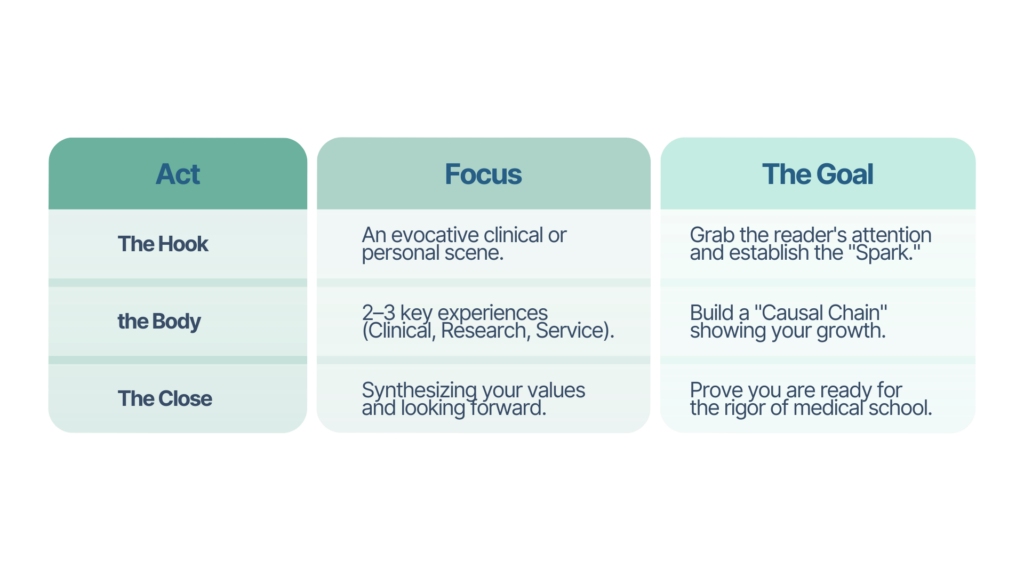
When you look at successful examples, you’ll notice a common “Three-Act Structure.”
Sample 1: The “Non-Traditional” Hook
“The restaurant was at its Friday night peak when the kitchen line stalled. As a lead server, I wasn’t just managing plates; I was managing the rising cortisol levels of my team and the expectations of fifty hungry strangers. It was in these high-stress, low-margin-for-error moments that I first realized I thrived in chaos—but I wanted that chaos to serve a higher purpose than a medium-rare steak.”
Why it works: It takes a “normal” job and pivots it toward a medical competency (resilience and leadership) without being cheesy.
Sample 2: The Advocacy-Focused Caretaker
“The prescription in Mrs. G’s hand was for a standard course of antibiotics, but to her, it might as well have been written in a dead language. It wasn’t just the medical jargon; it was the $80 co-pay and the three-bus transfer required to reach the pharmacy. Standing in that exam room, I realized that a physician’s greatest tool isn’t always a stethoscope—it’s the ability to identify the barriers that prevent a patient from ever reaching the pharmacy door.”
Why it works: This is a classic “Observation to Insight” narrative. It moves quickly from a specific scene to a broader understanding of the Social Determinants of Health (SDOH). In 2026, committees are looking for “systems-thinkers” who understand that medicine doesn’t happen in a vacuum.
Sample 3: The Research-to-Bedside Bridge
“For three months, my world was measured in microliters and the steady hum of the centrifuge. I was chasing a specific protein marker for pancreatic cancer, a pursuit that felt purely academic until I met Arthur. Shadowing in the oncology ward, I watched Arthur struggle to swallow his tea, his skin yellowed by the very disease I had been quantifying in a petri dish. Suddenly, my pipettes weren’t just tools; they were the frontline of his survival.”
Why it works: This sample perfectly bridges the gap between the “lab rat” and the “clinician.” It proves you have the intellectual stamina for scientific inquiry but anchors that curiosity in human empathy. It answers the “Why not just a PhD?” question before they even ask it.
Pro-Tip:
Notice that none of these samples start with “I was born to be a doctor” or “My grandfather was a surgeon.” They start with action. By showing yourself in the middle of a problem, you invite the reader to watch you solve it, which is exactly what you’ll be doing for the next forty years of your career.
Common Pitfalls to Avoid in 2026
- The “Shadowing” Diary: Don’t write about what the doctor did. Write about what you observed and how it changed your understanding of the patient-physician relationship.
- The “Pity Party”: It is okay to discuss adversity, but only if you focus on the resilience you built from it. 80% of the paragraph should be about your growth, not the hardship itself.
- The “Pre-Med Buzzword” Overload: Words like “passionate,” “driven,” and “dedicated” are fillers. Replace them with verbs. Instead of saying you are “passionate about service,” show us you volunteering at the same clinic for three years.
Timeline: The “April 1st” Deadline
If you are applying in the 2026–2027 cycle, you should aim to have a “final-ish” draft by April 1st.
- Late March: Gather feedback from 2–3 trusted sources (one who knows medicine, one who knows your writing style).
- Early April: Finalize the “Why Medicine” narrative.
- May: Spend this month on the “Work and Activities” section. You don’t want to be still struggling with your Personal Statement when the AMCAS portal opens on May 5th.
Your Next Step
A personal statement is only as strong as the experiences it describes. Now that you’ve got the narrative arc down, the next hurdle is the Work and Activities section—where you have to summarize your 15 most important life experiences.
Frequently
Asked Questions about
The Personal Statement
The AMCAS limit is 5,300 characters (including spaces). For AACOMAS (DO), it’s 4,500. For TMDSAS (Texas), it’s 5,000. We recommend aiming for 5,000 characters to ensure it fits across all platforms if you are double-applying.
Generally, no. The Personal Statement is for your “Why.” Use the “Optional Essay” or “Adversity” sections (if provided) to explain academic fluctuations. Don’t waste your 5,300 characters being defensive.
Mostly, yes. However, for DO schools, you should ensure your narrative aligns with the osteopathic philosophy (holistic care, preventative medicine). You don’t need a total rewrite, but a slight “tweak” to the conclusion can make a big difference.
No. There are specific boxes in the application for “Disclosures.” Keep the Personal Statement focused on your journey toward becoming a physician.