Last updated on January 9th, 2026 at 06:32 am
Program Overview & Institution Identity
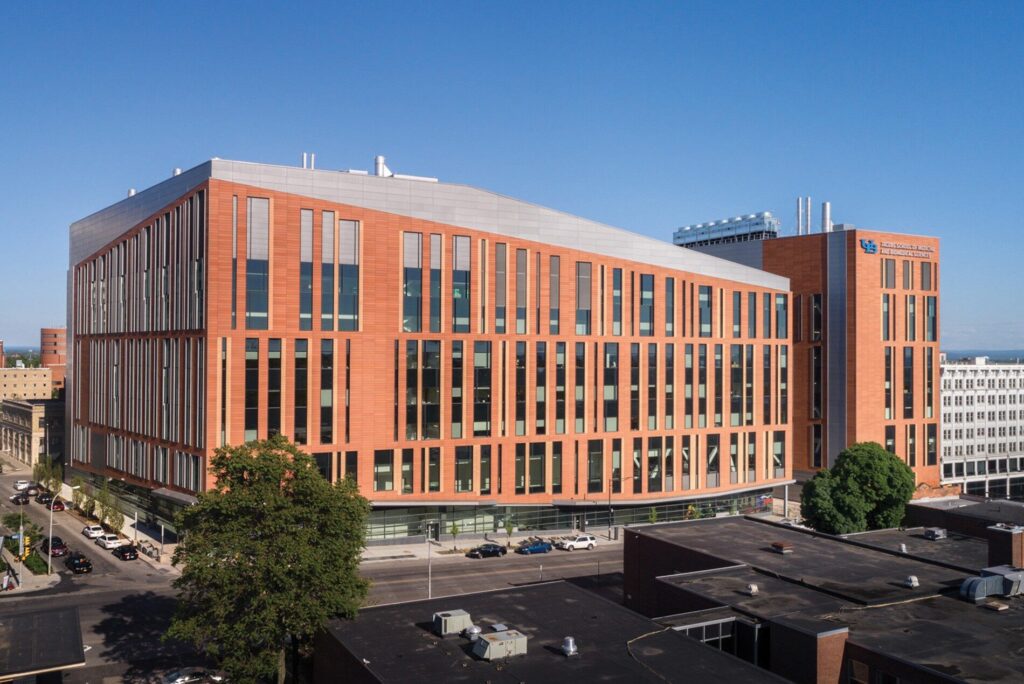
The Jacobs School of Medicine and Biomedical Sciences at the University at Buffalo is a prestigious public medical school located in Buffalo, New York, on an urban campus. Founded in 1846, this LCME-accredited institution has trained physicians for nearly 180 years, making it one of the oldest medical schools in the United States.
Program Duration and Structure
The Jacobs School offers a traditional 4-year MD program with a comprehensive curriculum designed to prepare students for successful careers in medicine. Students entering in 2024 and beyond train under the innovative “Well Beyond” curriculum, emphasizing early clinical exposure, community engagement, and adaptable problem-solving skills essential for modern healthcare.
Accreditation and Recognition
- LCME Accreditation: Full accreditation (2019), next site visit scheduled for 2026–2027.
- Graduates are eligible for USMLE and ACGME-accredited residency programs.
Combined Degree Programs
- MD/PhD – Physician-scientist training
- MD/MBA – Medicine + business administration
- MD/MPH – Public health and population medicine
- Medical Oral Maxillofacial Surgery (MOMS) – Specialized dental-medical training
Admission Requirements
Academic Prerequisites
Minimum Education:
- At least two full years (60 credits) of higher education in the U.S. or Canada
- Bachelor’s degree strongly recommended (not strictly required)
Required Courses:
- Biology: 2 semesters with lab
- General Chemistry: 2 semesters with lab
- Organic Chemistry: 2 semesters with lab
- Physics: 2 semesters (lab optional)
- English: 2 semesters (writing-intensive preferred)
Strongly Recommended:
- Biochemistry (essential for success)
- Genetics & Molecular Biology
- Statistics
- Social Sciences: four courses recommended
- Humanities: two additional courses beyond English
Applicants must complete at least half of prerequisites before applying and finish all requirements before matriculation.
GPA Requirements
- Median GPA (matriculants): 3.79
- Competitive range: 3.7+ is typical
- The committee holistically weighs overall and science GPAs, with emphasis on prerequisites and upper-level sciences.
Standardized Testing
MCAT:
- Median MCAT: 510 (84th percentile)
- Validity: Scores within 3 years of application
- For 2026 matriculation: Accepted from Jan 2023 – Sept 2025 (latest test date Sept 2025)
- Competitive range: 507+
AAMC PREview (SJT):
- Recommended, not required for 2025–2026; UB is evaluating its future use.
- Not used for evaluation in the 2026 application year.
Letters of Recommendation (via AMCAS Letter Service only)
- Preferred: Pre-Health Committee Letter
- Or: Three individual letters, at least one from a science professor
- Graduate applicants: May submit three letters from graduate faculty (undergrad letters may be omitted)
- Substitutions: Contact admissions if unable to meet requirements (case-by-case approval)
Application Process & Timeline
Primary (AMCAS):
- Opens: June 1, 2025
- Deadline: Nov 15, 2025
- Fee: $65
Secondary (Jacobs Supplemental):
- Deadline: Dec 1, 2025
- Sent to qualified applicants after AMCAS review
Early Decision Program (EDP):
- Deadline: Aug 1, 2025
- Decision: Oct 1, 2025
- Binding upon acceptance
Interview Process
- Invites: August–March
- Format: Multiple Mini-Interview (MMI) plus traditional components
- Decisions: Begin December 2025; rolling thereafter
Admission Statistics & Success Rates
- Applications (entering 2025): 5,828
- Matriculants: 181
- Acceptance Rate: ~3.1%
- Class Size: 181
Geographic Distribution
- Public, NY state preference: Strong for New York residents
- Out-of-state: Limited, reserved for exceptional candidates
- International: Not accepted (U.S. citizens/permanent residents only)
Academic Profile (Recent Matriculants)
- Median GPA: 3.79 (approx. 25th–75th: 3.65–3.95)
- Median MCAT: 510 (approx. 25th–75th: 507–515)
- Balanced section performance preferred.
Diversity
The school seeks a broad mix of academic backgrounds, socioeconomic experiences, and regions across New York State, valuing varied life experiences and perspectives.
Tuition & Financial Information (2025–2026)
Annual Tuition:
- NY Residents: $48,238
- Out-of-State: $70,368
Additional Estimated Costs:
- Tech/Lab Fees: ~$2,000–3,000/yr
- Health Insurance: ~$3,000–4,000/yr (if not on family plan)
- AMCAS Fee: $65; secondary fees may apply
4-Year Tuition Only (est.):
- In-State: ~$192,952
- Out-of-State: ~$281,472
Living in Buffalo (est./yr):
- Housing $800–1,500/mo, Food/Personal $600–1,000/mo, Public transit available (many students use cars)
- Total living expenses: $20,000–25,000/yr
Financial Aid & Scholarships
- Federal Aid: Stafford & Grad PLUS loans; limited work-study
- Institutional Aid: Merit awards; limited need-based funds
- State Aid: NY-specific programs (for residents)
- External: Professional orgs, community groups, national foundations
Click To See Hundreds Of Consultants Who Can Mentor You:


Curriculum & Program Structure
4-Year MD Program
“Well Beyond” Curriculum (Matriculants 2024+)
Phase 1 — Build Foundational Skills (≈18 months)
- Foundational sciences with early patient contact
- Small-group, PBL/TBL, simulation
- Integrated USMLE Step 1 preparation
Phase 2 — Gain Clinical Experience (≈12 months)
- Core clerkships: Internal Medicine, Surgery, Pediatrics, OB/GYN, Psychiatry, Family Medicine, Neurology, Emergency Medicine
- Clinical sites: Buffalo General Medical Center, Erie County Medical Center, Buffalo VA Medical Center, community hospitals
- Assessments: Clinical evals, OSCEs, Step 2 CK prep
Phase 3 — Prepare for Residency (≈12 months)
- Sub-internships, advanced electives, research blocks
- Specialty-specific prep, interview skills, residency application support
Classic Curriculum (Pre-2024)
- Preclinical (Y1–Y2): Organ-system based, lecture & labs
- Clinical (Y3–Y4): Core clerkships + electives/acting internships
Educational Philosophy & Methods
- PBL/TBL, simulation-based education, standardized patients
- Technology integration: EHR training, emerging AI tools
- Assessment: Preclinical Pass/Fail; clinical Honors/High Pass/Pass/Fail with narrative feedback; robust support for USMLE Step 1 & 2
Clinical Training Sites
- Buffalo General Medical Center (Level I trauma, comprehensive specialties)
- Erie County Medical Center (safety-net, diverse pathology)
- Buffalo VA Medical Center
- Oishei Children’s Hospital (pediatric subspecialties)
- Community health centers, rural rotations across Western NY, private practices
Special Programs & Opportunities
- Research: Summer research between M1–M2, optional year-long fellowships, MD/PhD track, close faculty mentorship
- Global Health & Service: International electives, mandatory community engagement, health advocacy training
Residency Preparation & Match Results
- USMLE: Step 1 pass rate above national average; Step 2 CK typically >95%
- Match: Consistently >95% for U.S. seniors; matches across all specialties and nationwide, including competitive fields (e.g., dermatology, ortho, radiology). Many graduates also remain in Western NY.
Pre-Medical Preparation
Undergraduate Academic Planning
Majors: Any major welcomed (science & non-science). Academic excellence outweighs specific major choice; interdisciplinary programs (e.g., BME, Public Health) are valued.
Sequencing (example):
- Freshman: Gen Chem, Bio, English, Math
- Sophomore: Organic, Physics, continued Bio
- Junior: Upper-level sciences, MCAT prep
- Senior: Advanced electives, application-year coursework
GPA Strategy:
Prioritize science GPA, take rigorous upper-level courses, demonstrate positive grade trends, and use academic supports as needed.
Clinical Experience
- No set hour minimum, but substantial and meaningful exposure is expected.
- Direct patient contact is essential (volunteering, employment, shadowing).
- Settings: Hospitals, clinics, nursing homes, rehab centers, community health.
Research Experience
- Not required, but advantageous (basic, clinical, public health, health services).
- Sustained involvement preferred; publications/presentations are helpful but not mandatory.
Extracurricular Activities
- Leadership: Student orgs, community roles, TA/tutoring, professional societies
- Service: Both healthcare-related and broader community service; long-term engagement favored
- Personal Development: Cultural competency, strong communication, wellness, and professional growth
MCAT Preparation
Optimal Timing: Junior year (after completing content prerequisites); 3–6 months of focused study; retake only with realistic improvement.
Preparation Strategies:
- Commercial courses or structured self-study (AAMC materials, etc.)
- Practice Tests