Last updated on January 9th, 2026 at 06:33 am
Program Overview & Institution Identity
Official Program Name & Institution Identity
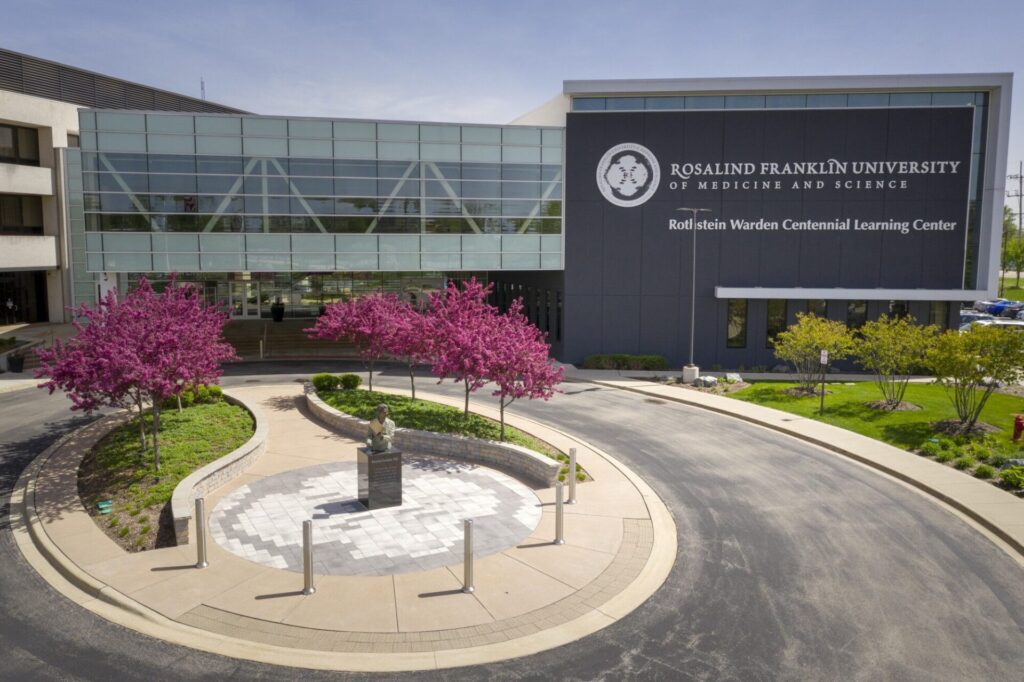
The Chicago Medical School at Rosalind Franklin University of Medicine & Science (CMS-RFUMS) is a prestigious private medical institution established in 1912. Located on a suburban campus in North Chicago, Illinois, this LCME-accredited medical school has been training physicians for over a century, building a strong reputation for excellence in medical education, research, and community service.
Program Duration & Structure
CMS offers a traditional 4-year allopathic medicine (MD) program structured in three sequential phases:
- Phase I (Years 1-2): Scientific and Clinical Foundations followed by eight system-based blocks
- Phase II (Year 3): Seven core clinical clerkships plus one career exploration elective
- Phase III (Year 4): Residency preparation with sub-internship and 31 weeks of electives
Location & Campus Details
The medical school is situated in North Chicago, Illinois, on a suburban campus that provides easy access to both Chicago and Milwaukee metropolitan areas. This strategic location offers students diverse clinical experiences ranging from urban inner-city hospitals to suburban private practices and rural healthcare settings.
Accreditation Status
CMS holds full accreditation from the Liaison Committee on Medical Education (LCME) for the maximum eight-year term, awarded in March 2021. This accreditation ensures that graduates are eligible to take the USMLE and enter ACGME-accredited residency programs without restrictions. The next full survey visit is scheduled for 2027-2028.
Ranking & Recognition
While specific US News rankings vary annually, CMS consistently demonstrates strong performance through high residency match rates (96-97%) and excellent USMLE pass rates. The school is particularly recognized for its collaborative learning environment, interprofessional education approach, and strong preparation for board examinations.
Admission Requirements
Academic Prerequisites
Minimum Degree Requirements
- Bachelor’s degree required prior to matriculation (with exceptions for students from DePaul and Lake Forest College Pathways programs)
- Minimum 90 credit hours of undergraduate academic work at an accredited college or university prior to applying
Required Prerequisite Courses
Core Science Requirements:
- One year Introductory Biology with laboratory
- One year Physics with laboratory
- Two semesters of Chemistry (typically General Chemistry with laboratory)
- Additional advanced science coursework recommended
AP Credit Policy: AP science courses receiving credit at your undergraduate institution fulfill pre-medical requirements, but the admissions committee expects advanced undergraduate coursework in most science disciplines (except Physics).
GPA Requirements
- No official minimum GPA published
- Competitive applicants typically have:
- Cumulative GPA around 3.5 or higher
- Science GPA around 3.5 or higher
- 2024 Entering Class Statistics:
- Median cumulative GPA: 3.76
- Median science GPA: 3.54
Standardized Testing
MCAT Requirements
- MCAT required for application completion
- Valid MCAT scores: Tests completed after January 1, 2023
- Application cutoff: Tests taken after September 10, 2025 will not be considered
- Competitive MCAT scores:
- Minimum competitive score: 510
- 2024 entering class median: 509
- Provided data shows median of 511
Additional Testing
AAMC PREview Professional Readiness Exam:
- Recommended (not required) to enhance holistic review process
- Assesses professional readiness competencies
- Information available through AAMC website
CASPer Testing:
- Required as part of the application process
- Computer-based assessment measuring personal and professional characteristics
- Must be completed as part of application requirements
Experience & Activity Requirements
Holistic Evaluation Approach
CMS uses a comprehensive holistic review process that emphasizes:
- Medical and clinical exposure experience
- Humanitarian service and community involvement
- Research experience and scholarly activities
- Employment history and leadership roles
- Diverse life experiences and backgrounds
Clinical Experience
While no specific minimum hours are required, meaningful clinical exposure is essential for competitive applicants. The school values quality over quantity, looking for experiences that demonstrate commitment to healthcare and understanding of the physician role.
Research Experience
Research experience is valued but not required. The school appreciates diverse research backgrounds including basic science, clinical, and public health research.
Application Process & Timeline
Application System & Requirements
Primary Application: CMS participates in AMCAS (American Medical College Application Service)
Key Deadlines:
- Application deadline: November 1, 2025
- Early Decision Program deadline: August 1 (complete application including MCAT scores required)
- AMCAS opens: Early May
- Submission begins: June
Required Application Components
Chicago Medical School Supplemental Application
- $125 non-refundable supplemental application fee
- Short essay format with typically 2-3 prompts
- Recent essay topics include:
- Challenges in your journey to medical school (150 words)
- How your admission would contribute to CMS diversity (150 words)
- Management of discriminatory situations
- Greatest self-discovery
- Youth experiences that still teach lessons
Letters of Recommendation
Choose ONE of the following options:
- Committee Letter (1) – preferred if available
- Individual Letters (3) – from academic and/or professional sources
- Letter Packet containing maximum three individual letters
Important: No more than three individual letters, one committee letter, or one letter packet will be considered.
Interview Process
- Interview format: Mixed format interviews (specifics vary)
- Stress level: Generally reported as low-stress
- Applicant feedback: School ranks in top 38% of interview experiences
- Timeline: Interview invitations typically sent throughout the fall/winter cycle
Post-Interview Process
Important CYMS (Choose Your Medical School) Dates:
- April 30, 2026: All accepted students must indicate “plan to enroll”
- July 1, 2026: All accepted students must indicate “commit to enroll”
Admission Statistics & Success Rates
Application Volume & Acceptance Rates
- 2024 entering class: 203 students
- AMCAS applicants: 11,120
- Calculated acceptance rate: Approximately 1.8% (203/11,120)
- Overall institutional acceptance rate: Approximately 33% (varies by program)
Class Demographics & Statistics
2024 Entering Class Profile:
- Class size: 203 students
- Average age at matriculation: 25 years
- Age range: 20-35 years
- Geographic distribution: 47% Illinois residents, 53% out-of-state
- Midwest representation: Approximately 50% of class
Academic Statistics:
- Median cumulative GPA: 3.76
- Median science GPA: 3.54
- Median MCAT score: 509 (note: some sources report 511-513)
Residency Match Performance
Exceptional Match Results:
- 2025 Match Rate: 97%
- 2024 Match Rate: 98%
- Historical performance: Consistently 96-98% match rates
- Performance vs. National Average: Consistently exceeds national average (94%)
Prestigious Residency Placements:
Recent graduates have matched at top institutions including:
- Mayo Clinic
- Brigham and Women’s Hospital
- UCLA
- Yale-New Haven
- Johns Hopkins
- Stanford
- Cleveland Clinic
- University of Chicago
- Northwestern
- Rush University
Tuition & Financial Information
Tuition Rates (2025-2026)
Annual Tuition: $71,757
- In-state residents: $71,757
- Out-of-state residents: $71,757
- International students: $71,757
As a private institution, CMS charges the same tuition regardless of residency status.
Additional Fees & Costs
- Supplemental application fee: $125
- Technology and student services fees: Estimated $960 annually
- Health insurance: Required (cost varies)
- Laboratory and equipment fees: Included in tuition
- Clinical rotation fees: May apply for certain rotations
Total Cost of Attendance
4-Year Program Estimated Total Cost:
- Tuition only: ~$287,028 (4 years × $71,757)
- Living expenses: Approximately $16,800/year for on-campus housing
- Total estimated cost: ~$350,000+ including living expenses over 4 years
Cost of Living in North Chicago
Housing Options:
- On-campus dormitory: Room charge ~$16,800/year
- Off-campus housing: Varies, suburban Chicago rates
- Dormitory capacity: 582 beds available
Financial Aid Opportunities
While specific scholarship details weren’t found in the research, as a private institution, CMS typically offers:
- Merit-based scholarships
- Need-based financial aid
- Federal loan programs
- Work-study opportunities
- External scholarship opportunities
Contact the financial aid office for specific scholarship information and application procedures.
Click To See Hundreds Of Consultants Who Can Mentor You:
Curriculum & Program Structure
Educational Philosophy & Approach
CMS emphasizes an integrated, patient-centered curriculum that combines:
- Basic science and clinical integration
- Active learning methodologies
- Early clinical exposure
- Interprofessional education
- Community-based learning experiences
Three-Phase Curriculum Structure
Phase I (Pre-Clinical Years 1-2)
M1 Year Curriculum:
- Scientific Foundations of Medicine
- Clinical Foundations of Medicine
- Clinical Anatomy
- Essentials of Clinical Reasoning
- Foundations of Interprofessional Practice
- System-based blocks: Infection-Immunology-Hematology, Gastroenterology, Cardiovascular-Pulmonary-Renal
- Bioethics and Professionalism courses
M2 Year Curriculum:
- Neurobehavioral Health
- Patient Safety training
- Musculoskeletal system
- Endocrine-Reproductive system
- Multisystem integration
- Clinical Skills development
- M2 Elective opportunity
Assessment: Pass/Fail grading system for first two years
Phase II (Clinical Year 3)
Seven Core Clerkships:
- Internal Medicine
- Surgery
- Pediatrics
- Obstetrics & Gynecology
- Psychiatry
- Family Medicine
- Neurology or other specialty
Plus: One elective for career exploration
Phase III (Clinical Year 4)
Residency Preparation Focus:
- One required sub-internship (4 weeks)
- 31 weeks of electives (intramural and extramural options)
- Transition to Internship course (final week)
- Extensive flexibility for specialty exploration
Clinical Training Sites
CMS provides diverse clinical experiences through partnerships with over 20 healthcare systems, including:
Major Teaching Hospitals:
- Advocate Health System hospitals (Christ, Lutheran General, Illinois Masonic)
- Cook County Stroger Hospital
- Captain James A. Lovell Federal Health Care Center
- Northwestern Medicine McHenry Hospital
- Edward Hospital
- Mount Sinai Hospital
Unique Clinical Opportunities:
- Federal Health Care Center serving military personnel
- Inner-city hospitals serving underserved populations
- Suburban private practices
- Rural healthcare settings (including Montana rotations)
Special Programs & Opportunities
Combined Degree Programs:
- MD/PhD programs available
- Research opportunities throughout curriculum
- Interprofessional education with other health sciences programs
Community Engagement:
- Free clinic located across from campus
- Community service opportunities
- Health equity focus integrated throughout curriculum
Pre-Medical Preparation
Undergraduate Program Recommendations
Academic Preparation
Recommended Majors:
- Any major accepted – CMS values diverse academic backgrounds
- Science majors: Biology, Chemistry, Biochemistry provide strong foundation
- Non-science majors: Psychology, Public Health, Liberal Arts welcomed
- Interdisciplinary programs: Encourage well-rounded preparation
Academic Planning Strategy:
- Complete prerequisite courses early to allow for advanced coursework
- Maintain strong GPA (target 3.5+ cumulative and science)
- Consider advanced science courses beyond minimum requirements
- Develop strong study skills and time management
Clinical Experience Development
Types of Clinical Exposure:
- Hospital volunteering in various departments
- Shadowing physicians in multiple specialties
- Clinical research participation
- Emergency medical services (EMT, paramedic)
- Healthcare employment (medical assistant, scribe)
Quality over Quantity:
- Focus on meaningful, long-term commitments
- Demonstrate genuine interest in healthcare
- Show understanding of physician responsibilities
- Document learning outcomes and reflections
Research Experience Building
Research Opportunities:
- Basic science research in university laboratories
- Clinical research at hospitals and medical centers
- Public health research and epidemiological studies
- Biomedical engineering and medical device development
- Healthcare policy and health services research
Research Goals:
- Develop scientific thinking and analytical skills
- Learn research methodology and statistical analysis
- Consider publication opportunities (not required but beneficial)
- Present findings at undergraduate research symposiums
Extracurricular & Leadership Development
Leadership Opportunities:
- Student government and campus organizations
- Community service leadership roles
- Healthcare-related organizations (Pre-Med Society, etc.)
- Teaching and tutoring experiences
- Cultural and diversity organizations
Community Service:
- Healthcare-focused volunteering (free clinics, health fairs)
- Community outreach programs
- International service experiences
- Social justice and health equity initiatives
Standardized Test Preparation
MCAT Preparation Strategy
Timeline:
- Begin preparation: 3-6 months before test date
- Target score: 510+ for competitive consideration
- Retake policy: Consider if initial score below 508
Preparation Resources:
- AAMC official materials (essential)
- Commercial prep courses (Kaplan, Princeton Review, etc.)
- Study groups and tutoring
- Practice exams and timed sections
CASPer Preparation
Test Overview:
- Computer-based assessment of personal characteristics
- Scenario-based questions requiring written responses
- Professional behavior evaluation
Preparation Tips:
- Review sample questions on CASPer website
- Practice typing skills for timed responses
- Consider ethical frameworks for healthcare situations
Gap Year Considerations
When Gap Years Are Beneficial
- MCAT score improvement needed
- Clinical experience development required
- Research experience completion
- Personal growth and maturity development
- Financial preparation for medical school
Productive Gap Year Activities
Full-time Employment:
- Clinical research coordinator positions
- Medical assistant or healthcare roles
- Teaching (especially science education)
- AmeriCorps or public service programs
Continued Learning:
- Post-baccalaureate programs if GPA improvement needed
- Master’s degree in biomedical sciences or related field
- Additional coursework to strengthen academic record
Frequently Asked Questions
What is Chicago Medical School’s average GPA and MCAT score?
The 2024 entering class had a median cumulative GPA of 3.76, median science GPA of 3.54, and median MCAT score of 509. However, successful applicants typically have scores of 510+ to be competitive.
Does Chicago Medical School look at extracurriculars?
Yes, CMS uses a holistic review process that heavily weighs extracurricular activities including clinical experience, research, community service, leadership, and diverse life experiences alongside academic metrics.
Does Chicago Medical School prefer in-state applicants?
As a private institution, CMS doesn’t have formal in-state preferences. However, about 47% of each class consists of Illinois residents, with 53% from out-of-state, showing the school welcomes geographic diversity.
How competitive is Chicago Medical School compared to other medical schools?
CMS is moderately to highly competitive with an acceptance rate of approximately 1.8% (203 accepted from 11,120 AMCAS applicants).