

Last updated on January 9th, 2026 at 06:34 am
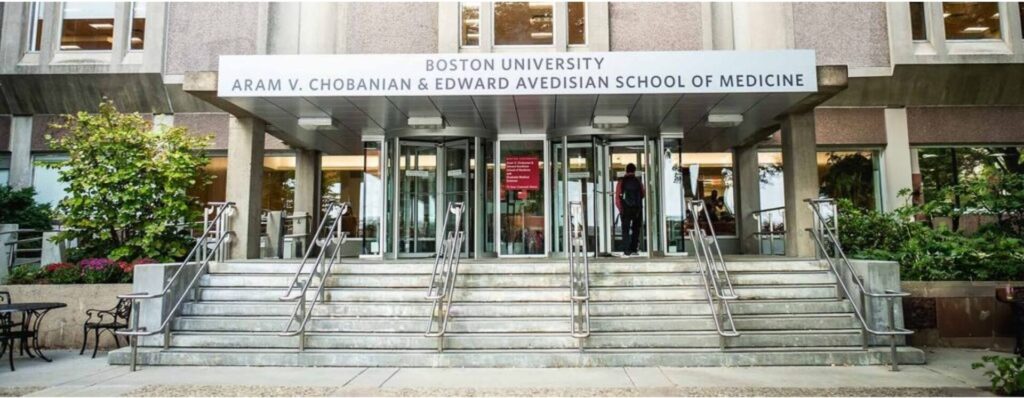
Program Overview & Institution Identity
Boston University Aram V. Chobanian & Edward Avedisian School of Medicine, formerly known as Boston University School of Medicine, is a prestigious private medical institution located in Boston, Massachusetts. The school operates on an urban campus and offers a comprehensive 4-year MD program designed to prepare future physicians for the evolving healthcare landscape.
Program Duration and Structure
The BU Chobanian & Avedisian School of Medicine follows a traditional 4-year MD curriculum with innovative features. The program emphasizes the integration of foundational science, clinical medicine, and health equity throughout the educational experience.
Location and Campus Details
Located in the heart of Boston, Massachusetts, the school benefits from its urban setting with access to diverse patient populations and multiple clinical training sites. The primary teaching hospital is Boston Medical Center, which serves as the cornerstone of clinical education and provides exposure to underserved populations.
Accreditation Status
Boston University School of Medicine is fully accredited by the Liaison Committee on Medical Education (LCME), ensuring graduates are eligible for:
- USMLE examinations
- Residency programs accredited by ACGME
- Medical licensure in all 50 states
- Federal funding opportunities and programs
Recognition and Distinction
The school is recognized for its commitment to diversity, health equity, and serving underserved populations. BU School of Medicine has a strong reputation for producing physicians who are dedicated to social justice and healthcare equity.
Admission Requirements
Academic Prerequisites
Bachelor’s Degree Requirements:
Applicants must earn a bachelor’s degree from a four-year college or university accredited in the U.S. or Canada. International applicants who completed at least two years at a U.S. or Canadian accredited institution, including all prerequisites, may also be considered.
Required Coursework:
- English Composition or Literature (1 year)
- Humanities (1 year)
- Biological Sciences with lab work (1 year)
- Chemistry with lab work (1 year)
- Physics (1 year)
Strongly Recommended Courses:
- Mathematics (particularly statistics)
- Biochemistry
- Social and Behavioral Sciences (Psychology, Sociology, Anthropology)
- Genetics
- Molecular Biology
Typical Course Structure:
Most successful applicants complete two semesters each of:
- English
- Biology
- General Chemistry
- Organic Chemistry
- Physics
- Mathematics
- Social Sciences
GPA and Academic Performance
- Median GPA: 3.91
- Competitive Range: Most successful applicants have GPAs of 3.8 or higher
- No Hard Cutoffs: BU uses holistic review without strict GPA requirements
- The school considers both overall GPA and science GPA in evaluation
Standardized Testing Requirements
MCAT Requirements:
- Median MCAT Score: 519
- Competitive Range: Most admitted students score 517 or higher
- National Context: BU’s average scores are significantly above national averages
- No Minimum Score: However, competitive scores are essential for serious consideration
- Validity Period: MCAT scores must be current according to AAMC guidelines
Extracurricular Activities & Experience Requirements
Boston University School of Medicine uses a comprehensive, holistic review process that evaluates:
Research Experience:
- Strong research background valued but not mandatory
- Both basic science and clinical research considered
- Publication experience beneficial but not required
Clinical Experience:
- Healthcare exposure essential for demonstrating commitment to medicine
- Quality of experience more important than quantity of hours
- Diverse clinical settings preferred
Service and Volunteering:
- Community service demonstrates commitment to serving others
- Preference for sustained, meaningful involvement
- Special consideration for work with underserved populations
Leadership Experience:
- Leadership roles in any capacity valued
- Demonstrates ability to work in team-based healthcare environments
Application Process & Timeline
Application System
Boston University School of Medicine accepts applications exclusively through the American Medical College Application Service (AMCAS). The school does not prescreen primary applications, meaning all applicants who designate BU will receive secondary applications.
Key Deadlines
- Primary Application Opens: June 1
- Application Deadline: November 1
- Early Application Recommended: Submit by July for best consideration
Required Documents
- Official transcripts through AMCAS
- MCAT scores
- Letters of recommendation (typically 3-4 letters)
- Personal statement
- Work and activities descriptions
- Secondary application essays
Secondary Application
All applicants who select Boston University in their AMCAS application receive a secondary application. The secondary includes school-specific essays and questions designed to assess fit with the institution’s mission and values.
Interview Process
Boston University conducts comprehensive interviews as part of their holistic review process. The interview evaluates:
- Communication skills
- Professionalism
- Fit with institutional mission
- Commitment to serving diverse populations
- Personal and professional experiences
Application Fees
Specific fee information should be verified on the official AMCAS website and BU’s admissions portal, as fees may change annually.
Admission Statistics & Success Rates
Overall Competitiveness
- Application Volume: Over 12,000 applications received annually
- Acceptance Rate: Approximately 1.33% (extremely competitive)
- Class Size: 140 students per entering class
- Matriculation: 160 students typically matriculate
Academic Statistics of Admitted Students
- Median GPA: 3.91
- Median MCAT: 519
- GPA Range: Most admitted students have GPAs between 3.8-4.0
- MCAT Range: Competitive scores typically 517 and above
Geographic and Demographic Distribution
As a private institution, Boston University School of Medicine:
- Accepts students from all states and internationally
- No in-state preference for Massachusetts residents
- International Students: Accepted but with limited financial aid
- Strong commitment to diversity across multiple dimensions
Comparison to National Averages
BU’s admission statistics significantly exceed national averages:
- National Average GPA: ~3.77
- National Average MCAT: ~511.7
- BU’s Standards: Substantially higher, reflecting the school’s selectivity
Tuition & Financial Information
2024-2025 Tuition and Fees
Annual Tuition: $72,490 (same for in-state and out-of-state residents)
Additional Required Fees:
- Graduate Program Fee: $750
- Health and Wellness Fee: $538
- Technology and equipment costs (first year): $2,551
Total Cost of Attendance by Year
Year 1 (10 months): $99,453
Year 2 (10 months): $98,432
Year 3 (12 months): $105,201
Year 4 (12 months): $103,832
Total 4-Year Program Cost: Approximately $406,918
Cost Breakdown Includes:
- Tuition and fees
- Estimated living expenses (rent/utilities)
- Food allowance
- Books and supplies
- Transportation
- Personal expenses
- Clinical rotation transportation
- USMLE examination fees
Financial Aid Options
Financial Aid Statistics:
- 82% of MD students receive financial aid
- Limited scholarships available for international students
Available Aid:
- Federal Direct Loans
- Merit-based scholarships
- Need-based financial aid
- Work-study opportunities
- Graduate PLUS loans
- Private loan programs
Application Process:
- Complete FAFSA (Free Application for Federal Student Aid)
- Additional institutional financial aid applications may be required
Click To See Hundreds Of Consultants Who Can Mentor You:


Curriculum & Program Structure
Educational Philosophy
The BU Chobanian & Avedisian School of Medicine curriculum is guided by the principle of integration of foundational science, clinical medicine, and health equity. The program follows evidence-based instructional design principles emphasizing active learning, spaced repetition, and interleaving concepts.
Pre-Clinical Phase (Years 1-2)
Principles Integrating Science, Clinical Medicine, and Equity (PISCEs):
- Longitudinal integrated course during pre-clerkship phase
- Three foundational modules followed by nine systems-based modules
- Integrated threads include oncology, infectious disease, anatomy, microbiology, pharmacology, and pathology
- Strong emphasis on health equity throughout all modules
Advanced Integration Weeks:
- Final nine weeks of pre-clinical phase
- Case-based learning focused on Core patient presentations
- Real patient cases from Boston Medical Center
- Preparation for USMLE Step 1
- Small group collaborative problem-solving
Learn, Experience, Advocate, Discover, and Serve (LEADS):
- Two-year course focusing on health equity
- Addresses social determinants of health
- Develops skills in designing scholarly innovations
- Emphasizes physician role in addressing health inequities
Clinical Phase (Years 3-4)
- Traditional clinical rotations in core specialties
- Access to diverse patient populations at Boston Medical Center
- Opportunities for elective rotations
- Community-based and specialty experiences
- Research opportunities throughout clinical years
Teaching Methods
- Problem-Based Learning (PBL)
- Team-Based Learning (TBL)
- Case-based instruction
- Simulation-based learning
- Small group sessions
- Interactive lectures with active learning components
Assessment Approach
The curriculum uses multiple assessment methods designed to promote deep learning and long-term retention rather than traditional high-stakes testing.
Combined Degree Options
Boston University offers several combined degree programs:
- MD/PhD: Research-intensive program for future physician-scientists
- MD/MBA: Business administration focus for healthcare leadership
- MD/JD: Law degree combination for healthcare policy and legal expertise
- MD/MPH: Public health emphasis for population health focus
Pre-Medical Preparation
Recommended Undergraduate Path
Academic Planning:
- Complete prerequisite courses at four-year institutions
- Maintain high GPA with strong performance in science courses
- Consider advanced coursework in biochemistry and statistics
- Engage in research experiences throughout undergraduate years
Clinical Experience:
- Seek diverse healthcare exposure through volunteering, shadowing, and employment
- Prioritize quality over quantity of experiences
- Document learning and growth from clinical experiences
- Consider experiences with underserved populations
Research Opportunities:
- Engage in meaningful research projects
- Both basic science and clinical research valued
- Develop relationships with faculty mentors
- Consider presenting research at conferences
Leadership and Service:
- Demonstrate sustained commitment to community service
- Seek leadership roles in organizations or initiatives
- Focus on experiences that demonstrate commitment to serving others
- Document impact and learning from service experiences
MCAT Preparation
- Plan adequate preparation time (typically 3-6 months)
- Utilize multiple preparation resources
- Consider retaking if score is below competitive range
- Understand BU’s holistic review approach while maintaining competitive scores
Frequently Asked Questions
What is Boston University School of Medicine’s average GPA and MCAT score?
The median GPA is 3.91 and median MCAT is 519 for admitted students.
How competitive is Boston University School of Medicine?
Extremely competitive with an acceptance rate of approximately 1.33%.
Does Boston University School of Medicine prefer Massachusetts residents?
No, as a private institution, BU treats all applicants equally regardless of state residency.
Does Boston University School of Medicine accept international students?
Yes, but international students must have completed degree requirements at U.S. or Canadian institutions and have limited financial aid options.
What makes Boston University School of Medicine unique?
Strong emphasis on health equity, diverse patient populations, urban setting, and integrated curriculum combining science and social medicine.
What clinical experience is needed for Boston University School of Medicine?
Healthcare exposure is essential, with emphasis on quality experiences demonstrating genuine commitment to medicine and serving diverse populations.
Does Boston University School of Medicine require research experience?
Research experience is highly valued but not strictly required. The school uses holistic review considering all aspects of an applicant’s background.
How many letters of recommendation does Boston University School of Medicine require?
Typically 3-4 letters of recommendation through AMCAS, including evaluations from science faculty and healthcare professionals.
What is Boston University School of Medicine’s curriculum like?
Innovative 4-year curriculum emphasizing integration of basic science, clinical medicine, and health equity with active learning methodologies.
Where do Boston University School of Medicine graduates match for residency?
Graduates match at competitive residency programs across the country, with strong placement in primary care and specialty fields.
When should I apply to Boston University School of Medicine?
Applications open June 1 with a November 1 deadline, but early application submission is strongly recommended.
Does Boston University School of Medicine offer financial aid?
Yes, 82% of students receive financial aid through federal loans, institutional scholarships, and need-based assistance.
This comprehensive guide provides prospective applicants with detailed information about Boston University Aram V. Chobanian & Edward Avedisian School of Medicine’s requirements, curriculum, and admissions process. The school’s commitment to health equity, diverse clinical experiences, and innovative curriculum makes it an excellent choice for students dedicated to serving underserved populations and advancing healthcare equity.