Last updated on January 9th, 2026 at 06:26 am
Introduction
Applying to dental school is a detailed process that requires careful planning, whether you’re applying in the United States or Canada. Most programs rely on the ADEA AADSAS, a centralized application system that allows students to complete one primary application and send it to multiple schools. Canadian applicants can also use this platform when applying to U.S. dental schools, though some Canadian programs may accept the Canadian Dental Aptitude Test (CDAT) instead of the U.S. DAT. Internationally trained dentists have a separate option through CAAPID, designed for advanced placement programs in the U.S.
Regardless of where you’re applying, the steps are similar: finish prerequisite courses in biology, chemistry, and physics, prepare for and complete the Dental Admission Test, and gain valuable shadowing experience in a dental clinic. Your application will also include transcripts, academic history, a personal statement, and letters of evaluation. Volunteer work, research, and extracurricular activities add further depth to your profile. Since both U.S. and Canadian dental schools often use rolling admissions, applying as early as possible can improve your chances of securing an interview.
This guide will walk through the entire application process, from preparing your materials to navigating interviews, so you can approach dental school admissions with clarity and confidence.
Understanding the ADEA AADSAS
What AADSAS is and why it exists
The ADEA AADSAS, short for the American Dental Education Association’s Associated American Dental Schools Application Service, is the main gateway for most applicants to dental schools in the United States and Canada. Instead of sending separate applications to each program, students complete one centralized application and submit it to multiple schools. This system saves time, standardizes information, and makes it easier for both applicants and admissions offices to track materials like transcripts, recommendation letters, and test scores.
Through AADSAS, applicants provide their personal information, academic history, coursework details, and Dental Admission Test (DAT) results. They also upload a personal statement, list professional experiences, and add achievements such as honors or scholarships. By housing all of these materials in one place, the service streamlines a complicated process into a single, organized platform.
Dental schools benefit as well, since admissions committees can review academic data, extracurriculars, and letters of evaluation in a consistent format. The centralized system allows them to compare applicants fairly across different institutions and grading scales. For students, it reduces the chances of missing documents and keeps progress visible through status checks. While each dental program sets its own deadlines and may request supplemental essays, the primary application always begins in AADSAS.
Other application systems: TMDSAS (Texas) and CAAPID (international dentists)
While ADEA AADSAS is widely used, there are exceptions. In Texas, most dental schools require applicants to go through TMDSAS, the Texas Medical and Dental Schools Application Service. The process is similar to AADSAS but is specific to the state and follows its own deadlines, essay prompts, and guidelines. Applicants targeting schools in Texas must plan separately, as they cannot apply to those programs through AADSAS.
Another option exists for internationally trained dentists who want to continue their education in the U.S. but are not applying to traditional first-year programs. These candidates use CAAPID, the Centralized Application for Advanced Placement for International Dentists, also administered by the American Dental Education Association. CAAPID is tailored to advanced standing or placement programs, which allow foreign-trained dentists to join U.S. dental schools at a later point in the curriculum rather than starting from year one.
Canadian students should note that while they use AADSAS to apply to American dental schools, some programs in Canada accept the Canadian DAT instead of the U.S. DAT. Checking each school’s requirements is important, since test score acceptance can differ across borders. Understanding whether to use AADSAS, TMDSAS, or CAAPID ensures that applications are directed to the right place and meet each institution’s specific rules.
Application costs and fee structure
Applying to dental school through ADEA AADSAS involves application fees that increase with the number of schools selected. The base fee covers the first dental school choice, and each additional program adds another charge. At present, the initial fee is $264, and every extra school costs $115. Because many applicants apply to an average of 10 programs, budgeting for these expenses early is important.
Applicants should also be aware of the Fee Assistance Program (FAP). This program opens before the main application cycle and offers reduced costs for eligible students who meet certain financial criteria. Since applying to dental schools can quickly become expensive—especially when factoring in travel for interviews and the cost of preparing for the Dental Admission Test—FAP can ease some of the financial burden.
In addition to the base application fees, some dental schools have their own supplemental or secondary fees. These are program-specific and are paid directly to the individual institutions, not through AADSAS. Applicants should research each program’s financial requirements in advance so there are no surprises after submitting their initial application.
Because AADSAS works on rolling admissions, many students aim to complete their applications as soon as the cycle opens in early June. Early submission ensures faster verification of transcripts and DAT scores, reduces the stress of approaching deadlines, and improves the chances of receiving interview invitations sooner. Since application processing itself can take several weeks, planning finances and preparing all documents ahead of time helps applicants stay competitive and avoid delays.
Staying on Track with the Application Timeline
Opening dates (soft open in May, submission in June)
The application cycle for dental schools follows a fairly predictable calendar each year. The ADEA AADSAS system opens in mid-May with what’s often called a “soft open.” During this period, applicants can log in, explore the different sections, and begin entering information such as academic history, transcripts, experiences, and personal statement drafts. However, submissions cannot be made yet.
The official submission date arrives in early June. That’s when applicants can formally send their dental school application to their chosen programs. Because most schools set their own internal deadlines, it’s important to know both the general cycle dates and the individual requirements of each program. Some schools may also request supplemental or secondary applications with their own due dates, so keeping a calendar of all deadlines is essential.
This soft open and submission timeline gives students a short but useful preparation window. It’s an opportunity to verify prerequisite courses, double-check test registration, and make sure letters of evaluation are in progress before the system accepts official submissions.
Fee Assistance Program availability
Applying through ADEA AADSAS comes with costs, but the Fee Assistance Program (FAP) helps reduce the financial barrier for qualified applicants. The FAP usually opens in mid-May, around the same time as the soft open, but before the official June submission start date. Students approved for fee assistance can benefit from reduced application costs, which is especially valuable for those applying to multiple dental schools.
The program is entirely paperless and requires documentation of financial need. Since application expenses can add up quickly—base application fees, additional school fees, and even preparation costs for the Dental Admission Test—taking advantage of the FAP can make the process more manageable. Because funds are limited, applicants should apply as early as possible once the program opens. Waiting too long could mean missing the chance to secure assistance before funds are allocated to others.
Importance of early submission because of rolling admissions
One of the most important aspects of the ADEA AADSAS cycle is its rolling admissions system. Unlike programs that wait until a final deadline to evaluate all applicants at once, dental schools in the U.S. and Canada review applications as they arrive. This means that earlier submissions are often reviewed first, leading to earlier interview invitations and potentially earlier admission offers.
For traditional applicants—students applying the summer after their junior year of undergraduate studies—this timing is especially critical. Submitting in June, right after the portal opens, maximizes the likelihood of being placed at the front of the review queue. Because many dental schools interview in the fall and release admission decisions beginning in December, students who apply later may find fewer interview slots available.
Submitting early also shows a sense of preparation and organization. Having prerequisite courses completed, transcripts requested, and DAT scores available before sending in the application signals readiness to admissions committees.
Processing and verification timeframes
Once an applicant submits through ADEA AADSAS, the application does not go directly to dental schools. First, it undergoes a verification process. This step involves cross-checking the academic history and transcript entries against official documents sent by colleges and universities. The process usually takes four to six weeks, depending on when the transcripts are received and the overall volume of submissions at that time.
During this waiting period, applicants can monitor the progress through the “Check Status” page in their online portal. This feature updates when transcripts arrive, when letters of evaluation are submitted, and when verification is complete. If delays occur—such as a registrar’s office taking longer than expected to send transcripts—it can push back the entire application timeline.
Because of this, students are encouraged to request transcripts as soon as the application opens in May, even before submission is allowed in June. Official transcripts must come directly from the institution to ADEA AADSAS, and student-issued copies are not accepted for verification. It can take up to a week after transcripts are received for the system to show them as processed, so building in extra time is important.
Verification is also tied to test scores. DAT results are sent electronically, but this too can take several weeks to appear in the system. Dental schools generally will not begin reviewing an application until the verification step is complete and the DAT results have posted. That’s why timing matters so much—delays in any part of the process can slow down when an application is officially considered by admissions committees.
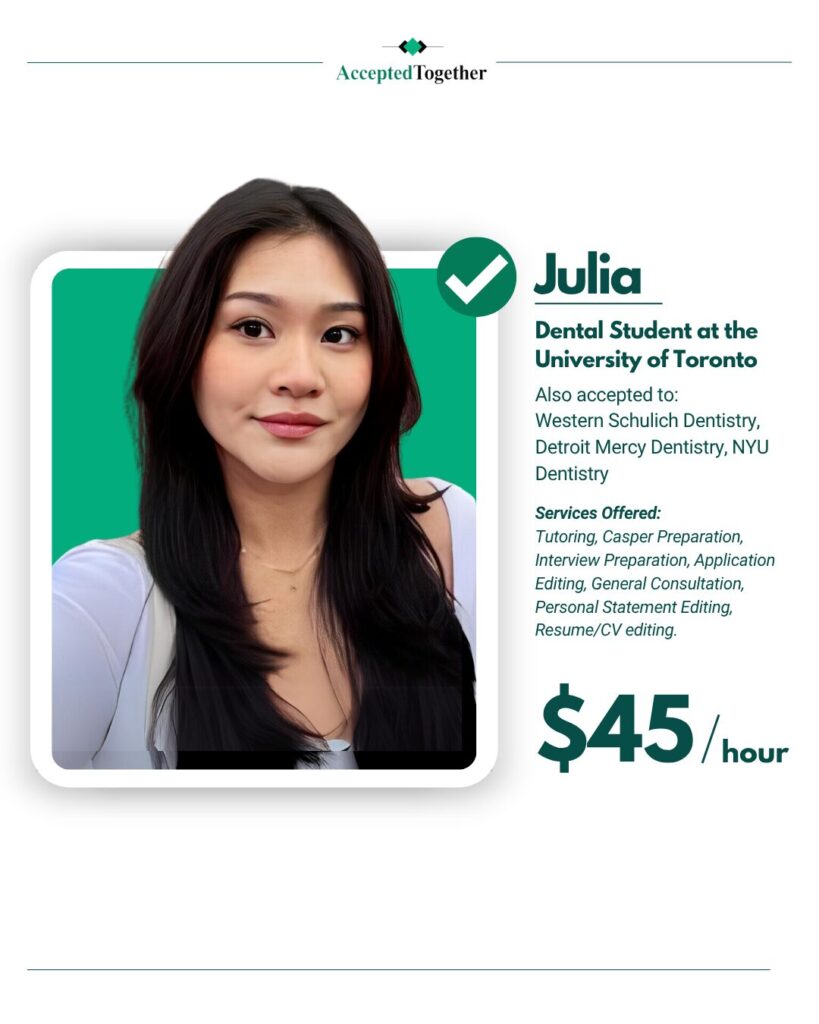
Click to see hundreds of consultants who can mentor you:

Preparing Before You Apply
Course Requirements
Before starting the dental school application, students must complete specific prerequisite courses. These courses are the academic foundation on which the rest of the application rests, and they are often required before registering for the Dental Admission Test. Most schools expect at least eight credit hours of biology with lab, eight credit hours of general chemistry with lab, eight credit hours of organic chemistry with lab, eight credit hours of physics, and eight credit hours of English.
Individual dental schools may also ask for additional classes, such as anatomy, microbiology, or psychology. Some programs emphasize writing-intensive courses, while others value electives in the humanities or social sciences. Because requirements vary, checking each target program’s admissions page is critical. Falling short on even one prerequisite could prevent an application from moving forward in ADEA AADSAS.
Planning coursework with these expectations in mind can save time later. Students often work with pre-health advisors to sequence courses correctly, making sure they finish the harder science classes—such as organic chemistry—before sitting for the DAT. Beyond the minimum credits, strong performance in these subjects signals to admissions committees that the applicant can handle the academic workload of dental school.
Core Competencies
In addition to coursework, schools look for applicants who demonstrate specific professional competencies. The American Dental Education Association outlines a set of qualities that align with what dental schools expect in future clinicians. These competencies include critical thinking, professionalism, communication and interpersonal skills, health promotion, practice management and informatics, and patient care.
While undergraduate students may not yet have direct experience with diagnosis or treatment planning, they can still show progress toward these competencies through other avenues. Shadowing a dentist, volunteering in clinics, conducting research, or even participating in student organizations can highlight skills like teamwork, problem-solving, and ethical decision-making.
Applicants should also use experiences to reflect on their personal statement and later in interviews. For example, explaining how volunteer work improved communication skills or how research projects strengthened critical thinking demonstrates readiness for the profession. When schools evaluate applications through ADEA AADSAS, they consider more than GPA and test scores. Competencies show whether a student has the attributes to grow into a capable and compassionate dentist.
Another area sometimes overlooked is practice management and informatics. Even if applicants haven’t managed a clinic, they can explore introductory business or health systems courses to gain perspective. Showing interest in the administrative side of dentistry helps round out the picture of a candidate preparing seriously for the field.
Dental Admission Test (DAT)
The Dental Admission Test is a major component of the dental school application process and is required by all U.S. programs. Many Canadian schools accept the U.S. DAT, while some accept the Canadian DAT instead. Either way, applicants must prepare strategically, since scores play a significant role in admissions decisions.
Most students sit for the exam in the spring of their junior year, often right after completing organic chemistry courses. The test is four hours long and divided into sections covering natural sciences, perceptual ability, reading comprehension, and quantitative reasoning. Each section highlights skills considered essential for success in dental school.
Registering for the DAT provides students with a DENTPIN, a unique identifier that is also required throughout the ADEA AADSAS application. Scores are sent directly to the system within a few weeks of the exam, but applicants also manually enter their results for accuracy. If retaking the test is necessary, students must wait at least 90 days between attempts, and a maximum of three tries is allowed before requesting special permission.
Preparing for the DAT often involves a mix of self-study, review courses, and practice exams. Because dental schools rarely review applications until test scores are available, completing the DAT early helps keep the overall application on track. A delay of even three months can affect when applications are verified and when schools begin their review. Since rolling admissions give priority to earlier submissions, having DAT scores ready when sending materials through ADEA AADSAS improves chances for timely consideration.
Shadowing Experience
Dental schools expect applicants to have meaningful exposure to the profession before applying. Shadowing gives students a direct view of daily responsibilities, patient interactions, and the overall environment of a dental practice. Most programs recommend shadowing a general dentist as a baseline, though adding time with specialists—such as orthodontists, oral surgeons, or pediatric dentists—can provide a broader perspective.
While there is no universal requirement for hours, many applicants complete at least 100 hours of shadowing before submitting their materials through ADEA AADSAS. Logging these hours carefully is important since the system asks applicants to record dates, duties, and reflections on what was learned. Beyond meeting a number, shadowing should be used to understand whether dentistry is the right career fit and to collect examples that can later be shared in the personal statement or during interviews.
Admissions committees look for evidence that applicants have observed the profession closely enough to make an informed commitment. Experiences gained in a dental clinic also help highlight core competencies such as communication, professionalism, and ethical decision-making.
Manual Dexterity
Dentistry requires strong hand skills, so applicants are encouraged to develop and demonstrate manual dexterity well before starting dental school. This doesn’t always mean working in a clinical setting. Activities such as playing a musical instrument, painting, sculpting, sewing, or even woodworking can strengthen fine motor control and attention to detail.
When filling out the ADEA AADSAS application, students can include manual dexterity activities under the “experiences” section or highlight them in the personal statement. Schools want to see evidence that applicants have practiced tasks that require precision and patience, even outside of academic settings.
Developing dexterity is not just about listing hobbies—it shows preparation for the technical skills required in dentistry. Since procedures often involve working in tight spaces with accuracy, demonstrating these abilities signals readiness for the challenges of dental school training. Applicants who connect these activities to their motivation for dentistry often stand out, as it shows awareness of the profession’s physical demands.
Breaking Down the Application Components
Personal Information
The first step in completing the dental school application is providing personal information. Within ADEA AADSAS, this section asks for details such as biographical data, contact information, and demographic background. It also includes questions about environmental factors that may have shaped the applicant’s educational experience, including socioeconomic challenges or first-generation college status. Providing this information gives schools more context about an applicant’s journey and the obstacles they may have overcome. Accuracy here is essential, as errors could affect how schools communicate with applicants throughout the process.
Academic History
The academic history section is one of the most time-consuming parts of ADEA AADSAS. Applicants must manually enter every course taken, along with credits and grades, and then request official transcripts from each institution they attended. This allows the application service to verify coursework and calculate standardized GPAs across all applicants. Because verification takes time, ordering transcripts early prevents delays. Applicants should double-check entries against their transcript to avoid mistakes that could stall the process. This section also includes places to report planned or in-progress coursework, which helps schools see how applicants will meet prerequisite requirements by the time they matriculate.
Programs
After entering academic history, applicants choose the dental schools they want to apply to. Each selected program carries an additional cost within the ADEA AADSAS system, and applicants should budget accordingly. The average applicant applies to around 10 schools, though the number varies depending on individual goals. When selecting programs, students should carefully review each school’s prerequisites, deadlines, and supplemental application requirements. Some schools require specific essays, secondary fees, or additional documentation that must be submitted directly to them. The Programs section essentially serves as the distribution point, sending the primary application to the schools applicants designate.
DAT Scores
The Dental Admission Test is a required component of nearly every dental school application. Within the ADEA AADSAS application, applicants must self-report their DAT scores and request that official results be sent electronically. This ensures that schools receive both the applicant’s reported data and the verified scores from the testing agency. Because official results can take several weeks to appear, applicants are encouraged to take the DAT early so that scores are ready by the time their application is verified. Retake policies, reporting timelines, and whether schools also accept the Canadian DAT should be reviewed in advance to prevent unnecessary delays.
Supporting Information
Supporting information gives applicants the chance to show what they’ve done outside of coursework. This section includes several key pieces:
- Personal Statement: Applicants write a one-page essay describing their motivation for dentistry, relevant experiences, and qualities that make them a strong candidate. It’s the main opportunity to speak directly to admissions committees in their own words.
- Experiences: Students can list employment, research, volunteer activities, and extracurricular involvement. They must include responsibilities, hours, and supervisors, and they can select their most meaningful experiences for additional reflection.
- Achievements: Honors, awards, scholarships, and certifications can be entered to highlight accomplishments beyond academics.
- Letters of Evaluation: Applicants request recommendations from professors, dentists, or committee writers through the ADEA AADSAS portal. Waiving the right to view letters is recommended, as it assures schools the evaluations are candid.
Each of these components adds depth to the application and provides admissions committees with a clearer sense of the applicant beyond grades and test scores.
Program-Specific Materials
Many dental schools require more than the primary application. Program-specific materials may include prerequisite checklists, supplemental essays, or short-answer responses. These additional documents are often used to address topics unique to each program, such as a commitment to serving certain populations or alignment with the school’s mission. Applicants should not overlook these requirements, as failing to submit them can result in an incomplete application. Fees for these materials are usually paid directly to the dental school, separate from ADEA AADSAS. Staying organized and tracking both primary and supplemental requirements ensures that nothing is missed as deadlines approach.
Submitting and Tracking Your Application
Reviewing before submission
Before hitting submit, applicants need to carefully review every part of their dental school application in ADEA AADSAS. Once submitted, changes are very limited, so catching mistakes early saves time and stress. Common errors include typos in coursework entry, incorrect course numbers, or missing experiences in the supporting information section. Since academic history is later verified against official transcripts, any mismatch can slow down the entire process.
Applicants should also double-check that their personal statement is final and formatted correctly, as it cannot be replaced after submission. Similarly, confirming that letters of evaluation have been properly requested through the ADEA AADSAS portal avoids last-minute surprises. Because schools evaluate applications holistically, accuracy in every section—from demographics to test scores—matters. A thorough review also ensures that nothing critical is overlooked, especially for those applying to multiple programs with slightly different requirements.
Fee payment process
Once an applicant is satisfied with their application, the next step is paying the required fees. ADEA AADSAS charges a base fee that covers submission to the first dental school program, and each additional school requires a separate fee. This cost structure can add up quickly, especially for applicants applying broadly, so budgeting early in the cycle is important.
Payment is completed directly through the ADEA AADSAS system at the time of submission. The system accepts major credit cards, and receipts are provided electronically. Applicants approved for the Fee Assistance Program receive reduced costs, but they still need to finalize payment before the application is officially submitted. Missing or failed payments can result in processing delays, so verifying payment details is an essential step. In addition, many schools charge their own supplemental or secondary application fees outside of AADSAS. These must be paid directly to the school and tracked separately by the applicant.
How to monitor transcript and evaluation letter arrivals
Submitting the application is only part of the process—supporting materials such as transcripts and letters of evaluation must also be received by ADEA AADSAS before verification begins. Because transcripts can take time to process, applicants should request them from their universities as soon as the application opens. Student-issued transcripts are not accepted; they must come directly from the registrar’s office.
It often takes several business days for transcripts to appear as received in the system after being sent, and even longer for them to be marked as processed. This lag means that early requests are crucial to avoid bottlenecks in the timeline. The same applies to letters of evaluation. Applicants initiate requests through the ADEA AADSAS portal, and once evaluators submit their letters electronically, the system updates their status. Checking regularly ensures that recommenders have followed through and that no letters are missing.
Applicants should also keep backups by maintaining communication with letter writers and verifying with their registrar that transcripts were sent correctly. Delays in these materials are one of the most common reasons for postponed application verification, which in turn affects when schools receive the completed file.
Using the “Check Status” page to track progress
The “Check Status” page within ADEA AADSAS is one of the most important tools for applicants. It serves as a central dashboard showing updates on transcripts, letters of evaluation, test scores, and overall application verification. Applicants can log in to see whether transcripts have been received, if evaluation letters are uploaded, and when their application moves into verification.
During peak season, when thousands of applications are submitted, updates may take several days. Applicants should be patient but also proactive in following up on materials that appear delayed. The page also reflects when applications are officially transmitted to dental schools, meaning programs can begin their review. Because rolling admissions prioritize early review, monitoring this status is critical for staying competitive.
Using the “Check Status” page effectively allows applicants to spot issues before they cause bigger problems. For example, if a transcript is marked as undeliverable, the applicant can immediately contact their registrar to resend it. Likewise, if a recommender has not uploaded a letter, applicants can remind them promptly. Treating this page as a routine checkpoint—rather than something to look at only once—keeps the process on track and reduces the chances of delays impacting admission opportunities.
What Happens After Submission
Application Review
Once the application is submitted through ADEA AADSAS, it goes through a formal review by each dental school selected. The process begins only after the application has been verified, meaning transcripts, coursework, and test scores have all been cross-checked by the system. From there, schools look at the application as a whole rather than focusing on one factor.
Most schools use a holistic review. They examine GPA trends, performance in prerequisite courses, and results from the Dental Admission Test, while also weighing personal qualities shown in the personal statement, shadowing hours, and community service. Letters of evaluation provide another perspective, often reinforcing qualities such as professionalism, teamwork, and reliability.
Because rolling admissions are in place, applications are typically reviewed in the order they are received. Submitting early through ADEA AADSAS ensures that an application is in the first group considered. For applicants, this means decisions can arrive sooner and interview opportunities may be more plentiful. Schools are not only looking for academic strength but also for evidence that the applicant understands dentistry as a career and has demonstrated core competencies aligned with patient care and professional responsibility.
Interviews
If the application is competitive, the next step is the interview stage. Dental schools use several formats, and the type often depends on the program’s philosophy. Traditional one-on-one interviews are still common, but some schools use Multiple Mini Interviews (MMI), panel interviews, or group formats. Each type tests different skills. For example, MMIs often involve ethical scenarios or role-play, while panel interviews emphasize communication under pressure.
Interviews typically begin in late summer or early fall and run throughout the cycle. Offers of admission can be extended as early as December 1 for U.S. schools, with Canadian programs following similar timelines. Because of rolling admissions, interview timing matters—students invited earlier may have more available seats to compete for.
Preparation is key. Applicants should be ready to discuss why they want to become a dentist, what they learned from shadowing experiences, and how they developed manual dexterity. Schools may also ask about leadership roles, academic challenges, or community service. Reviewing the personal statement and experiences submitted through ADEA AADSAS is a smart strategy, since interviewers often use these sections to generate questions.
Staying Productive While Waiting
After interviews, there is often a waiting period before final decisions are released. This downtime can be stressful, but it is also an opportunity to strengthen an application further. Schools may request academic updates through the ADEA AADSAS system, where applicants can submit fall or spring semester grades. Strong performance in additional science coursework can reinforce readiness for the dental curriculum.
Continuing to shadow dentists, volunteer in healthcare settings, or engage in community work demonstrates ongoing commitment to the profession. Applicants can also use this time to improve manual dexterity through activities such as painting, playing an instrument, or other fine motor tasks. Keeping track of new experiences ensures that if a school requests an update, the applicant has fresh material to share.
Equally important is self-care. The application process is demanding, and maintaining balance during the waiting period helps applicants perform well in interviews and, eventually, as dental students. Staying engaged academically, professionally, and personally ensures that by the time offers arrive, applicants are prepared to transition smoothly into the next stage of training.
Conclusion
Applying to dental school is a detailed process that requires careful planning, steady organization, and consistent follow-through. Each section of the application serves a clear purpose, from completing prerequisite courses and recording academic history to preparing for the Dental Admission Test and gaining shadowing experience. Through ADEA AADSAS, applicants bring together personal statements, transcripts, and letters of evaluation into one system that helps admissions committees see the full scope of an individual’s preparation.
The timeline is just as important as the content. With rolling admissions, submitting early can make a significant difference in how quickly an application is reviewed and when interview invitations are extended. Staying on top of deadlines for supplemental applications, secondary fees, and verification steps ensures that nothing slows down progress once materials are sent.
For many students, the interview stage is the turning point where schools evaluate communication skills and readiness for the profession. Continuing to build experiences, improve manual dexterity, and demonstrate commitment while waiting for decisions can strengthen the overall profile. By approaching the dental school application process through ADEA AADSAS with attention to detail and awareness of requirements, applicants put themselves in the best position for success. If you’d like guidance in refining your application, you can explore the dentistry consultants available on AcceptedTogether’s consultant list page.
Frequently
Asked Questions
ADEA AADSAS is the centralized application service used by most dental schools in the United States and many in Canada. Instead of sending separate applications to each program, applicants complete one main application that includes transcripts, coursework, test scores, and supporting documents. This system makes the process more efficient for both applicants and admissions offices by providing one standardized platform.
The application cycle typically has a soft launch in mid-May when students can begin filling out sections of the ADEA AADSAS application. Submissions officially open in early June, at which point applicants can send their completed applications to chosen dental schools. Because verification and review take time, submitting early in the cycle is highly recommended.
Most programs require eight credit hours each of biology, general chemistry, organic chemistry, and physics, all with lab components. English coursework is also required, and some schools may ask for additional classes in subjects such as anatomy, microbiology, or psychology. It’s important to review each school’s individual requirements to ensure that all prerequisites are met before applying.
The DAT is a major factor in admissions decisions and is required by nearly all dental schools in the U.S., with some Canadian programs also accepting the U.S. DAT. The exam covers natural sciences, perceptual ability, reading comprehension, and quantitative reasoning. Since official scores take time to process and appear in ADEA AADSAS, taking the test early helps avoid delays in application review.
Shadowing demonstrates that an applicant has firsthand exposure to dentistry and understands the profession beyond academics. Most schools expect shadowing with a general dentist, though observing specialists can strengthen an application further. Documenting hours and experiences accurately in the application shows commitment and provides examples for essays and interviews.
After submission and verification, dental schools review applications holistically. They consider GPA, performance in prerequisite courses, DAT scores, and supporting materials like the personal statement and letters of evaluation. Non-academic factors, including community service, shadowing, and competencies such as communication and professionalism, also weigh heavily in the decision-making process.
Verification of the application cannot begin until transcripts and letters of evaluation are received by ADEA AADSAS. Any delay in these materials slows down when dental schools can access the completed file. Applicants should request transcripts early and follow up with letter writers to avoid setbacks in the review timeline.
Dental schools review applications as they arrive rather than waiting for a final deadline. Submitting early ensures that an application is reviewed while more interview spots and admission offers are still available. Applicants who delay may find fewer opportunities, even if their academic record is strong.
Interview formats vary by program and can include traditional one-on-one interviews, panel interviews, group interviews, or Multiple Mini Interviews (MMIs). Each format assesses different skills, such as communication, ethical reasoning, or problem-solving under time pressure. Being familiar with the submitted application materials helps applicants prepare, since many interview questions are drawn directly from personal statements or listed experiences.
Applicants can use the waiting period productively by continuing to shadow, volunteer, or engage in community activities. Updating ADEA AADSAS with new coursework or grades can also strengthen the application if requested by schools. Staying active during this time shows ongoing dedication to dentistry and can provide additional talking points if further interviews or updates are required.