Last updated on January 9th, 2026 at 06:30 am
Program Overview & Institution Identity
Official Program Name
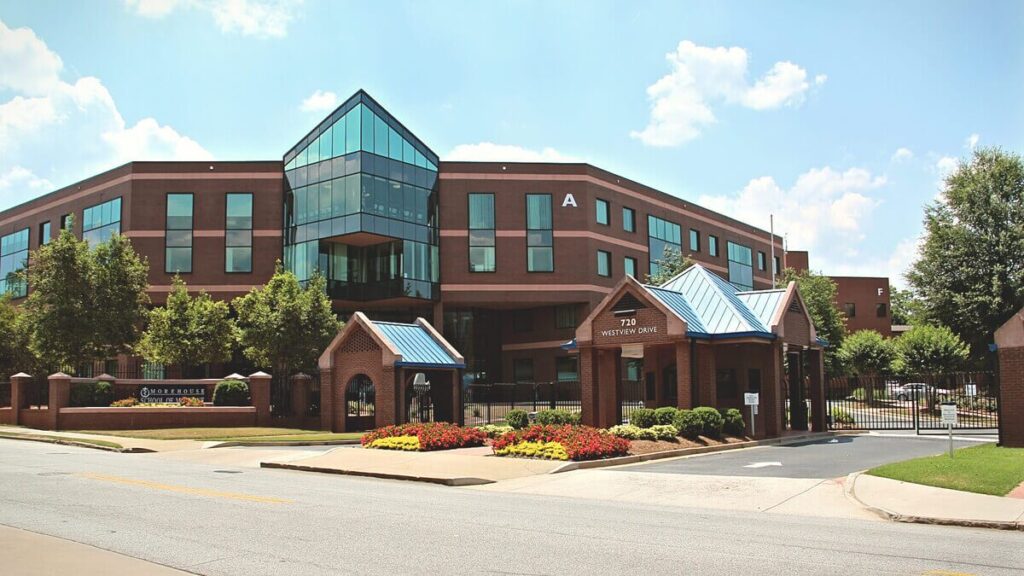
Morehouse School of Medicine is a prestigious private medical institution located in Atlanta, Georgia. Established in 1975, MSM operates as a member of the Atlanta University Center Consortium Inc., which consists of five historically Black colleges and universities (HBCUs). The school offers a Doctor of Medicine (MD) degree program that fulfills all educational requirements for medical licensing in the United States.
Program Duration & Structure
The Morehouse School of Medicine MD program is a 4-year traditional curriculum extending over 10.5 months for the first year. The program is designed with a unique focus on primary healthcare and serving underserved communities, combining rigorous scientific training with community-centered medical education.
Unique Program Features:
- Strong emphasis on primary care and underserved populations
- Early clinical exposure beginning in the first year with clinical preceptorships
- State-of-the-art clinical skills training lab
- Service-learning and community service integration
- Small class sizes fostering personalized attention (105 students per class)
Location & Campus Details
Campus Location: 720 Westview Drive, SW, Atlanta, GA 30310-1495
- Urban Campus: Located in Atlanta, providing access to diverse clinical opportunities
- Primary Teaching Hospital: Grady Memorial Hospital (Level 1 Trauma Center)
- Additional Clinical Sites: Atlanta Veterans Administration Medical Center, Children’s Hospital of Atlanta, South Fulton Medical Center, and multiple other healthcare facilities
Accreditation Status
Morehouse School of Medicine holds full accreditation from the Liaison Committee on Medical Education (LCME), ensuring the highest standards in medical education. The institution is also accredited by the Southern Association of Colleges and Schools Commission on Colleges (SACSCOC) to award masters and doctorate degrees.
What LCME Accreditation Means:
- Graduates are eligible for medical licensing in all 50 states
- Students can participate in federal financial aid programs
- Credits transfer to other accredited institutions
- Residency programs recognize MSM graduates
Available Combined Degrees
Morehouse School of Medicine offers several dual degree options:
- MD/MPH (Master of Public Health)
- MD/MBA (Master of Business Administration)
- MD/PhD (Research-focused combined degree)
Admission Requirements
Academic Prerequisites
Minimum Degree Requirements
- Bachelor’s Degree: Completion of a baccalaureate degree or equivalent from an accredited U.S. undergraduate institution is required
- No Specific Major Required: MSM encourages diverse academic backgrounds; no particular major is deemed superior
Required Prerequisite Courses
Based on AMCAS requirements, prospective students must complete:
Science Requirements:
- Biology: 8 credit hours with laboratory
- General Chemistry: 8 credit hours with laboratory
- Organic Chemistry: 8 credit hours with laboratory (or Biochemistry may substitute for Organic Chemistry II)
- Physics: 8 credit hours with laboratory
- Biochemistry: Recommended (may substitute for Organic Chemistry II)
Additional Requirements:
- English: 6 credit hours
- Mathematics: Including statistics and calculus
- Behavioral/Social Sciences: 6 credit hours total (3 hours Social Sciences, 3 hours Behavioral Sciences)
Course Flexibility:
- AP credits accepted with proper transcript notation
- Pass/Fail grading accepted for Spring 2020 coursework (COVID-19 accommodation)
- Online coursework evaluated case-by-case
- Community college credits accepted
GPA Requirements
Academic Performance Standards:
- Median GPA: 3.78 for admitted students
- Competitive Range: While no minimum GPA is published, successful applicants typically maintain GPAs well above 3.5
- Science GPA vs Overall GPA: Both are evaluated, with emphasis on science coursework performance
- GPA Calculation: AMCAS calculates both cumulative and science GPAs using their standardized methodology
MCAT Requirements
Standardized Testing Requirements:
- MCAT Required: All applicants must submit valid MCAT scores
- Median MCAT: 508 for admitted students
- Competitive Range: Successful applicants typically score 505 or higher
- MCAT Validity: Scores must be current according to AMCAS guidelines
- Retake Policy: Multiple attempts evaluated holistically
- Section Requirements: No specific section minimums published, but balanced performance across all sections preferred
MCAT Preparation Recommendations:
- Allow 3-6 months for comprehensive preparation
- Consider your academic schedule when planning test dates
- Retakes should show improvement to be beneficial
Extracurricular Activities & Experience Requirements
Holistic Evaluation Approach:
Morehouse School of Medicine uses a comprehensive evaluation system that equally considers:
Clinical Experience:
- Highly Valued: Direct patient care experience
- Types: Hospital volunteering, clinical shadowing, medical missions
- Quality over Quantity: Meaningful, sustained engagement preferred
- Documentation: Clear description of responsibilities and learning outcomes
Research Experience:
- Encouraged but not Required: Research background strengthens applications
- Types Valued: Basic science, clinical, public health, and community-based research
- Publications: Beneficial but not expected for all applicants
Community Service:
- Essential Component: Aligns with MSM’s mission of serving underserved populations
- Types: Healthcare-related volunteering, community outreach, mentoring
- Leadership Roles: Positions demonstrating initiative and commitment
Leadership Experience:
- Organizational Leadership: Student government, club leadership, project management
- Healthcare Leadership: Leading health initiatives, coordinating volunteers
- Academic Leadership: Tutoring, teaching assistantships
Geographic Diversity
Out-of-State Friendly: MSM welcomes students from all states and accepts out-of-state and Canadian students, making it one of the more geographically diverse private medical schools. Approximately 45% of matriculants come from outside Georgia.
Application Process & Timeline
Application System & Deadlines
Primary Application:
- System: AMCAS (American Medical College Application Service)
- Application Opens: Early May for the following year’s class
- Application Deadline: December 1, 2025
- Early Decision Program (EDP): Available with earlier deadline (typically August 1)
Secondary Application:
- Invitation: Sent to qualified primary applicants
- Deadline: Typically 30 days from receipt
- Components: School-specific essays and supplemental information
Required Documents
Academic Records:
- Transcripts: All undergraduate and graduate coursework submitted through AMCAS
- Foreign Transcripts: Must be evaluated by credential evaluation service
Letters of Recommendation:
- Committee Letter: Strongly preferred when available from undergraduate institution
- Individual Letters: Minimum of 3 letters if no committee letter available
- Recommended Writers: Science faculty, non-science faculty, healthcare professional, research mentor
- Professional References: For non-traditional applicants with work experience
Personal Statement:
- AMCAS Personal Statement: Maximum 5,300 characters
- Focus Areas: Motivation for medicine, commitment to serving underserved populations, personal experiences
Work and Activities:
- AMCAS Work and Activities Section: Up to 15 experiences
- Categories: Clinical, research, volunteer work, leadership, teaching, hobbies
- Meaningful Experiences: Designate most significant experiences with detailed descriptions
Application Fees
Cost Structure:
- AMCAS Primary Application: $170 for first school, $42 for each additional school
- MSM Secondary Application Fee: Varies (typically $50-100)
- Fee Assistance Program (FAP): Available for qualifying applicants through AMCAS
Interview Process
Interview Format:
- Traditional Panel Interview: Multiple mini-interview (MMI) format may also be used
- Interview Season: October through March
- Invitation Timeline: Rolling basis, typically 6-12 weeks after secondary submission
- Interview Options: In-person preferred, virtual options available when necessary
Interview Components:
- Academic Discussion: Scientific knowledge and critical thinking
- Personal Motivation: Commitment to medicine and MSM’s mission
- Ethical Scenarios: Moral reasoning and professionalism
- Community Service: Dedication to serving underserved populations
Interview Statistics:
- Interview Rate: Approximately 15-20% of completed applicants receive interviews
- Post-Interview Acceptance: Historically 30-40% of interviewed candidates receive offers
Post-Interview Process
Acceptance Timeline:
- First Acceptances: December/January
- Rolling Admissions: Continues through spring
- Traffic Rules: AMCAS traffic rules apply for acceptance timing
- Deposit Requirements: Typically $500 deposit to hold seat
Waitlist Process:
- Waitlist Notifications: Begin in spring
- Movement: Can continue through summer
- Letters of Intent: Accepted and encouraged for waitlisted candidates
Admission Statistics & Success Rates
Overall Acceptance Rate
Competitiveness Analysis:
- Overall Acceptance Rate: Approximately 6-8% (estimated based on class size and typical application volume)
- Application Volume: Receives approximately 10,000+ applications annually for 105 seats
- Trend: Increasing competitiveness over recent years with growing application numbers
Competitive Context:
- Morehouse School of Medicine is considered moderately competitive among private medical schools
- More accessible than top-tier schools while maintaining high academic standards
- Strong reputation for diversity and community service mission attracts high-quality applicants
Class Profile Statistics
Academic Statistics for Admitted Students:
- Median GPA: 3.78
- Median MCAT: 508
- GPA Range (25th-75th percentile): Typically 3.6-3.9
- MCAT Range (25th-75th percentile): Typically 505-512
Class Demographics:
- Class Size: 105 students per entering class
- Geographic Distribution: 55% Georgia residents, 45% out-of-state (including international)
- Age Range: Typically 20-35, with average age around 23-24
- Diversity: Strong commitment to racial, ethnic, and socioeconomic diversity
- Academic Backgrounds: Diverse undergraduate majors represented
Application Volume Trends:
- Applications Received: 10,000+ annually
- Secondary Applications: Approximately 3,000-4,000
- Interviews Granted: Approximately 500-700
- Matriculants: 105 students
Waitlist Statistics
Waitlist Information:
- Waitlist Size: Varies annually, typically 100-200 students
- Waitlist Movement: Historically 10-20% acceptance rate from waitlist
- Timeline: Movement continues through July/August
- Communication: Regular updates provided to waitlisted candidates
Comparison with Peer Institutions
Regional Comparison:
- More Accessible: Than Emory University School of Medicine (Georgia)
- Similar Competitiveness: To other private medical schools in the Southeast
- Higher Acceptance Rate: Than most top-tier national medical schools
- Strong Mission Alignment: Attracts applicants committed to primary care and underserved populations
Tuition & Financial Information
Current Tuition Rates
Tuition Structure (2024-2025 Academic Year):
- Annual Tuition: $47,721 (same rate for all students regardless of residency)
- Private Institution: No difference between in-state and out-of-state tuition
- International Students: Same tuition rate as domestic students
Additional Fees & Expenses
Mandatory Fees:
- Technology Fees: Included in tuition structure
- Student Services Fees: Health services, activities, facilities
- Health Insurance: Required for all students (approximately $2,000-3,000 annually)
- Laboratory Fees: Included for required courses
- Clinical Rotation Fees: May apply for certain elective rotations
Estimated Total Cost of Attendance (Annual):
- Tuition and Fees: $47,721
- Room and Board: $15,000-20,000 (varies by housing choice)
- Books and Supplies: $2,000-3,000
- Transportation: $1,500-2,500
- Personal Expenses: $2,000-3,000
- Total Estimated COA: $68,000-76,000 per year
Total Program Investment
4-Year MD Program Cost:
- Total Tuition: ~$190,880 (4 years × $47,721)
- Total Cost of Attendance: ~$272,000-304,000 over 4 years
- Comparison: Competitive with other private medical schools nationally
Financial Aid Opportunities
Merit-Based Scholarships:
- Academic Merit Scholarships: Awarded to top applicants based on GPA and MCAT scores
- Renewable Requirements: Maintained academic performance and professionalism
- Coverage: Partial to full tuition scholarships available
Need-Based Financial Aid:
- Federal Financial Aid: Stafford Loans, Grad PLUS loans available
- Institutional Aid: MSM-specific need-based grants and scholarships
- Work-Study: Limited opportunities available
Specialized Scholarship Programs:
- Ty Cobb Educational Scholarship: Georgia residents
- George and Pearl Strickland Scholarship: Academic excellence and community service
- Scholarships for Disadvantaged Students (SDS): Federal program for qualifying students
- Primary Care Leadership Program: Students committed to primary care
- National Health Service Corps (NHSC) Scholarship: Service commitment required
External Scholarships:
- Armed Forces Health Professions Scholarship Program (HPSP): Military service commitment
- State-Specific Programs: Georgia Board of Health Care Workforce programs
- Private Foundations: Numerous specialty-specific and diversity scholarships
Loan Repayment Programs:
- National Health Service Corps Loan Repayment: Service in underserved areas
- State Loan Repayment Programs: Various state-specific options
- Specialty-Specific Programs: Primary care and rural medicine emphasis
Living Expenses in Atlanta
Cost of Living:
- Housing: $800-1,500/month depending on proximity to campus and housing type
- Transportation: MARTA public transit available, parking fees for campus
- Food: $300-500/month for groceries and dining
- Utilities: $100-200/month
- Entertainment: $200-400/month
Housing Options:
- On-Campus Housing: Limited graduate housing available
- Off-Campus Apartments: Abundant options in Atlanta metro area
- Roommate Matching: Student services assist with finding compatible roommates
Click To See Hundreds Of Consultants Who Can Mentor You:
Curriculum & Program Structure
Program Duration and Timeline
4-Year Traditional Structure:
- Years 1-2: Pre-clinical sciences on main campus
- Years 3-4: Clinical rotations at affiliated hospitals and clinics
- Extended First Year: 10.5 months to accommodate comprehensive curriculum
Educational Philosophy
Mission-Driven Curriculum:
- Primary Care Focus: Emphasis on family medicine, internal medicine, pediatrics
- Underserved Populations: Training specifically designed for healthcare delivery in underserved communities
- Cultural Competency: Integration of social determinants of health and health equity
- Evidence-Based Medicine: Scientific rigor combined with compassionate care
Teaching Methods:
- Problem-Based Learning (PBL): Small group case-based discussions
- Traditional Lectures: Foundation sciences and clinical knowledge
- Simulation-Based Learning: High-fidelity simulation center for clinical skills
- Early Clinical Exposure: Patient interaction beginning in year 1